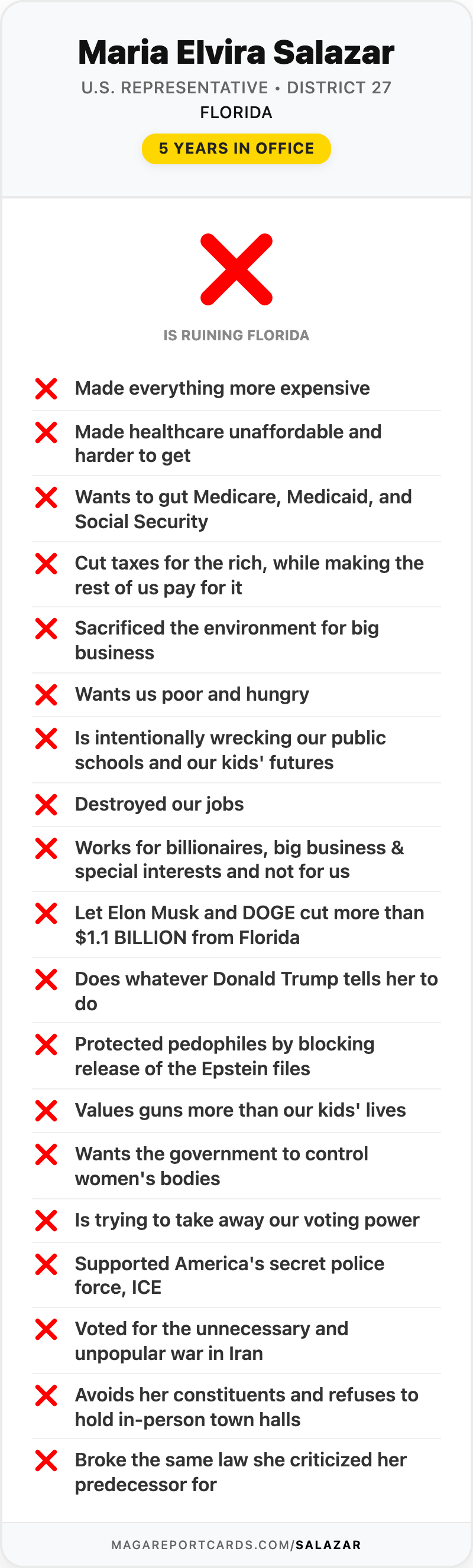
Maria Elvira Salazar represents Florida's 27th District — Little Havana, Coral Gables, Westchester, Palmetto Bay. It is one of the most immigrant-heavy districts in America. And she has an answer for the people in it: the Dignity Act.
She has an entire section of her congressional website devoted to it. She launched a national "Dignity Tour" in March 2026. Her office put out a press release in July announcing that the bill had generated "250+ stories leading the national conversation on immigration reform." Another announced that its coalition had passed 100 endorsements.
Two things are true about that bill that don't appear in any of those press releases.
One: nothing has happened to it. At all.
Salazar introduced the DIGNIDAD Act on July 15, 2025. On July 16, 2025, it was referred to the House Judiciary Committee's Subcommittee on Border Security and Enforcement.
That is the last thing that has ever happened to it. Congress.gov lists no action since. No hearing. No markup. No committee vote. No floor vote. Nearly thirteen months.
It has 39 cosponsors, out of 435 members.
Her own party runs the House. Her own party runs the Judiciary Committee. Her own party sets the floor schedule. In nearly thirteen months of Republican control, the Republican leadership has not given her signature bill a single hour of committee time — and she has not made them pay any price for it.
What she has done instead is tour.
Two: read what's actually in it
The Dignity Act is not the amnesty its critics on the right call it. It is also not what a lot of people in Little Havana think they're being offered.
Here is what the bill actually does, per the National Immigration Forum's summary:
What an immigrant has to do to qualify for "Dignity Status":
- Have been continuously present in the U.S. since December 31, 2020
- Pay $7,000 in restitution over seven years
- Pay taxes, including some owed from previous years
- Pass a criminal background check
- Carry health coverage — while being barred from federal means-tested benefits
- Work or study at least four of the seven years
- Report to the Department of Homeland Security every two years
And at the end of all that, what do they get?
In the summary's own words: "The status does not provide a path to U.S. citizenship."
It's a seven-year deferred-action status, renewable every seven years, forever, as long as you stay in good standing. Pay $7,000, hand DHS your address every two years for the rest of your life, and you are still not a citizen. You are still not a permanent resident. You are a person with a renewable permission slip.
What the bill gives the enforcement side, meanwhile:
- Authorization to build physical barriers, tactical infrastructure, and border technology — with the DHS Secretary given power to "waive all legal requirements the Secretary determines necessary" to get it built, and with the $46.5 billion Congress already approved for barriers in the 2025 budget law behind it
- Mandatory E-Verify for every employer in the country, phased in over 6 to 24 months
- Expedited removal for anyone who fails a credible-fear screening, and detention during processing
- Illegal reentry penalties raised from a current maximum of two years to up to 10 years in prison — up to 20 years for anyone who re-enters after being removed three or more times
That is the trade Salazar is touring the country to sell: a waiver of any law standing in the way of the $46.5 billion wall money Congress has already voted, a national employment-verification mandate, and longer prison sentences — in exchange for a status that runs out every seven years and never becomes citizenship.
Now put it next to how she actually votes
While the Dignity Act sat untouched in a subcommittee, a different immigration bill moved.
On June 9, 2026, the House passed S. 2, which puts $70 billion into DHS, Customs and Border Protection, and ICE through fiscal year 2029 — money for ICE hiring, transportation, facility and fleet maintenance, 287(g) agreements that deputize local police as immigration agents, and, in the law's own summary language, "operations by ICE to arrest certain unlawful aliens."
It passed 214 to 212. Two votes.
Salazar voted yes. At that margin, every single Republican yes was a deciding vote — hers included. One Republican switching would have made it 213 to 213, and a tie fails. Not one switched.
That same money goes to the agency running a social-media dragnet that pays contractors to scan people's posts around the clock — a program already up and running when she voted, and one the bill added no transparency rules to.
So the record since she introduced it reads: one immigration bill she talks about, which has never received a vote of any kind, and one immigration bill she voted for, which is now Public Law 119-98 and is spending $70 billion in her constituents' neighborhoods.
This is the same district, the same people
Her neighbor in Congress, Mario Diaz-Balart, has run the same play with letters — writing to the administration on behalf of Venezuelans in South Florida, then voting for the money that pays for their arrest. Salazar signed one of those statements with him.
She has urged the administration to ensure fair treatment for Cubans holding I-220A paperwork. That is a real thing and it belongs in the record.
But a letter is not a vote. A tour is not a hearing. And $70 billion for immigration enforcement and border security is not offset by a bill that a subcommittee chaired by her own party has ignored for nearly thirteen months.
What we'd want to hear her asked
Salazar is a former television journalist. She knows the difference between a story and a result. So the questions are simple:
- Why has the Republican Judiciary Committee never given the Dignity Act a hearing, and what have you done about it?
- Does the Dignity Program lead to citizenship — yes or no?
- You cast a deciding vote on a $70 billion bill for ICE. Was that consistent with the Dignity Act?
She is unlikely to be asked in a room in her own district. Florida Politics reported in September 2025 that her "general disinclination to discuss policy and politics in an open, potentially unfriendly forum" had been noticed — she skipped a town hall Democrats say they invited her to, and a petition asking her to hold in-person town halls was still circulating.
A bill nobody will vote on is a very safe thing to campaign on. We deserve better.
Sources
H.R. 4393 — DIGNIDAD (Dignity) Act of 2025, Congress.gov: sponsor, introduction date, referral, cosponsor count, and complete action history.
"The Dignity Act of 2025: Bill Summary" — National Immigration Forum, July 15, 2025.
Roll Call 214, June 9, 2026 — U.S. House Clerk. Image: Office of Rep. María Elvira Salazar.