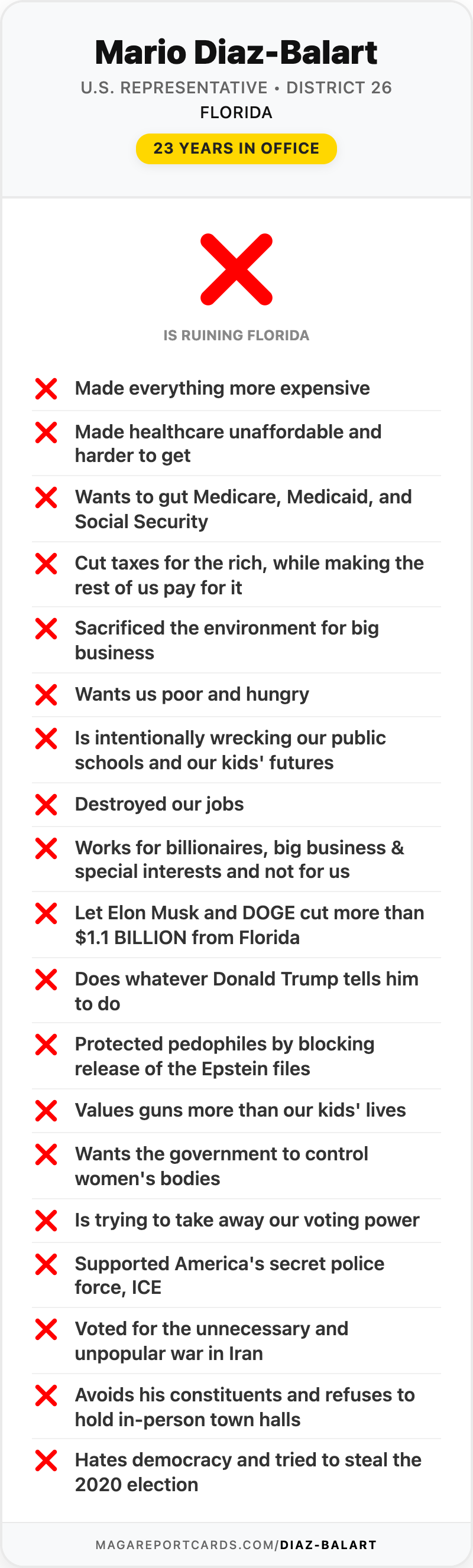
There is a way of doing politics where you say one thing to the people who elect you and do another thing on the House floor, and you count on the two never being read side by side.
So let's read them side by side.
What Mario Diaz-Balart said
February 6, 2025. Days after the Trump administration moved to end Temporary Protected Status for more than 300,000 Venezuelans, Diaz-Balart wrote to Homeland Security Secretary Kristi Noem:
"I respectfully request, within all applicable rules and regulations, that you assess all options available to ensure that Venezuelan nationals without criminal records are not forcibly returned to one of the most repressive dictatorships in the world."
May 21, 2025. After the Supreme Court cleared the way for the terminations, Diaz-Balart put out a joint statement, in English and in Spanish with Reps. Carlos Gimenez and Maria Elvira Salazar:
"As we have stated on numerous occasions, we have consistently supported and will continue to support Temporary Protected Status for Venezuelans."
The same statement blamed Joe Biden for opening the southern border, praised Donald Trump for restoring the rule of law "from day one," and promised they were "working with the Trump administration on a permanent solution."
That was the pitch to Miami-Dade: we're on your side, we're working on it, trust us.
What happened
Nothing was fixed.
On October 3, 2025, the Supreme Court sided with the administration and let the terminations proceed. On November 7, 2025, they took effect. More than 250,000 Venezuelans nationwide — including tens of thousands in South Florida — lost their protection from deportation. They also lost their work permits and, in many cases, their driver's licenses.
These are not strangers to Florida's 26th District. They are the people who fled Nicolás Maduro — a dictatorship Diaz-Balart has spent his career in Congress denouncing. They bought houses in Doral, opened businesses, sent kids to school here. And on a Friday in November, a large number of them woke up unable to legally go to work.
Diaz-Balart's letters did not stop it. His "permanent solution" never arrived.
What he did next
Here is where the story stops being about a letter that didn't work and starts being about a choice.
On June 9, 2026, the House voted on S. 2, the "Secure America Act" — the bill putting roughly $70 billion more into immigration enforcement. It passed by 214 votes to 212.
Two votes. At that margin, there is no such thing as a symbolic yes. Every Republican who pressed the green button cast a deciding vote; had any one of them voted no, it would have died on a 213–213 tie.
Diaz-Balart voted Aye. So did Gimenez. So did Salazar. Not a single Republican voted no.
That money is what pays for the agents, the vehicles, the detention beds and the flights that turn a revoked TPS designation into a person taken out of a parking lot in Hialeah. Diaz-Balart could not stop the Supreme Court. He could not make Kristi Noem answer his letter. But the vote on funding the machine was entirely his, and it was close enough that his single vote was the difference.
He voted to fund it.
Somebody noticed a year before the vote
He was warned, publicly, by people in his own community.
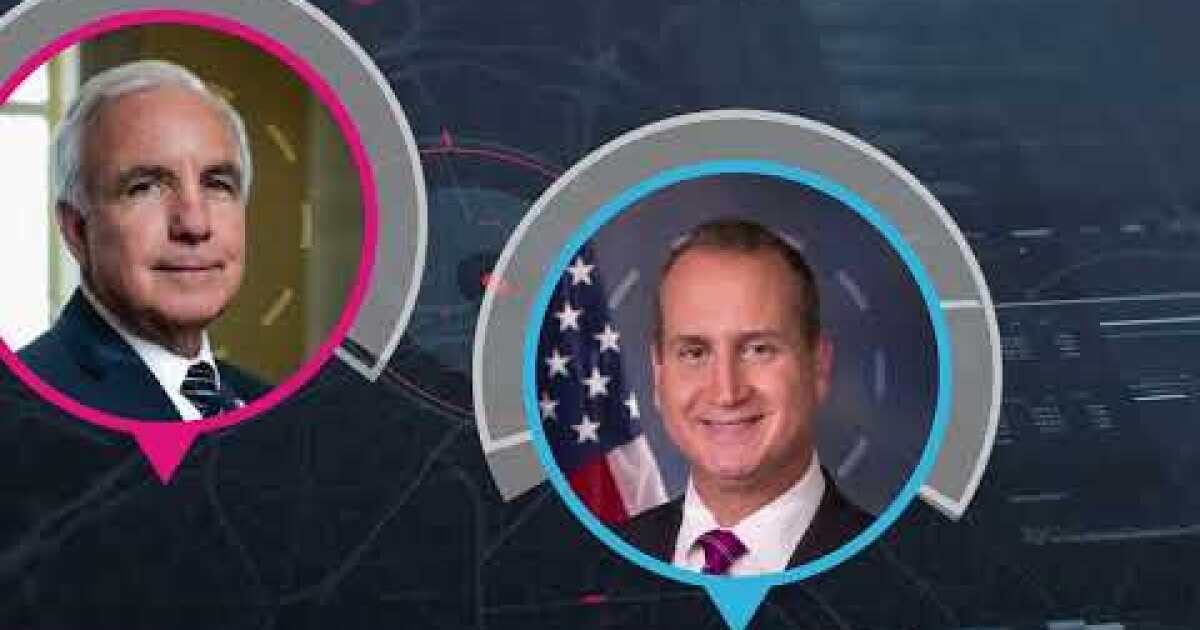
In June 2025, a nonprofit called Keep Them Honest launched a digital and cable ad campaign in South Florida aimed squarely at Diaz-Balart and Gimenez over deportations affecting families from Venezuela, Nicaragua, Haiti and Cuba. The ads accused Diaz-Balart of taking no action to stop the administration.
"We will hold those Republicans accountable for each and every family that is ripped apart by Trump and Rubio's cruel policies targeting immigrants," the group's spokesman, Chris Wills, told WLRN.
That was a year before the S. 2 vote. He had all the notice anyone could ask for.
The thing about representing an exile community
Diaz-Balart's whole political identity is built on standing with people fleeing dictatorships. He co-founded and co-chairs the Congressional Venezuela Democracy Caucus. He co-chairs the Congressional Hispanic Conference. He chairs the House appropriations subcommittee that writes the State Department and foreign aid budget — which means when he says the Maduro regime is repressive, he isn't just talking, he's holding the pen on U.S. policy toward Venezuela.
That is exactly what makes this indefensible. He is not a Republican from Idaho who has never met a Venezuelan asylum seeker. He is the member of Congress best positioned in the entire House to know precisely what happens to a person sent back to Caracas — and he told his constituents so, in writing, in both languages.
Then he voted to fund the removals by a two-vote margin.
What we deserve
A letter is not a vote. A press release is not a vote. "We are working with the administration on a permanent solution" is not a vote.
The vote is the vote, and Diaz-Balart's is on the record: Aye, on the bill that puts $38 billion into ICE, cast four days short of a year after his own constituents put his face in an ad asking him to do something.
If he genuinely believes Venezuelans without criminal records shouldn't be sent back to Venezuela, there was a moment when believing it would have cost him something. That moment was June 9, 2026, and it came down to two votes.
Sources
- Díaz-Balart writes letter to DHS urging protection for Venezuelans facing deportation — Claire Healy, Miami Herald, February 6, 2025
- Díaz-Balart, Giménez and Salazar statement on SCOTUS ruling on TPS for Venezuelans — Office of Rep. Mario Díaz-Balart, May 2025
- New digital, TV ad campaign targets Giménez and Díaz-Balart over Trump's deportation policies — WLRN, June 13, 2025. Image: campaign ad still, via WLRN.