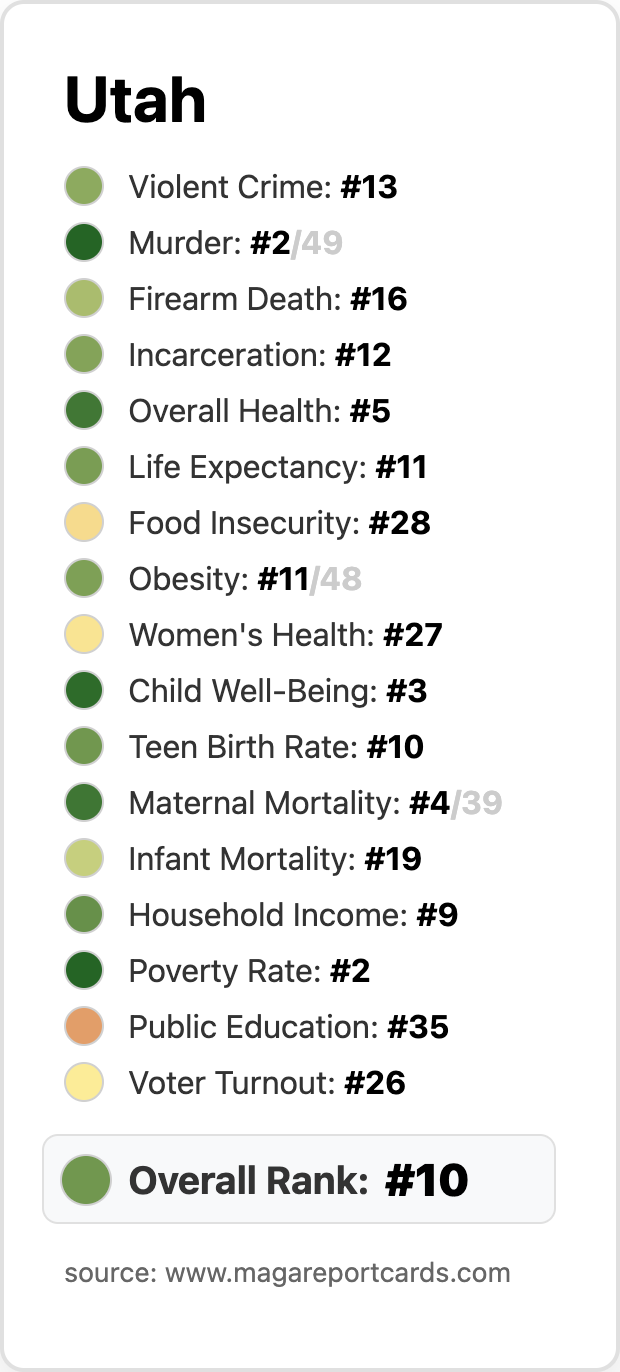
Utah ranks 10th out of 50 on the measures we track — health, crime, food security, education, life expectancy, and more. That's one of the best scores in the country, and it isn't an accident. It's insured families, funded hospitals, kids who eat, a university that does real research, and land nobody sold.
Most of that was built here. A lot of it is paid for in Washington. And the three Utahns who represent this state in the House have spent the past two years voting to spend it down.
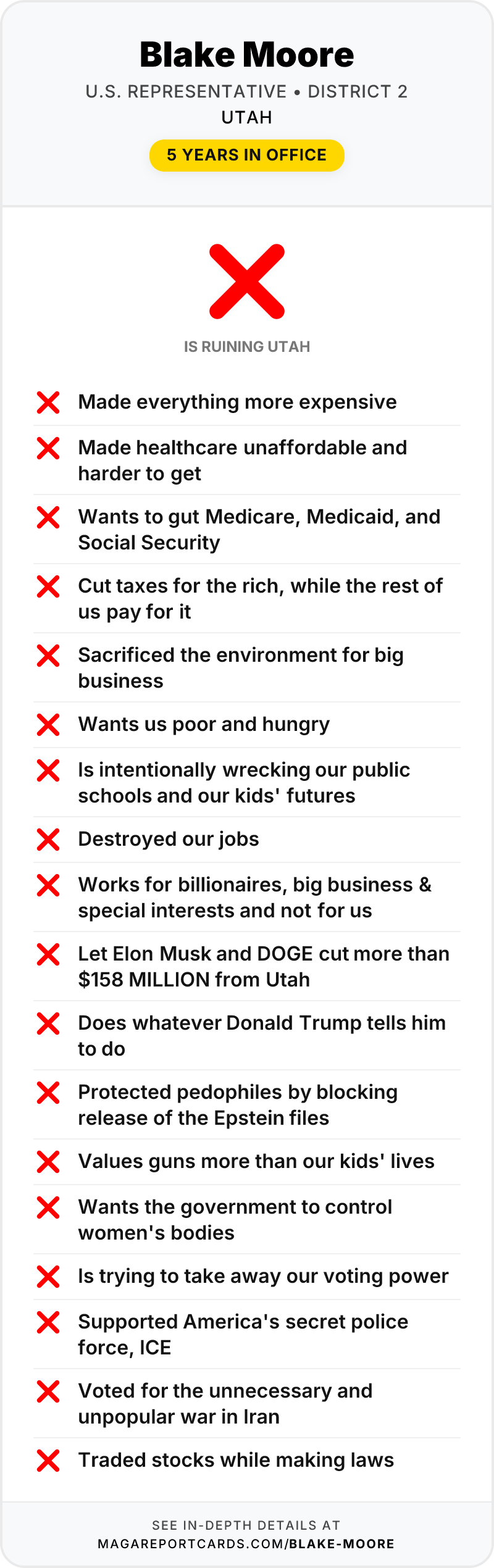
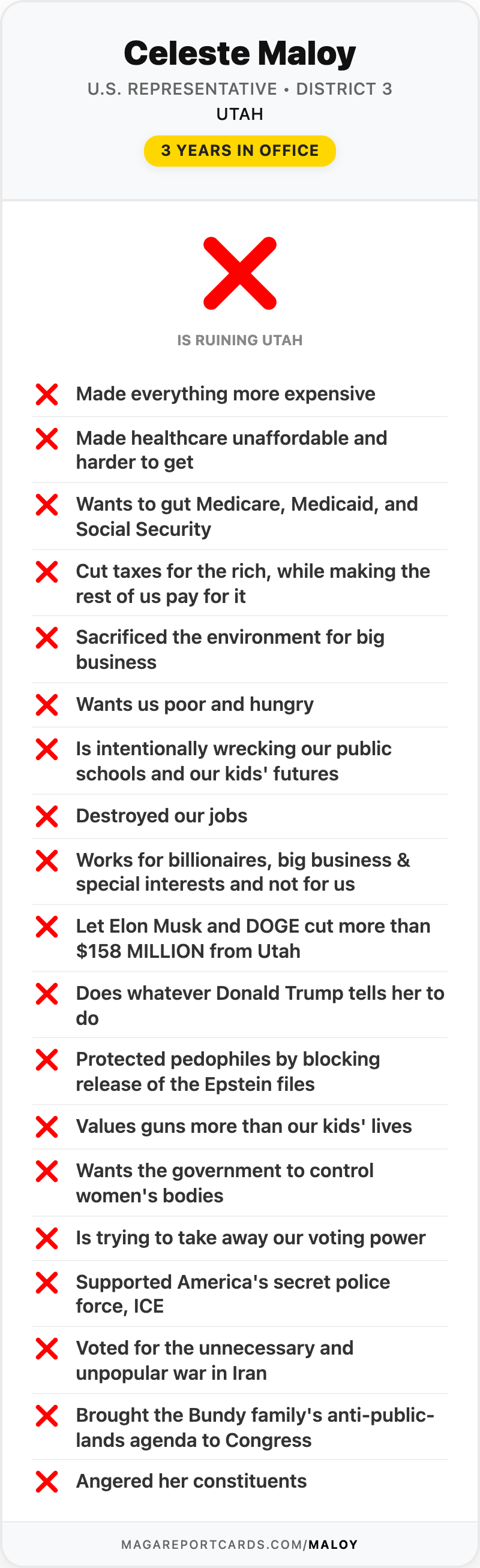
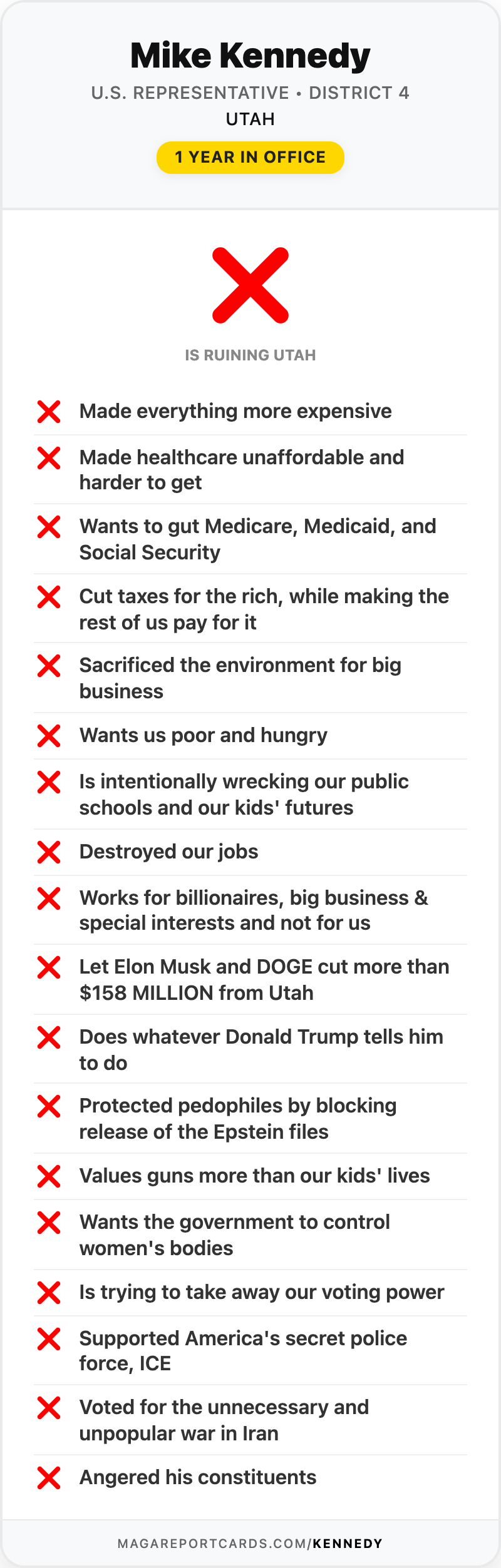
Blake Moore, the House Republican Conference Vice Chair and a senior member of the tax-writing Ways and Means Committee. Celeste Maloy, who sits on Appropriations and Natural Resources. Mike Kennedy, a practicing family physician who serves as Vice Chair of the Federal Lands Subcommittee.
All three voted for the One Big Beautiful Bill Act on July 3, 2025 — the law that cuts health coverage and food aid to pay for tax breaks. All three voted twice to lock DOGE's cuts into permanent law, in June 2025 and again in July. And on February 11, 2026, when the House actually passed a resolution to end the tariff emergency, 219–211, all three voted no.
Here's what those votes cost.
77,000 more Utahns projected to lose their health insurance — and a doctor cast one of the votes
KFF projects that Trump's budget bill will leave 77,000 more Utahns uninsured by 2034, with a published range of 58,000 to 97,000 — working families, people with disabilities, and rural communities that already drive furthest for care.
Utah's strong health ranking is exactly the thing 77,000 lost policies eats into. High rankings are built out of people having a doctor.
Mike Kennedy is a family physician. He voted for the bill anyway, and then defended the Medicaid cuts in a published op-ed, writing that they "cut waste while preserving resources for the people it was intended to serve." He has eight children. Presumably he'd want them to be able to see a doctor.
Utah's Republicans celebrated the bill's passage while health advocates in the state said plainly what it would do.
One in five Utah kids is hungry
Here in Utah, 1 in 5 kids faces hunger. About 176,200 Utahns — roughly 5% of the state — receive SNAP benefits every month to put food on the table.
Utah's SNAP enrollment is one of the lowest rates in the country. That is not a program running wild. It's a thin program in a state that already leans hard on churches, food banks, and neighbors — and the megabill the delegation voted for tightens who qualifies on top of it.
One in five kids goes hungry in a state that ranks 10th overall. Voting to make the food line shorter doesn't make the hunger smaller.
DOGE claimed $157 million. The University of Utah paid part of the bill.
DOGE says it "saved" Utah more than $157 million. Some of what that bought:
DOGE canceled 77 research grants at the University of Utah, costing $28.4 million in lost funding for medical and scientific research. That's not an abstraction in a state whose health ranking runs partly through its own research hospital.
Blake Moore isn't a bystander here — he co-chairs the House DOGE Caucus, which he helped launch in December 2024 alongside Elon Musk and Vivek Ramaswamy. But by his own account his northern Utah district ranks in the top 5% of all 435 congressional districts for federal workforce size — Hill Air Force Base, the IRS processing facility in Ogden, the veterans hospital, air traffic control, TSA, BLM, the Forest Service. When the cuts hit those workers, Moore told a February 2025 tele-town hall that "the communication that's come out from the DOGE world has been antagonistic" and that "I've been very, very frustrated at this alongside you." He helped build the bulldozer, then complained about the damage.
Celeste Maloy is a DOGE Caucus member too, and told Utahns she'd "like to see agencies do less with less" — advising them to ignore "the hysteria" over the administration's cuts. For someone crusading against government waste, she has her own history with public money: before Congress, she successfully lobbied Utah lawmakers in 2019 to hand $300,000 in state funds to a public-lands nonprofit she had helped launch and later led. Watchdog reporting found "scant evidence" of what it accomplished. It dissolved in 2023, after she launched her run for Congress.
Meanwhile there were 267,000 layoffs in Utah in 2025. Utah's delegation spent that year voting to add to the pile.
They tried to sell 10,000 acres of Utah to pay for the tax cuts
This is the one that's specific to us.
Celeste Maloy pushed to sell more than 10,000 acres of Utah public land — parcels across Washington County near St. George — as an amendment to Trump's budget bill. The proposal drew bipartisan opposition and was stripped from the final bill. It failed because Utahns and others objected, not because she stopped pushing.
She also sponsored the Ending Presidential Overreach on Public Lands Act, which would require Congress to sign off on every new national monument — gutting the century-old law that protected millions of acres of American wilderness, a lot of it here.
Maloy is the cousin of Ammon Bundy and niece of Cliven Bundy, the family behind the 2014 armed standoff with federal agents over public land. Aaron Weiss, deputy director of the Center for Western Priorities, put it this way: "Leave it to a member of the Bundy family to lead an egregious attack on America's public lands, this time from within the halls of Congress."
On the environment generally, none of the three is close to a defender. Moore holds a 0% score from the League of Conservation Voters in 2025 and 7% lifetime. Maloy is at 3% in 2025, 5% lifetime. Kennedy is at 0% in 2025 with a 0% lifetime score — every single vote against the environment.
450 Utahns a year, and ICE arrests doubled
Utah has about 13.3 gun deaths per 100,000 people — 4% above the national average, with about 450 Utahns dying from gun violence every year. That's one of the places a top-10 state is not doing well, and there's no bill from this delegation to fix it.
And ICE arrests in Utah more than doubled in 2025 — over 4,000 people, about 17% of them with no criminal history at all. One Utah father applying for a green card was arrested at his own immigration interview and shipped to a detention center in Las Vegas.
Mike Kennedy went further than a vote. In April 2025 he toured El Salvador's notorious CECOT maximum-security prison, where deportees — including wrongly deported Americans — are held in brutal conditions. He called the visit "sobering" and praised El Salvador for putting "the safety of their citizens first." He did not meet with or speak up for any of the wrongly deported Americans held there.
Utahns already told them
In March 2025, Maloy and Kennedy held a joint town hall at the University of Utah. Roughly 300 people showed up and heckled and shouted them down over DOGE cuts, federal layoffs, and health care. Kennedy suggested police remove a man he dubbed "Mr. Outburst." When Maloy insisted "I'm here to answer questions," the crowd shouted back "no you're not!"
By 2026, Maloy had moved to tightly managed events. At an Americans for Prosperity–sponsored town hall in St. George on January 28, 2026, more than two dozen residents protested outside, saying they'd spent months trying to get a real town hall with a congresswoman who was "always unavailable."
Who voted for this
These are the three members of Congress representing Utah in the House who voted for the budget law behind the health and food cuts, voted twice to codify DOGE's cuts, and voted to keep the tariffs:
- Blake Moore — House Republican Conference Vice Chair, Ways and Means Committee, DOGE Caucus co-chair
- Celeste Maloy — Appropriations and Natural Resources Committees
- Mike Kennedy — family physician, Vice Chair of the Federal Lands Subcommittee
Utah sits at 10th because generations of people here paid for hospitals, schools, universities, and land they never put up for sale. A high ranking is the most expensive thing a state owns and the easiest to spend: 77,000 people projected off insurance, $28.4 million out of the U, 267,000 layoffs, and 10,000 acres nearly auctioned off is what spending it looks like.
In 2026, Utahns decide whether the three people who cast those votes get to keep casting them.