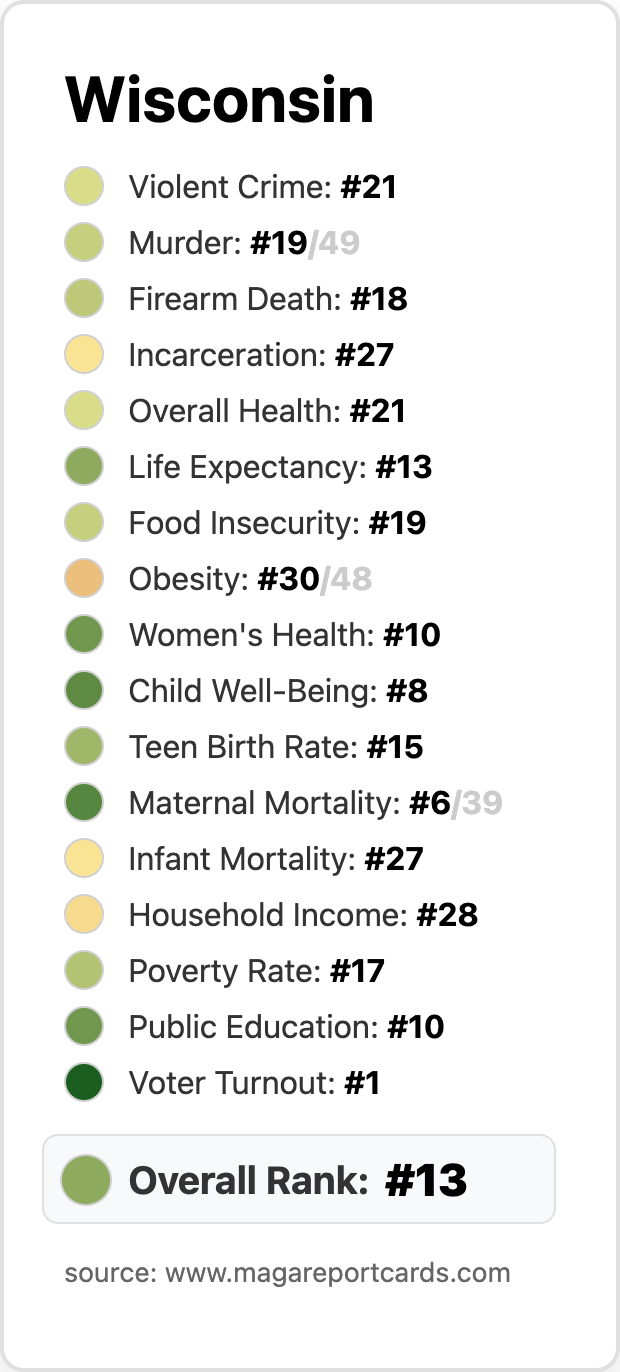
Here's something Wisconsinites don't hear often enough: this state is doing pretty well. On the measures we track — health, crime, food security, education, and more — Wisconsin ranks 13th out of 50. Not perfect. But better than 37 other states, and a whole lot better than most of the states whose politicians Wisconsin's delegation votes with.
That standing wasn't built in Washington. It was built here, over decades, by people who paid for hospitals and schools and food programs and expected them to work.
Now look at what Wisconsin's six Republicans in the U.S. House have been voting for. Every one of them — Bryan Steil, Derrick Van Orden, Scott Fitzgerald, Glenn Grothman, Tom Tiffany, and Tony Wied — voted for the budget law that cuts health coverage and food aid to pay for tax breaks. Every one of them voted twice to lock in DOGE's cuts. And every one of them just voted to keep the tariffs that are squeezing Wisconsin farms and factories.
You don't stay 13th by doing that. Here's what those votes cost.
270,000 Wisconsinites lose health coverage
Gov. Tony Evers' administration estimates that 270,000 Wisconsinites will lose health care coverage under Trump's budget bill — and the new red tape and work requirements will cost Wisconsin taxpayers over $284 million more to administer.
Read that twice. The state pays more money, and 270,000 people get less care. That's not efficiency. That's paperwork designed to make people give up.
Two hundred seventy thousand is nearly as many people as live in Madison. It's parents who work jobs that don't come with insurance, and seniors in rural counties where the nearest hospital is already thin.
All six — Steil, Van Orden, Fitzgerald, Grothman, Tiffany, and Wied — voted for the bill that does it.
Food aid, in a state where 1 in 5 kids faces hunger
Here in Wisconsin, 1 in 5 kids faces hunger. About 693,100 Wisconsinites receive SNAP benefits every month — 11.6% of the state — to put food on the table.
The same budget law all six voted for cuts SNAP and pushes new costs onto the state. When you tighten the rules on food assistance, the people who fall off aren't fraudsters. They're the working parent whose hours got cut, the grandmother raising grandkids, the kid who eats at school because there isn't enough at home.
Wisconsin is a state that grows food for the world. Letting one in five of its children go hungry is a choice, and six members of Congress from this state just voted to make that choice harder to reverse.
The trade war is hitting America's Dairyland from both sides
Canada is Wisconsin's biggest customer. In 2024 the state exported roughly $8.5 billion worth of goods to Canada — more than to any other country. Wisconsin's economic development agency calls it the state's "single most important trading relationship."
That relationship is now the target. The Trump administration has announced 50% tariffs on Canadian goods including wine, dairy, and cement, taking effect in August 2026 — after what that agency calls a year and a half of trade and political tensions with Canada. A report from the Midwest Economic Policy Institute and the University of Illinois found that in Wisconsin, the 2025 tariffs already pushed average household costs up $1,500 and cost the manufacturing sector 6,100 jobs.
On the farms it's worse, because the damage comes from two directions at once:
- China stopped buying U.S. soybeans in its trade war with Trump, triggering a price collapse and leaving Wisconsin farmers with a bumper crop and no buyer while input costs climbed.
- Wisconsin's dairy industry depends on immigrant labor for 60–90% of its workforce, so ICE raids like the one that scooped up 24 dairy workers in Manitowoc — most with no criminal records — have deepened a labor crisis on top of the tariff losses.
On February 11, 2026, the House got a chance to end it. A resolution to terminate the national emergency Trump used to impose the Canada tariffs passed 219–211. Six Republicans crossed over to vote for it.
Not one of them was from Wisconsin. Steil, Van Orden, Fitzgerald, Grothman, Tiffany, and Wied all voted no — to keep the tariffs on the country that buys $8.5 billion of what Wisconsin makes and grows.
DOGE bragged about $483 million. Wisconsin lost 2,400 jobs.
DOGE claims it "saved" Wisconsin more than $483 million. Here's what that looked like on the ground: under Trump and DOGE, Wisconsin lost 2,400 federal jobs — cutting services Wisconsin families rely on while federal spending actually went up.
That last part matters. The spending didn't go down. The staff did. Wisconsin traded 2,400 paychecks and the services those people delivered for a number somebody could post online.
And Wisconsin's delegation didn't just stand by for it — they voted to write DOGE's cuts into law. All six backed the Rescissions Act, first when it squeaked through the House 214–212 in June 2025, and again on final passage 216–213 in July, locking roughly $9 billion in DOGE cuts into law.
There were 382,000 layoffs in Wisconsin in 2025 — 13% higher than the year before. Wisconsin's members of Congress spent that year voting to add to the pile.
Who voted for this
These are the six members of Congress representing Wisconsin who voted for the budget law behind the health and food cuts, voted to codify DOGE's cuts, and voted to keep the tariffs on Wisconsin's largest export market:
- Bryan Steil — 1st District
- Derrick Van Orden — 3rd District
- Scott Fitzgerald — 5th District
- Glenn Grothman — 6th District
- Tom Tiffany — 7th District, now running for Governor
- Tony Wied — 8th District
Tom Tiffany is asking Wisconsin to promote him. Before anyone votes on that, it's worth knowing what he did with the job he has.
Wisconsin ranks 13th because generations of people here decided that hospitals, schools, and full lunch trays were worth paying for. Rankings like that are easy to lose and slow to win back — and 270,000 people losing coverage, 6,100 manufacturing jobs gone, and $8.5 billion in exports put at risk is how you start losing one.
In 2026, Wisconsinites decide whether the six people who cast those votes get to keep casting them.