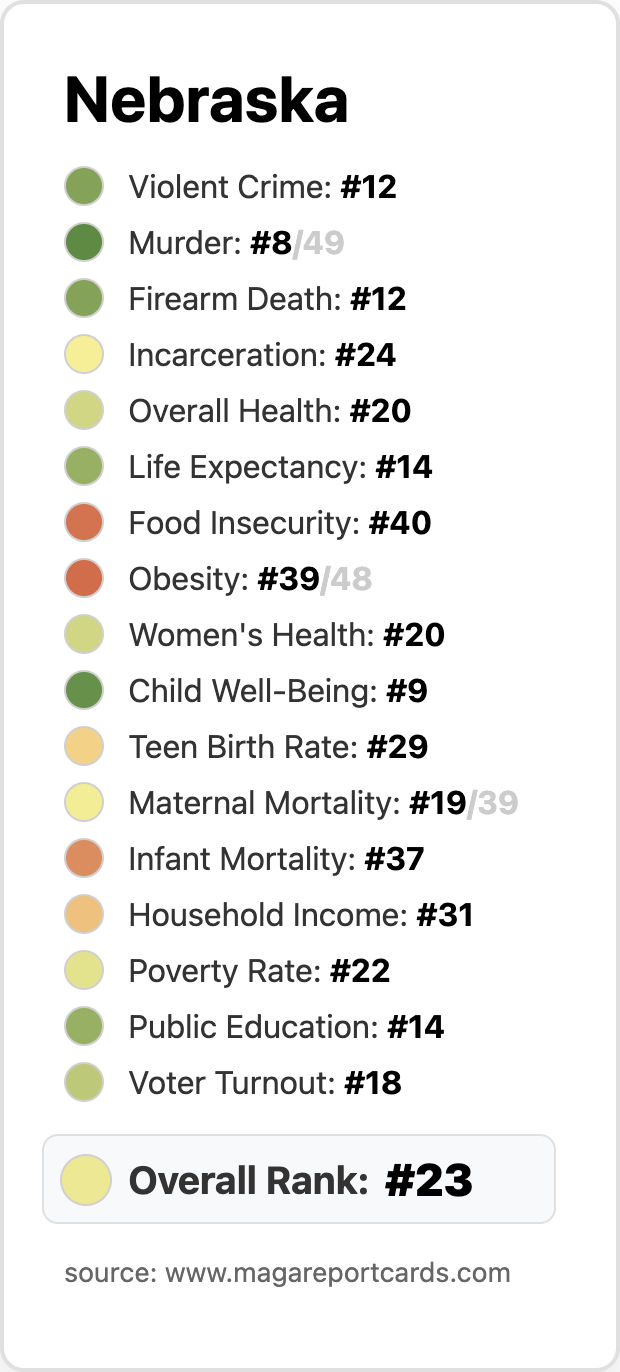
Nebraska ranks 23rd out of 50 on the measures we track — health, crime, food security, education, and more. Middle of the pack. Not a crisis, not a bragging point. A state with real strengths and some soft spots, held roughly steady by hospitals, schools, and food programs that people here have paid for over generations.
None of that was built in Washington. But a lot of it is funded there — and three of the Nebraskans who represent this state in Congress have spent the past two years voting to cut exactly those things.
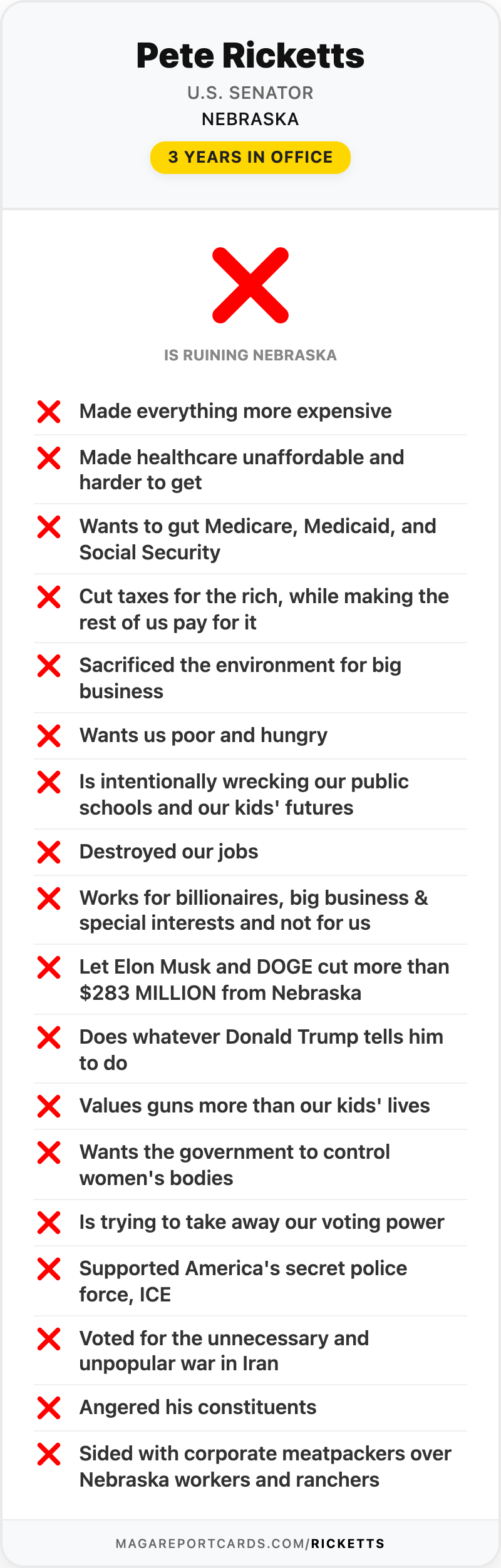
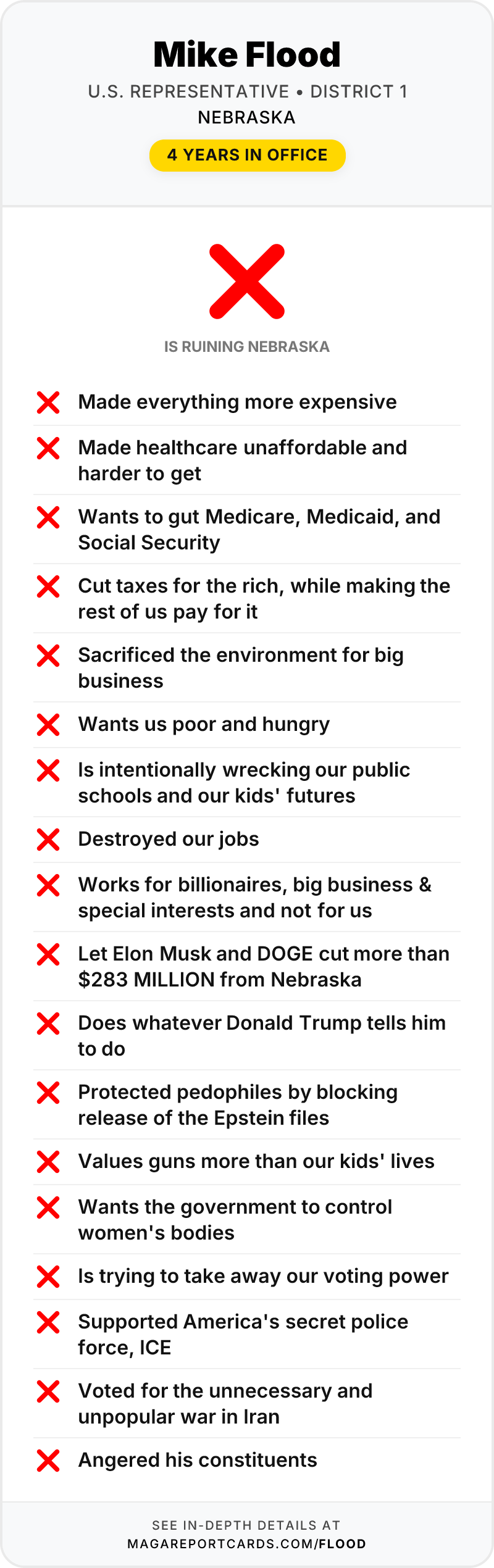
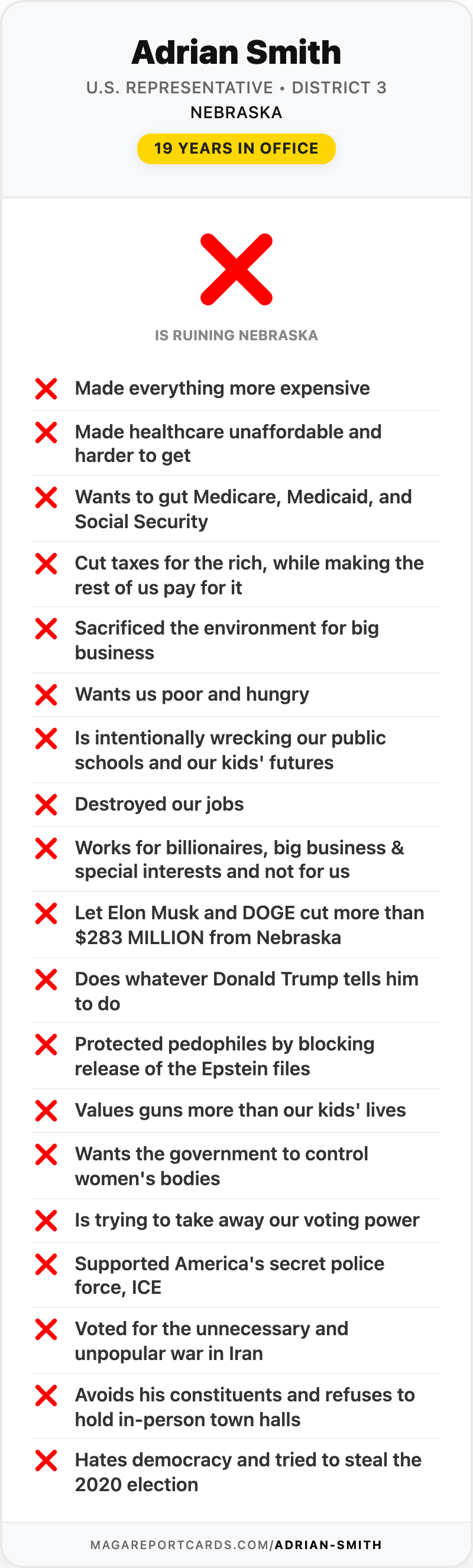
Pete Ricketts in the Senate. Mike Flood in the 1st District. Adrian Smith in the 3rd. All three voted for the budget law that cuts health coverage and food aid to pay for tax breaks. All three voted to cancel foreign aid and public broadcasting money Congress had already approved. And all three voted to keep the tariffs that are squeezing Nebraska farms and factories — even after two of them said out loud they had problems with them.
Here's what those votes cost.
Up to $4 billion out of Nebraska's health care, and up to 55,000 people off coverage
Nebraska stands to lose an estimated up to $4 billion in federal Medicaid funds over the next decade. That means fewer doctors, more strain on rural hospitals, and worse outcomes for families who already struggle to get care. As many as 55,000 Nebraska residents could lose health coverage.
In a rural state, pulling billions in federal dollars out of the health system doesn't produce efficiency — it produces closed wings, longer drives, and hospitals that stop offering services because they can't cover the cost.
Flood and Smith voted for the bill that does it on July 3, 2025. Ricketts voted for it in the Senate two days earlier, on a 50–50 tie broken by the vice president. One vote the other way and it doesn't become law.
Ricketts also voted twice to let the enhanced ACA premium tax credits expire on top of that — against an extension in June 2025, and again in December 2025, when a motion to take up the bill to extend them fell short, 51–48. Asked what Republicans would do instead, he offered no specifics beyond sending payments directly to buyers — only that "clearly Obamacare has failed" and that his party would "come back with a plan." Nebraskans watching their premiums climb don't get to wait for it.
One in five Nebraska kids faces hunger. 18,000 fewer are getting food aid.
Here in Nebraska, 1 in 5 kids faces hunger. About 150,600 citizens — 7.5% of the state — receive SNAP benefits every month to put food on the table.
That number is now falling, and not because hunger went away. About 18,000 fewer Nebraskans are getting food assistance than a year earlier — an 11% drop in participating households that food-access advocates attribute to the Republican megabill's new federal restrictions on who qualifies.
Read that next to the first number. One in five kids here faces hunger, and the response from Nebraska's delegation was to vote for a law that advocates say pushed 18,000 people off food assistance. This is a state that feeds the world. Deciding it can't feed its own children is a choice, and three members of Congress from here voted to make it.
"You're hurting Americans" — then three votes to keep it going
On April 24, 2025, Pete Ricketts stood in front of a town hall crowd in Kearney and described what he said he'd told Trump's Cabinet about the tariffs: "It's an $100 million impact. Lay off people -- that's a problem. You're hurting Americans, and specifically Nebraskans, if you don't fix this."
Six days later, on April 30, the Senate voted on a resolution to end the tariff emergency. It failed 49–49. Ricketts voted no. Had he, or any one of the other 48 no votes, gone the other way, it would have passed.
He did it again on October 29 and October 30, 2025, voting no both times as the Senate passed resolutions to terminate the Canada tariffs and the global tariffs anyway, without him.
Adrian Smith has the same problem, with less excuse. Smith chairs the House Ways & Means Subcommittee on Trade — on paper, the Nebraskan with the most power over this. He told the Ripon Society, "I'm not a fan of tariffs."
On February 11, 2026, the House voted on ending the tariff emergency. It passed 219–211. Six Republicans crossed over — including Nebraska's own Don Bacon, who represents Omaha. Smith and Flood both voted no. So this isn't a case of nobody having a choice: a Nebraska Republican in the same delegation voted the other way, on the same bill, on the same day.
What they voted to protect: Nebraska's manufacturing exports fell 12.6% in the first nine months of 2025, and Bish Enterprises in Giltner says component prices are up 75% to 80% over the prior year. On the farm side, China bought over $12 billion in U.S. soybeans in 2024, and as of that September had not ordered any since May 2025, shifting to Brazil instead. As one Grand Island farmer put it: "Commodity prices are in the basement, and all the inputs are way sky high."
DOGE claimed $283 million. Here's the receipt.
DOGE says it "saved" Nebraska more than $283 million. What that bought:
- Humanities Nebraska lost more than 40% of its annual funding — over $1 million — when the National Endowment for the Humanities cut its entire federal grant.
- UNL lost $850,000 in humanities grants, including $100,000 from the Willa Cather Archive.
- DOGE moved to terminate the leases of a USDA field office in south Lincoln, SBA and FDA offices in Omaha, and the Niobrara National Scenic River Visitor Center in Valentine — though a lost lease doesn't always mean an office closes.
- Hundreds of weather forecasters and other NOAA employees were fired — in a state where knowing what the sky is about to do is a business input.
- Mass layoffs at the USDA left an uncertain future for researchers and rural areas.
Cutting the weather service and the USDA in an agricultural state is not trimming fat. It's removing the tools farmers use to make money.
And Nebraska's delegation didn't just watch. Flood and Smith backed the Rescissions Act of 2025 — which cancelled money Congress had already approved for foreign aid and public broadcasting — twice, when it passed the House 214–212 in June 2025 and again on final passage in July. Ricketts voted for it in the Senate, 51–48. The version the House first passed cancelled $9.4 billion.
There were more than 130,000 layoffs and discharges in Nebraska in 2025. Nebraska's members of Congress spent that year voting to add to the pile.
Who voted for this
These are the three members of Congress representing Nebraska who voted for the budget law behind the health and food cuts, voted to cancel money Congress had already approved, and voted to keep the tariffs on Nebraska's farms and factories:
- Pete Ricketts — U.S. Senator
- Mike Flood — 1st District
- Adrian Smith — 3rd District, chairman of the House Trade Subcommittee
Two of the three voiced doubts about the tariffs. All three voted to keep them. That gap — between what they say at a town hall in Kearney and what they do on the floor in Washington — is the whole story.
Nebraska sits at 23rd because people here paid for hospitals, schools, and full lunch trays and expected them to work. A middling ranking is a fragile thing: easier to lose than to win back, and up to $4 billion in Medicaid, 18,000 fewer people on food aid, and a 12.6% drop in manufacturing exports is what losing it looks like on the way down.
In 2026, Nebraskans decide whether the three people who cast those votes get to keep casting them.