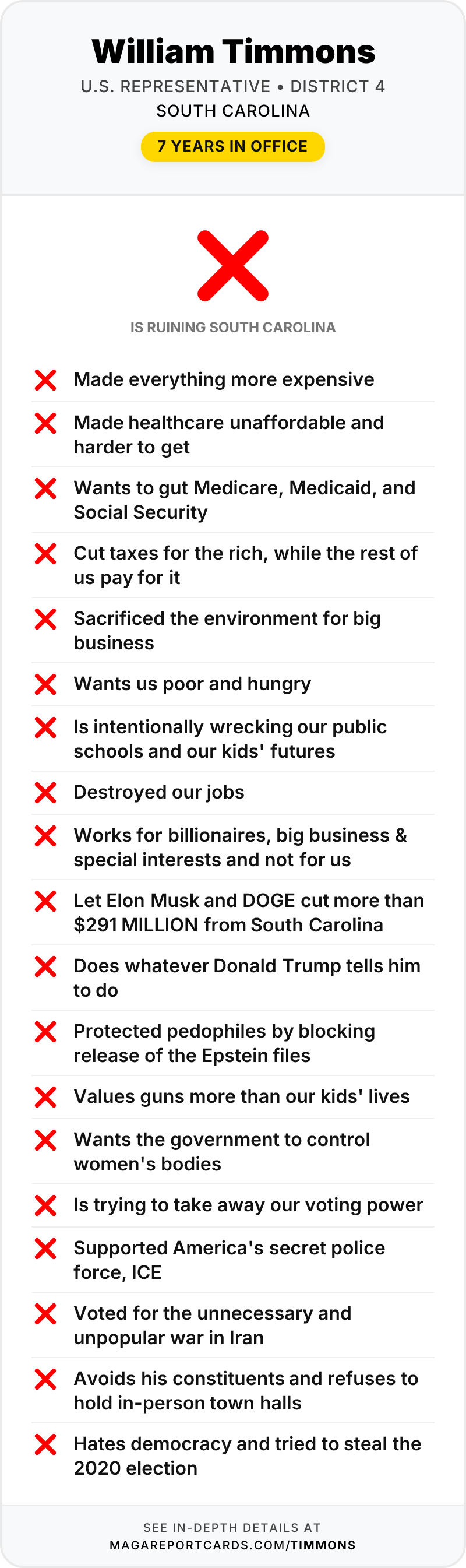
William Timmons spent four years as an assistant solicitor in Greenville, prosecuting murder, white-collar crime, and domestic abuse. He knows what the words mean.
So read what he wrote on his official House website, days after the Capitol was attacked:
"The actions yesterday by those who breached the U.S. Capitol are the very definition of domestic terrorism. There are no excuses for attacking law enforcement, breaking barricades, shattering windows, and busting down doors to gain entry. Anyone who was complicit in these acts of domestic terrorism should be prosecuted to the fullest extent of the law. This act of insurrection cannot go unpunished."
And then, two paragraphs later:
"This assault on our Capitol should have never happened. We need a thorough investigation of how and why it did."
That's his statement, on his own congressional website, still posted today.
Now here is the record of what he did about it. Every item below is a roll call on the House Clerk's website — public, permanent, and not in dispute.
The five votes
January 6, 2021 — the Arizona objection. Hours after the building was cleared, Timmons voted Yea on the objection to Arizona's electoral votes. Roll call 10. It failed.
January 7, 2021 — the Pennsylvania objection. The next day, he voted Yea again, this time to reject Pennsylvania's electors. Roll call 11. It failed too.
January 13, 2021 — impeachment. Five days after writing that the insurrection "cannot go unpunished," he voted Nay on impeaching Trump for inciting it. Roll call 17.
May 19, 2021 — the independent commission. The House voted to create a 9/11-style, evenly split, bipartisan commission to investigate the attack. That is, quite literally, the "thorough investigation of how and why it did" that Timmons had asked for. He voted Nay. Roll call 154. The bill passed the House and died in the Senate.
June 30, 2021 — the select committee. With the commission dead, the House created a select committee to do the work instead. He voted Nay again. Roll call 197.
Two votes to throw out other states' electors. Three votes against the House's mechanisms for holding anyone accountable.
The 1,300-word objection
Timmons did not just quietly vote with his party on January 6. Four days earlier, he published a long, lawyerly statement announcing that he would object — and it is worth reading closely, because it undercuts itself.
His argument was that in several swing states, courts had changed election rules that only state legislatures are allowed to set:
"Unfortunately, in the months preceding the November election, a group of big money funded, special interest, liberal elites intentionally and systematically sought to use state and federal judges to manipulate the election laws in swing states..."
Then he spent several paragraphs explaining what happened when somebody tried that in South Carolina. A federal district judge struck down the state's witness requirement for absentee ballots. South Carolina appealed. And the U.S. Supreme Court overturned the judge, in Andino v. Middleton. Timmons quoted Justice Kavanaugh's concurrence at length and wrote:
"Thankfully, South Carolina was ready to defend our state's election laws and through an expedited appeals process obtained a ruling on October 5, 2020 from the United States Supreme Court overturning the district judge's order."
So: the system he said was broken worked. In his own state. Before the election. Through the courts, exactly as designed.
His response was not to say the process works. It was to vote to throw out the electoral votes of states that hadn't won that relief — because, he wrote, "the fact that other states were not able to obtain relief from these attacks so close to the election does not make the conduct proper."
He was careful never to allege actual fraud. He wrote only that these rulings "may have enabled widespread fraud that could have altered the results of the election." May have. Could have. He voted to discard millions of real votes on that.
A month before all this, in December 2020, he had already put his name on a Supreme Court brief. Timmons was one of 126 House Republicans who signed the amicus brief backing Texas's lawsuit against Georgia, Michigan, Pennsylvania, and Wisconsin — the four states that decided the election. The Court threw it out, ruling that Texas had no business challenging how another state runs its elections.
The sentence that gives it away
Near the end of the January 2 statement, Timmons wrote this:
"The American people are right to look to Congress for answers and action, but to date, Congress has failed to launch any meaningful investigation or oversight into anything that relates to election integrity. This is unacceptable at a time when tens of millions of Americans feel disenfranchised."
Congress failing to investigate was unacceptable — on January 2.
By May 19, when the House voted on a bipartisan commission to investigate an actual attack on the actual Capitol, with actual injured police officers, he voted no. By June 30, when the House tried again, he voted no again.
He also wrote, in that same statement, that he looked forward "to working with my colleagues to establish standards and ensure this does not happen again."
What "unpunished" ended up meaning
On January 20, 2025, Trump pardoned or commuted the sentences of roughly 1,500 people charged over the attack, including people convicted of assaulting police officers and the leaders of the Proud Boys and Oath Keepers.
"Prosecuted to the fullest extent of the law," the former prosecutor had written. Four years later, the convictions were pardoned and the pending cases ordered dropped.
He is not the only one
This pattern — appalled in January, opposed to investigating by May — shows up again and again in the roll calls. Florida's Scott Franklin called for a bipartisan investigation a week after the attack, then voted against one four months later. Arkansas's Bruce Westerman hid from the mob with a ceremonial sword and then voted twice against investigating it. Alabama's Robert Aderholt cast the same five votes Timmons did.
What makes Timmons's version sting is that he wrote it all down himself, in full sentences, on government letterhead. Nobody has to characterize his position. He published it — and then he voted the other way, five times.
Both statements are still up on his House website. You can read them yourself.
Sources
Rep. William Timmons, "Timmons Statement on Domestic Terrorism at the U.S. Capitol" and "Timmons to Object to Electoral College Certification on January 6" — timmons.house.gov, January 2021. Roll call votes from clerk.house.gov.