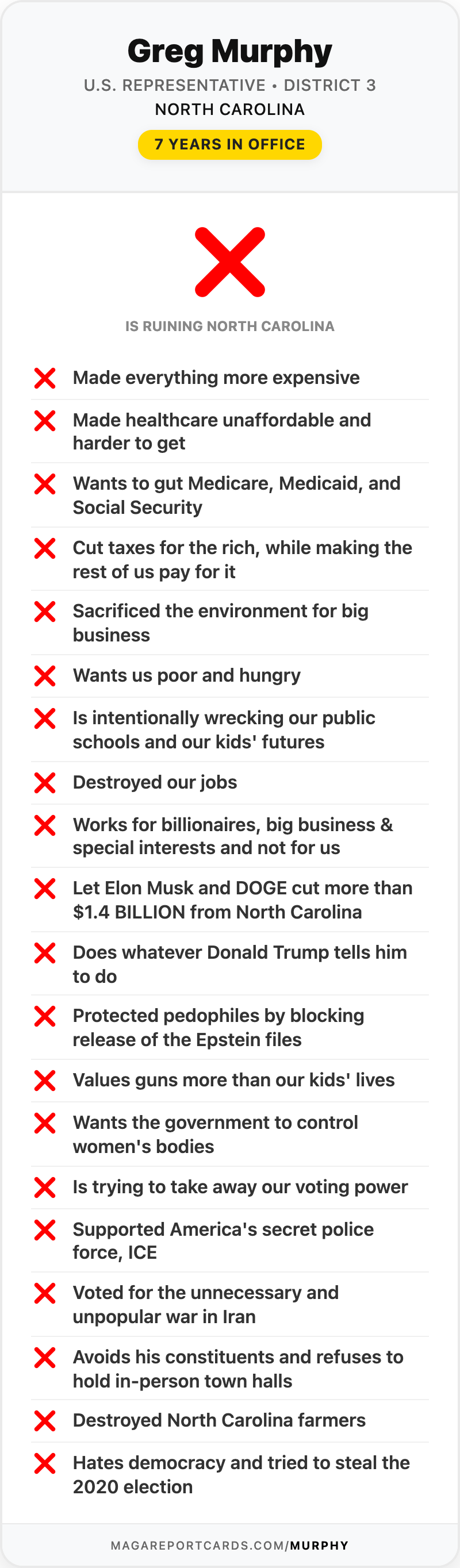
There's a version of the January 6 story where every Republican did the same thing, and so no individual is really responsible for any of it. Greg Murphy doesn't fit that version, which is why his record is worth reading closely.
He voted against one of the two objections. That is unusual. It also makes the rest of what he did harder to explain, not easier.
Here is the record, from the primary sources.
December 1, 2020: the letter to the Attorney General
Murphy signed a letter to Attorney General Bill Barr — his signature is on page two, second name in the block — complaining about "the shocking lack of action from the Justice Department" a month after the election.
The letter said there were "a number of anomalies, statistical improbabilities and accusations of fraud that bring the election results in several states into question." Then it made a demand:
"More than enough evidence has been presented to warrant the issuing of subpoenas, search warrants and the impounding of ballot materials and election devices for forensic analysis."
Members of Congress asked the Justice Department to seize voting machines. Here is the thing about the date on that letter. On that same day, December 1, 2020, Barr told the Associated Press that "to date, we have not seen fraud on a scale that could have affected a different outcome in the election" — and said specifically that the Justice Department and the Department of Homeland Security had looked into the claim that voting machines were programmed to skew results and found nothing to substantiate it.
Trump's own Attorney General had checked the voting machines. The letter asked him to impound them anyway.
December 10, 2020: the Supreme Court brief
Nine days later, Murphy put his name on the amicus brief of 126 House Republicans supporting Texas v. Pennsylvania — the lawsuit asking the Supreme Court to void the presidential results in Pennsylvania, Georgia, Michigan and Wisconsin.
He is listed by name: "Amicus U.S. Representative Gregory Murphy, M.D. represents the Third Congressional District" of North Carolina.
That's the part worth holding onto. Four weeks before the electoral count, Murphy had already asked the highest court in the country to throw out Pennsylvania's votes. The Supreme Court refused to hear the case.
January 6 and 7, 2021: the split
Then came the count itself, and the mob.
On the night of January 6, after the Capitol was cleared, the House voted on the objection to Arizona's electoral votes. It failed 121–303, and Murphy voted Nay — with the majority, against the objection.
The next day, on the objection to Pennsylvania's electoral votes, eighteen members who had voted no the night before switched to yes; one of the Arizona yes votes was absent, so the total rose by seventeen. Murphy was one of the eighteen. He voted Yea. That objection failed too, 138–282.
So he was not swept along. He made a distinction. He looked at two states and picked one.
And the one he picked was the one he'd already gone to the Supreme Court about.
What the objection would have done
Strip away the procedure. A successful objection to Pennsylvania would have discarded every ballot cast in that state — millions of them, counted, certified by the state, and already litigated to a dead end in court after court.
Murphy's own constituents in eastern North Carolina voted in the same election, under the same federal law, with their votes certified the same way. He did not propose throwing those out.
Then he voted against finding out what happened
Everything after this is about whether the country would be permitted to investigate.
- January 13, 2021 — the House impeached Trump for inciting the attack. Murphy was recorded as Not Voting; he was in North Carolina caring for his wife after back surgery. He issued a statement opposing impeachment anyway: "The President has committed to a smooth transfer of power. We should let that happen and work on uniting the country rather than dividing it further. I strongly oppose this action taken by the House today."
- May 19, 2021 — the House voted to create an independent, bipartisan commission to investigate January 6, modeled on the 9/11 Commission. Murphy voted Nay.
- June 30, 2021 — after Senate Republicans killed the independent commission, the House created a select committee instead. Murphy voted Nay.
He voted against both ways of investigating it. There was no third option he was holding out for.
What he said on the anniversary
On January 6, 2022, Murphy put out a statement calling the attack "shameful" and "a terrible, yet avoidable, security failure," and said those who entered the Capitol unlawfully should be held accountable.
The rest of it was about Democrats. He accused House leadership of "exploiting the tragic events of January 6th for political gain" instead of supporting Capitol security upgrades.
A security failure is a story about doors and staffing. It is not a story about why several thousand people came to Washington believing the election had been stolen, or about the members of Congress who spent December telling them so in letters and legal briefs.
Murphy was one of those members. His statement does not mention that.
The part that isn't in the past
Murphy is running for re-election in 2026 against Democrat Raymond Smith Jr., who won the March primary. Murphy's district was redrawn ahead of this cycle.
There is no public record of him retracting the December letter, and nothing he has said explains why Pennsylvania's voters were different from Arizona's. His own announcement the day before the count said only that he would object to "certain Electoral College votes". He was, in the end, a little more careful than most of his colleagues on that first vote — which means he thought about it, and then did it anyway.
We've written about the rest of his record: what he says about health insurers versus how he votes on coverage, and three other things worth knowing.
Sources
- Letter to Attorney General William Barr, December 1, 2020 (Murphy's signature, p. 2)
- Texas v. Pennsylvania — Amicus Brief of 126 Members of the U.S. House of Representatives, Supreme Court of the United States
- House Roll Call votes 10, 11, 17, 154 and 197, Office of the Clerk