Of all the members of Congress who were inside the Capitol on January 6, 2021, Bruce Westerman may have had the strangest afternoon.
When the House chamber was evacuated, the Arkansas Republican went to House Republican leader Kevin McCarthy's office. Then the rioters got into the building. McCarthy's security detail pulled McCarthy out.
They did not take Westerman.
According to the Encyclopedia of Arkansas: "Taking down a ceremonial Civil War sword from a display in the office, Westerman retreated into a private bathroom, crouching on the toilet ready to defend himself from any intruders."
A sitting member of the United States Congress, alone in a locked bathroom, holding an antique sword, waiting to find out whether the people outside would come through the door. The episode surfaced three months later, in New York Times reporting on Kevin McCarthy.
On the day itself, Westerman posted: "Americans will always disagree on politics, but violently storming our nation's Capitol is absolutely unacceptable. People are getting hurt. Enough."
He was right. And then, over the next six months, he voted against every serious attempt to find out how it happened.
One month before, he signed the brief
To understand the votes, start a month earlier.
In December 2020, Texas asked the Supreme Court to intervene in the presidential election results of four states its own voters had nothing to do with — Georgia, Michigan, Pennsylvania and Wisconsin. 126 House Republicans signed a friend-of-the-court brief supporting it. Westerman was one of them.
The brief is public. In it, the 126 members asked the Court to "uphold the plenary authority of the state legislatures to establish the manner by which electors are appointed, and determine the constitutional validity of any ballots cast under rules and procedures established by actors or public bodies other than state legislatures."
Translated: millions of already-counted votes in four states should be examined for possible invalidation, because governors, election officials and courts — rather than legislatures — had adjusted procedures during a pandemic.
The Supreme Court threw the case out. Texas didn't have standing to challenge how another state runs its election.
Twenty-seven days later, a mob stormed the building where Westerman worked, believing the election had been stolen.
To his credit, he certified the results
Westerman does not fit the simplest version of this story, and it's worth saying so.
When the House came back that night, the objections to Arizona's and Pennsylvania's electoral votes came to the floor. Westerman voted no on the Arizona objection and no on the Pennsylvania objection. He voted to certify Joe Biden as president. Plenty of his colleagues didn't.
Give him that. He looked at the mob's demand and refused it.
Which makes what came next harder to explain, not easier.
May 19, 2021: he votes against the independent commission
Four months later, the House took up the National Commission to Investigate the January 6 Attack on the United States Capitol Complex Act.
This was the modest option: an independent commission sitting outside Congress, charged with investigating the facts and circumstances of the attack, evaluating its causes, and recommending how to prevent the next one.
It passed 252 to 175. Thirty-five Republicans voted yes.
Westerman voted no.
June 30, 2021: he votes against the select committee
When the commission died in the Senate, the House created its own select committee to investigate the attack. It passed 222 to 190 on June 30, 2021.
Westerman voted no on that too.
He is not one of the Republicans who quietly missed the vote — the roll call records him as a recorded Nay on both. Twice asked whether Congress should examine an attack he personally hid from in a locked bathroom, he answered no both times.
The Encyclopedia of Arkansas summarizes it flatly: Westerman "has opposed all efforts to empanel either a bipartisan commission or a select committee to study the events of January 6." The same entry records that after the Supreme Court refused the Texas case, he "continued to profess doubts about President Joe Biden's victory."
That is the tell. He doubted the election out loud, certified it anyway, and then voted against finding out what came of it.
Why the second half matters more than the first
There is a version of this story where Westerman comes out fine. Man survives a riot, condemns it, certifies the election anyway. Sober, institutional, unglamorous. Good.
The reason it doesn't end there is that an investigation is how a country stops something from happening twice. The 9/11 Commission is the model everyone reaches for precisely because it produced findings that changed how the government works. A commission on January 6 would have done the same thing — established a factual record everyone could argue from, and recommended fixes.
Voting it down isn't neutrality. It's a decision that the country is better off not knowing.
And Westerman is not alone. Florida's Scott Franklin publicly called for exactly this kind of bipartisan committee a week after the attack — and then, when the House created one four months later, voted against it.
The record he'd rather run on
Westerman is now the chairman of the House Natural Resources Committee, and he'd much rather talk about forests and national parks. He has represented the district since 2015 and faces voters again in November.
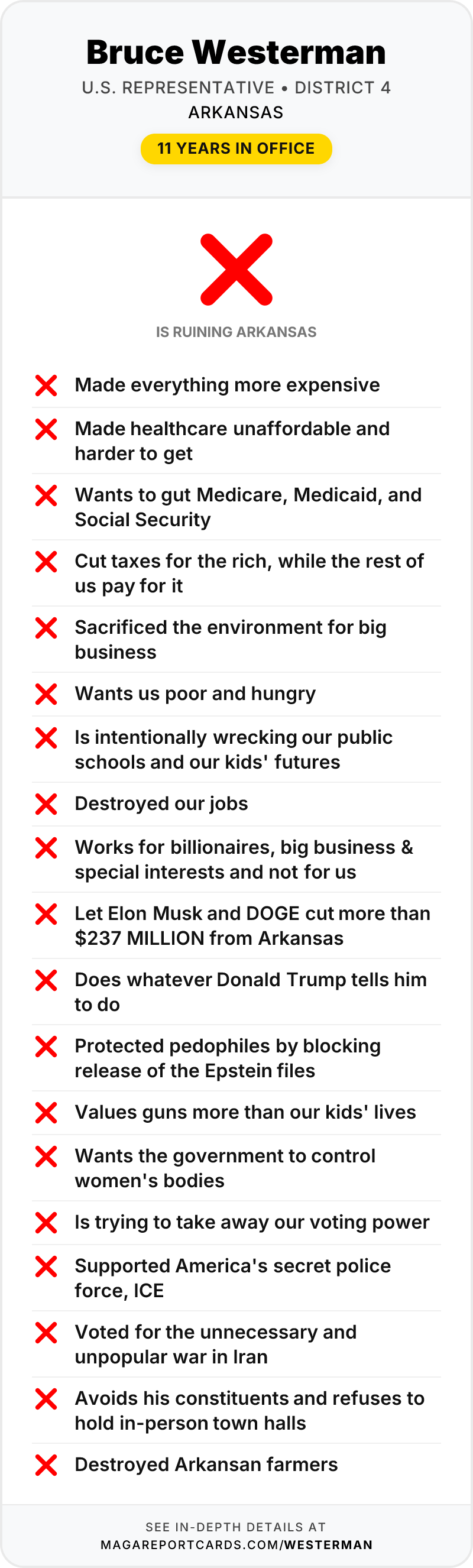
Arkansans in the 4th District are entitled to weigh this: their congressman signed a legal brief asking the Supreme Court to invalidate other states' ballots, watched what that argument produced from behind a locked bathroom door, and then voted twice to make sure nobody investigated it.
We could not find any record of him ever holding an in-person town hall where a constituent could ask him why.
We deserve better.
Sources
Bruce Eugene Westerman (1967–) — Encyclopedia of Arkansas, Central Arkansas Library System.
Report: Arkansas lawmaker barricaded himself in bathroom with sword during Capitol siege — KATV, April 27, 2021.