Scott Franklin had been a member of Congress for three days when the Capitol was attacked.
A week later, he sat for an interview with LkldNow, the Lakeland news site, and said several things that sounded like the start of an honest reckoning. Asked whether President Trump bore some responsibility for the riot, he said yes. He said impeaching a president in a single day would skip the due process such a proceeding deserves. And then he offered an alternative:
"I want to see a bipartisan committee established to investigate not only what transpired last Wednesday, but everything leading up to it."
That's a defensible position. Not impeachment — an investigation. Bipartisan. Covering not just the day itself but everything that led to it.
Four months later, the House created exactly that. Franklin voted against it.
The vote he asked for
On May 19, 2021, the House passed the National Commission to Investigate the January 6 Attack on the United States Capitol Complex Act — an independent commission in the legislative branch, charged with investigating the facts and circumstances of the attack, evaluating its causes, and recommending how to prevent the next one. Exactly what Franklin had asked for, four months earlier, in his own words.
It passed 252 to 175. Thirty-five Republicans voted for it.
Franklin voted no.
He never got a different investigation, either. When the Senate filibustered the bipartisan commission and the House created a select committee instead, Republicans spent the next two years calling that committee partisan — a complaint that only works if you didn't vote down the bipartisan version first.
What he did in the meantime
The January 6 interview was not the beginning of Franklin's involvement in the 2020 election fight. It was in the middle of it.
Before he was even sworn in, Franklin signed a December 15, 2020 letter with 25 other House members-elect, urging Speaker Pelosi to "initiate a thorough investigation into these voting irregularities" and claiming "verified reports" of ballots with missing signatures and unaccounted-for voting machine memory cards.
Hours after rioters attacked the Capitol, he voted to reject Biden's win in Arizona. The objection failed 121 to 303.
The next morning, he did it again for Pennsylvania. That one failed 138 to 282.
On January 12, he voted against the resolution urging Vice President Pence to invoke the 25th Amendment, calling the amendment itself "not a political weapon to deploy against a political opponent." It passed anyway, 223 to 205.
On January 13, he voted against impeachment, which passed 232 to 197.
Twice he voted to throw out another state's electoral votes. Twice he voted against a mechanism for accountability, each time with a public statement pointing at some other mechanism that would be more appropriate. And when the more appropriate mechanism showed up in May, that was a no too.
And in 2022, he voted against the fix
There's one more vote that closes the loop.
In September 2022, the House took up the Presidential Election Reform Act — the bipartisan Lofgren-Cheney bill rewriting the old, vague law governing how Congress counts electoral votes. It specified, under a heading reading "No discretionary power," that the role of the presiding officer at the joint session "is ministerial" — closing the door on the theory that a vice president can throw out a state's electors — and raised the threshold for objecting to at least one-third of both chambers, instead of one member of each.
In other words: a bill designed to make sure January 6, 2021 could not happen again.
It passed 229 to 203. Nine Republicans voted for it.
Franklin was not one of them.
What "due process" turned out to mean
Look at the whole sequence from a constituent's point of view.
January 2021: Impeachment is too fast, let's have a bipartisan investigation instead. May 2021: No to the bipartisan investigation. September 2022: No to the law that would stop it happening again.
The stated objection in January was about process — that impeachment in a day wasn't fair. But every subsequent vote was against the slower, more deliberate, more bipartisan options. If the concern had really been process, there was a yes vote available in May 2021 and another in September 2022. He passed on both.
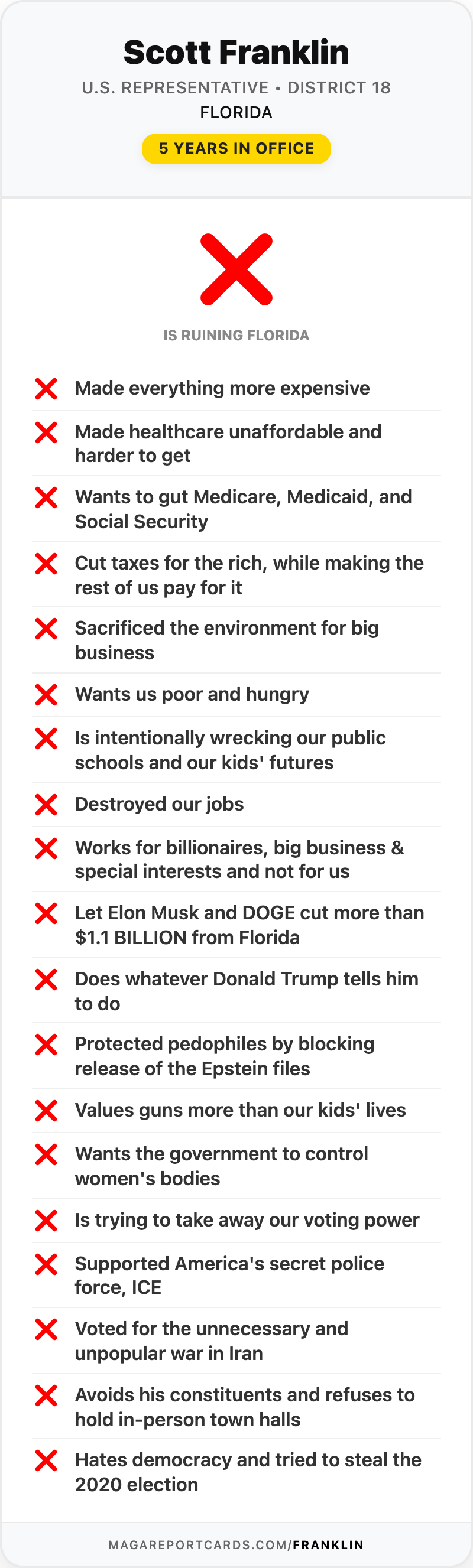
Franklin represents Florida's 18th District and is now in his sixth year in Congress. He is Vice Chairman of the House Appropriations Committee, one of the most powerful positions in the chamber. He has a 0% score from the League of Conservation Voters for 2025 and a 1% lifetime score. And when constituents showed up outside his Lakeland office in March 2025, they handed out flyers with his photo under the word "MISSING" — because he doesn't hold in-person town halls.
He is on the ballot again this November.
He said, on the record, that he wanted somebody to investigate what happened. Then he voted against everyone who tried. We deserve better.
Source
"Franklin: Trump Bears Some Responsibility, But Impeachment Inappropriate," Rick Rousos, LkldNow, January 13, 2021, with roll call records from clerk.house.gov.