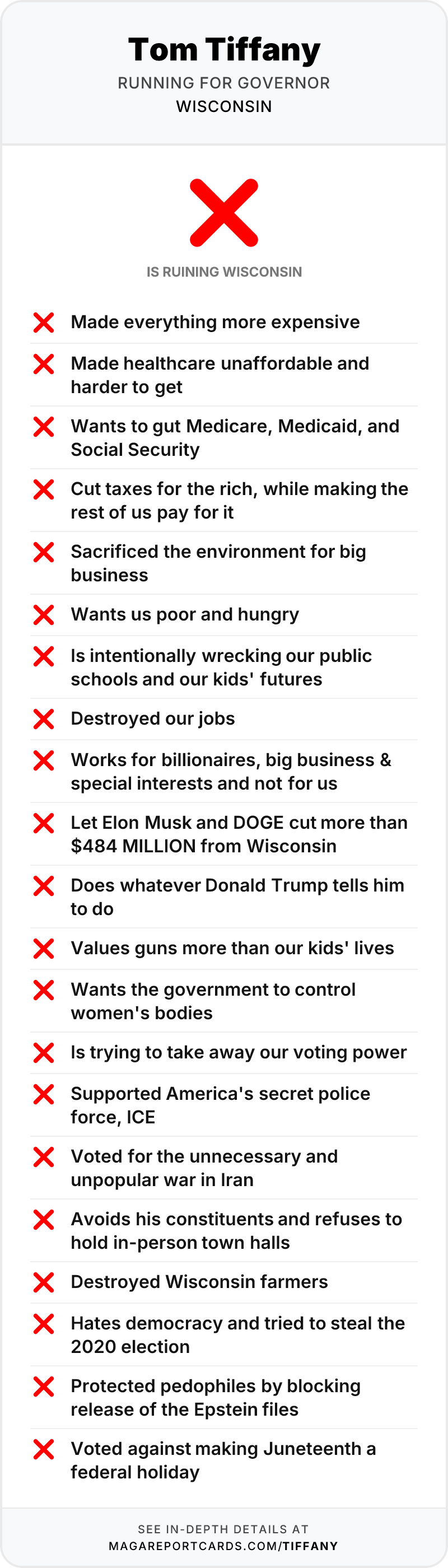
Tom Tiffany wants to be Wisconsin's next governor, and the story he tells about himself is that he grew up on a dairy farm and understands people who work for a living.
His voting record tells a different story. The Milwaukee Courier and Civic Media went back through fifteen years of it, and what they found is a straight line: from the law that gutted public unions in Wisconsin, to a bill he keeps signing that would do a version of it to every state in the country.
Act 10, and what it took out of a paycheck
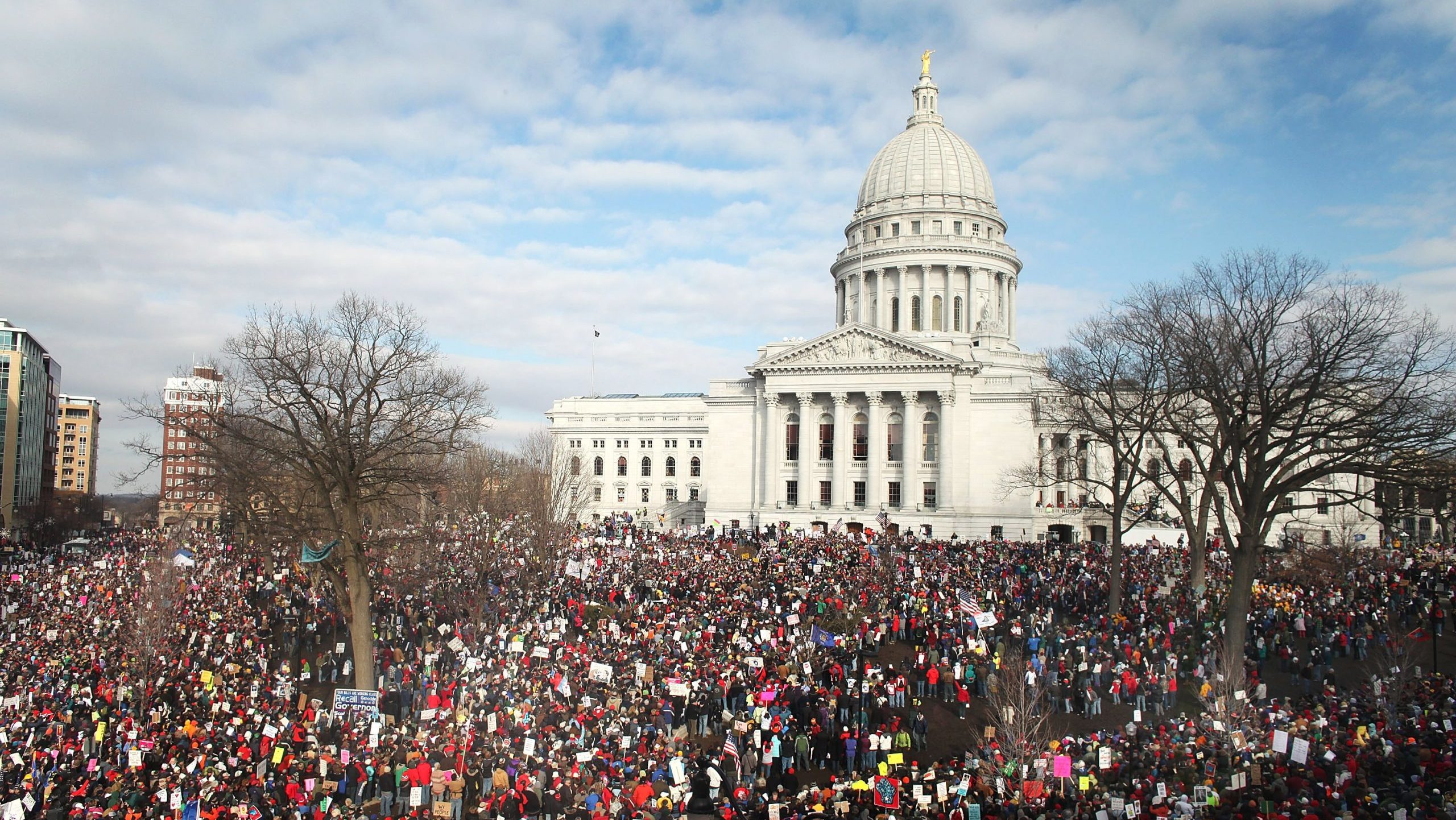
In 2011, Tiffany was a freshman in the state Assembly and a reliable ally of Governor Scott Walker. He voted for Act 10 — the law that stripped collective bargaining rights from public employees and brought as many as 100,000 people to the Capitol in weeks of protest.
The part that gets lost in the shouting is what it did to household budgets. The nonpartisan Legislative Fiscal Bureau analyzed it at the time: a public employee earning $50,000 a year saw take-home pay shrink by about 8.5%, because the law forced them to pay far more toward their own benefits.
That hit teachers, snowplow drivers, county clerks. Not a tax. A pay cut, written into law.
Then came the longer effect. Between 2010 and 2019, Wisconsin lost about 137,000 union members, according to the Bureau of Labor Statistics.
Tiffany does not regret it. He brags about it.
"I was in the state assembly at the time and I voted for it. Saved property taxpayers billions of dollars."
That was Tiffany in January, on a conservative talk show, attacking former Lt. Gov. Mandela Barnes for promising to restore bargaining rights.
The court said it was unconstitutional. He called the judge radical.
In 2024, a Dane County judge ruled Act 10 unconstitutional. The ruling is on appeal and the law stays fully in effect until the Wisconsin Supreme Court hears it.
Tiffany's response on X was not a legal argument:
"Today's Act 10 ruling is yet another example of judicial activism by a radical Dane County judge. The Left's relentless efforts to undermine Act 10 are nothing more than an attempt to raise your taxes and expand government control."
He has also said plainly he hopes the court leaves it alone. "There's no reason for them to overturn this," he said on another radio show in January, "and I hope they see the light of day in regards to this."
Then he tried to do it to the whole country
Act 10 hit public employees. The 2015 "right-to-work" law hit private ones — it banned requiring union dues at private businesses, and union strength across Wisconsin fell further.
Tiffany campaigned on that record when he ran for Congress in 2020:
"Thanks to my work with @ScottWalker, Wisconsin is a right-to-work state. Congress should support freedom for workers, not force them to be members of unions they don't want to join."
In Washington he went further. In 2021 he backed H. Res. 620, a resolution opposing any federal law that would override state right-to-work laws. And in three separate terms he has cosponsored the House bill to make right-to-work the law nationwide.
The current version is H.R. 1232, the National Right-to-Work Act, introduced in February 2025. By its own description, it repeals the parts of the National Labor Relations Act and the Railway Labor Act that let an employer and a union agree to require employees to join the union as a condition of employment. Tiffany is one of its cosponsors — 124 House Republicans signed on.
What right-to-work actually does to wages
Supporters call it worker freedom. The research says it's a pay cut.
An August 2014 study by researchers at the University of Illinois and the Illinois Economic Policy Institute found that, after controlling for other variables, right-to-work laws reduced workers' wages and salaries by 3.2% on average. The same study found the laws cut union membership by almost 10%, and reduced the share of workers with health insurance by 3.5% and with a pension by 3%.
Robin Clark-Bennett, director of the labor center at the University of Iowa College of Law, told Axios in 2022 that for decades the laws have been a way to depress union membership and pull resources away from bargaining.
There's also a simpler problem with the design: a worker can stop paying dues and still collect everything the union negotiates — the raises, the grievance process, the safety rules. Do that at scale and the union runs out of money to negotiate with. That's not an accident of the law. That's the mechanism.
The pattern
This is the same move we keep documenting from Tiffany. He runs as the plain-spoken guy from the farm while his actual votes go the other way.
He is currently attacking David Crowley as a friend of Big Tech — while the only registered lobbyist for Wisconsin's data center coalition gave his campaign $5,000. He voted for Trump's budget bill, and a year later Wisconsin's secretary of state put the cost at 270,000 Wisconsinites who stand to lose healthcare and tens of thousands who could lose food assistance.
Tiffany's campaign did not respond to the Courier's request for comment. Wisconsin's major labor unions have endorsed Crowley.
Election Day is November 3.
Source
From Wisconsin to D.C., Tiffany has pushed the anti-union agenda from the start — Civic Media / Milwaukee Courier, August 21, 2026.