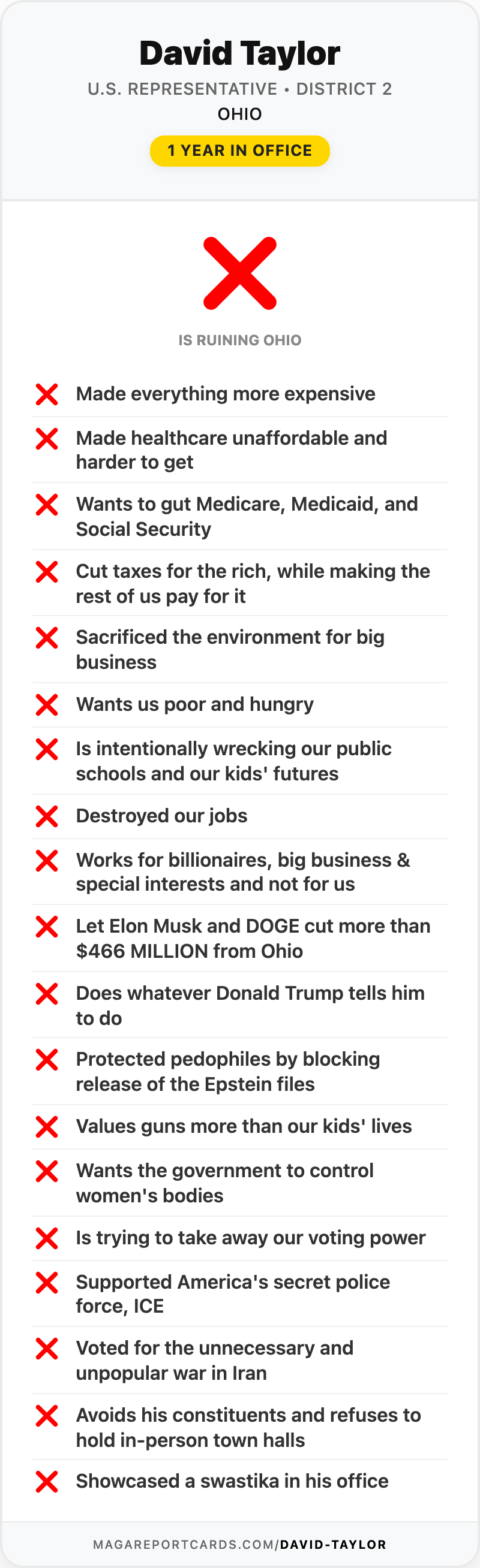
On August 12, 2025, seven months into his first term, David Taylor introduced a bill that would create a new federal crime.
The crime is driving.
H.R. 4964, which Taylor named the Child Interstate Abortion Notification Act, adds two new chapters to the federal criminal code. Here is what it says, in the bill's own words:
"Whoever knowingly transports a minor across a State line, with the intent that such minor obtain an abortion, and thereby in fact abridges the right of a parent under a law requiring parental involvement in a minor's abortion decision, in force in the State where the minor resides, shall be fined under this title or imprisoned not more than one year, or both."
Ohio's 2nd District sent a freshman to Congress. This is what he did with the seat.
Who actually goes to prison under this bill
Read the exceptions and the shape of the thing becomes clear.
The bill specifically says the pregnant girl herself cannot be prosecuted. It also says her parents cannot be prosecuted — unless the parent is the one who committed incest with her, which the bill makes a separate crime in its next section. So the person facing a federal charge is whoever else helped her get in the car — an aunt, a grandmother, an older sister, a friend's mother, a teacher, a clinic volunteer.
The only exception to the transport offense is if the abortion "was necessary to save the life of the minor because her life was endangered by a physical disorder, physical injury, or physical illness, including a life endangering physical condition caused by or arising from the pregnancy itself."
That's it. There is no exception for rape. There is no exception for incest.
There are two affirmative defenses, and both require paperwork most people helping a frightened teenager would never have. You can defend yourself if you got assurance directly from one of her parents that the required consent or notice already happened — or if you were handed documentation showing a court in her home state waived it.
In other words: get a signature from the parent she is afraid of, or produce a court order, or risk a year in prison.
The bill quietly protects the wrong people
There is a detail in the text that deserves more attention than it has gotten.
The bill lets "any parent who suffers harm" from a violation file a civil lawsuit against the person who drove. The single carve-out is that a parent may not sue if "the parent has committed an act of incest with the minor."
So Congress thought about abusive parents, and every time it did, it wrote incest and stopped there. The civil suit is barred only for a parent who committed incest. The separate crime the bill creates in its next section is for a person who committed incest and then drove the child across the line himself. A father who beats his daughter, throws her out, or has told her she'd be dead to him is none of those things — he can still sue the aunt who helped her. And nothing in the transport offense itself softens for a girl who was raped by anyone other than her own parent.
Ohio has already been here
Ohio law requires a parent's written consent, or a court order, before an unemancipated minor can get an abortion. Under Taylor's bill, that Ohio requirement would follow an Ohio girl across every state line in the country, enforced by federal prosecutors.
Ohio has already sent a child across that line.
On June 30, 2022, a 10-year-old girl from Columbus traveled to Indianapolis to end a pregnancy caused by rape. She was six weeks and three days pregnant — days past Ohio's limit at the time. Her case became national news, Ohio's attorney general said there wasn't a "whisper anywhere" of it, and then Columbus police arrested a 27-year-old man who confessed to raping her at least twice.
A 10-year-old cannot drive herself to Indianapolis. Her mother took her. It was her mother who had reported the rape to Franklin County's Children Services, which referred it to Columbus police on June 22, and her mother who traveled across the state line with her to see the doctor.
That is the one fact that would have kept this case out of Taylor's bill. H.R. 4964 says a minor "and any parent of that minor, may not be prosecuted or sued." A parent drove, so under the bill nobody goes to prison.
Which is the whole point of what the bill actually does. It is not written for the child whose mother believes her, reports the rape and gets in the car. It is written for the one whose mother doesn't — and it turns the aunt, the grandmother, the older sister or the teacher who drives instead into a federal defendant, facing up to a year in prison unless she can produce that same mother's consent or a judge's waiver from Ohio first. That the girl is ten and has been raped would not, by the text of Taylor's bill, matter.
What the research says about these laws
Taylor's press release frames the bill as protecting children from "coercion from oppressors trying to evade accountability from parents and the law."
The people who study these laws describe something close to the opposite. In October 2025, Human Rights Watch and If/When/How published a report on state parental-notification laws and judicial bypass. Its findings:
- Notification works like consent in practice. Providers and advocates told researchers that when a parent can withhold money, restrict a young person's movement, or cut off access to transportation, that parent effectively holds a veto whether the statute says "consent" or only "notify."
- The requirements deter young people from seeking care at all — in one case, clinic staff believed a young person was so frightened by parental involvement that she "may have remained pregnant against her wishes."
- Judicial bypass, the supposed safety valve, means a teenager standing in a courthouse explaining herself to a judge. The report describes a young survivor of sexual violence "forced to relive the trauma of her ordeal — the sexual violence, her mother's lack of support — before a judge."
- Bypass delays care, often by a week or more. In some cases the delay leaves a young person ineligible for medication abortion, and pushes her into multiple appointments on consecutive days at higher cost.
Taylor's bill takes that system and adds a federal prison sentence for the person who helps.
Ohio voters said the opposite
In November 2023, Ohioans wrote reproductive rights into their state constitution. Issue 1 passed with 56.8% of the vote — 2,227,384 people — enshrining a right to abortion, contraception, miscarriage care and fertility treatment.
Fourteen months later, Ohio's newest congressman went to Washington and wrote a bill to add a federal crime to the abortion statute books.
He is not alone in the direction he's pushing. We've written about the growing part of the right that wants to prosecute women themselves. Taylor's bill doesn't go that far — it explicitly exempts the girl. It goes after everyone standing between her and a parent she may have very good reasons to fear.
Where the bill stands
H.R. 4964 was referred to the House Judiciary Committee. Taylor introduced it with twelve cosponsors, including Andrew Clyde, Doug LaMalfa, Jodey Arrington, Robert Aderholt, Mary Miller, Ron Estes, Russ Fulcher, Jake Ellzey, Christopher Smith and Sheri Biggs.
On January 15, 2026, it picked up a Senate companion from Sen. Ashley Moody of Florida, joined by Sens. Bill Cassidy, Kevin Cramer, Jim Risch, Steve Daines, John Kennedy, Deb Fischer, James Lankford and Pete Ricketts. Susan B. Anthony Pro-Life America, March for Life, the National Right to Life Committee and Americans United for Life have all backed it.
The bottom line
Taylor says no one should be taking children across state lines "to receive secret abortions behind the backs of that child's parents."
But his bill doesn't distinguish between a stranger and a grandmother. It doesn't distinguish between a girl keeping a secret and a girl escaping a house where telling the truth isn't safe. The only abusive parent it names anywhere is one who committed incest, and it treats a year in federal prison as the right tool for a family emergency.
Taylor spent his first year in Congress in the top 8% of all members for stock trading and writing this.
Source
- H.R. 4964 — Child Interstate Abortion Notification Act, 119th Congress — full bill text as introduced, August 12, 2025
- Congressman Taylor introduces pro-family bill upholding parental rights — The Highland County Press
- Whose Abortion Is It? The Harms of State-Mandated Parental Notification for Abortion and Judicial Bypass in the United States — Human Rights Watch and If/When/How, October 29, 2025