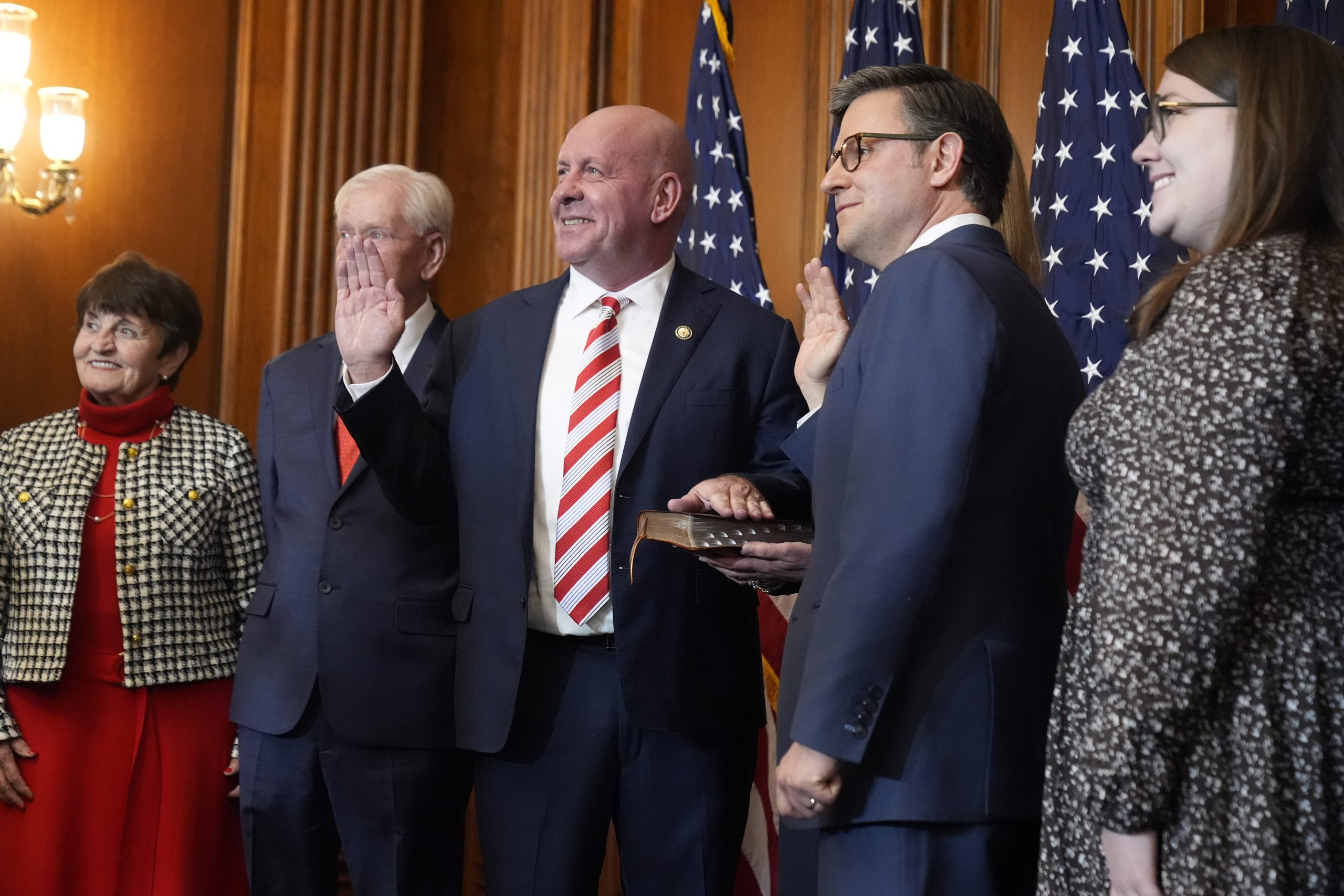
Within a month of being sworn in, David Taylor sold shares of Visa and JPMorgan Chase.
He was just getting started. In his first 14 months representing Ohio's 2nd District, the freshman Republican executed 132 more stock trades of $1,000 or more, according to the trading disclosures federal lawmakers are required to file. Signal Statewide's Jake Zuckerman went through them in March 2026 and found something remarkable for a member barely a year into the job.
Across the House and Senate, Taylor is the 43rd biggest trader by volume since he was sworn in, according to Capitol Trades. That is roughly the top 8% of Congress.
In 2025 he traded more than anyone else in Ohio's congressional delegation except one — a Democrat who has since announced he's selling off his individual stocks and backing a ban on the practice.
What he's been buying and selling
By the middle of March 2026 he had already made 59 trades that year, with a total volume somewhere between about $100,000 and $1 million. (Members disclose only a broad dollar range, so the public never learns the exact figure.) Most individual trades were between $1,000 and $15,000.
The list spans tech, transportation, health care and utilities: Apple, Alphabet, Amazon, Broadcom, IBM, Microsoft and Salesforce. It includes a set of Ohio companies — American Electric Power, Procter & Gamble, Kroger, Marathon Petroleum and RPM International.
And it includes two names that ought to give a constituent pause.
The companies with business before his own committee
Taylor sits on the House Transportation and Infrastructure Committee. He is Vice Chairman of its Water Resources and Environment Subcommittee, and also serves on the Highways and Transit Subcommittee and the Railroads, Pipelines, and Hazardous Materials Subcommittee.
Among the stocks he has been buying and selling are Parker Hannifin and Eaton Corp — companies with business before that very transportation panel.
He also sits on the Agriculture Committee's Commodity Markets, Digital Assets, and Rural Development Subcommittee, the panel writing the rules for cryptocurrency.
To be clear about what is and isn't being alleged: Taylor disclosed these trades. Nobody has accused him of breaking the Stop Trading on Congressional Knowledge Act — the 2012 law that bars lawmakers from trading on material, non-public information and requires them to report most trades.
That is exactly the problem. The floor is very low. We've documented 45 Republicans on this site who couldn't even clear it — members late by months and years on hundreds of trades. Taylor's reports mostly arrive within a few weeks, though his very first one, covering those January 30, 2025 sales, did not reach the Clerk until April 3 — 63 days later, past the law's 45-day limit. Clearing that bar is not the point. He is still a sitting congressman personally buying and selling shares in companies whose fortunes his committee votes can move.
The question he wouldn't answer
Signal Statewide called and emailed Taylor's office. They asked two things: about his trading activity, and whether he would support a proposal to prohibit members of Congress from buying or selling individual stocks.
He didn't respond to either.
Compare that to the other big trader in Ohio's delegation. Rep. Greg Landsman, a Cincinnati Democrat whose district adjoins Taylor's, faced his own criticism over belatedly disclosed trades — and responded by announcing he would sell off his individual holdings and move the money into mutual funds he doesn't directly control. He also came out for banning congressional stock trading outright.
"Some lawmakers have used insider information to gain financially and have been convicted in the past," Landsman wrote in an op-ed. "It's wrong, and with reforms, we can fix this and begin to rebuild trust."
That is what it looks like when a member takes the criticism seriously. Taylor's answer was silence.
He is not a man who needs the money
This isn't a story about a public servant scraping by.
Before Congress, Taylor worked as a prosecutor in Clermont County and then went to work for his family's business, Sardinia Ready Mix. His financial disclosure values that business at between $5 million and $25 million, and shows it paid him at least $1 million in income before he took office.
Look at what he does in Washington alongside that. He sits on the Highways and Transit Subcommittee, which handles federal road money. He co-chairs the Congressional Trucking Caucus. He belongs to the Congressional Aggregates Caucus — aggregates being the crushed stone, sand and gravel that ready-mix concrete is made of.
And his donor list matches. CRH, the road-building materials giant, gives to him, as do people at Total Quality Logistics, the Ohio freight brokerage — both industries before the Transportation Committee where he vice-chairs a subcommittee. Almost none of his money comes from ordinary people: he ranks #415 out of 440 House members in grassroots funding, near the very bottom of the chamber.
What Ohio's 2nd District gets instead
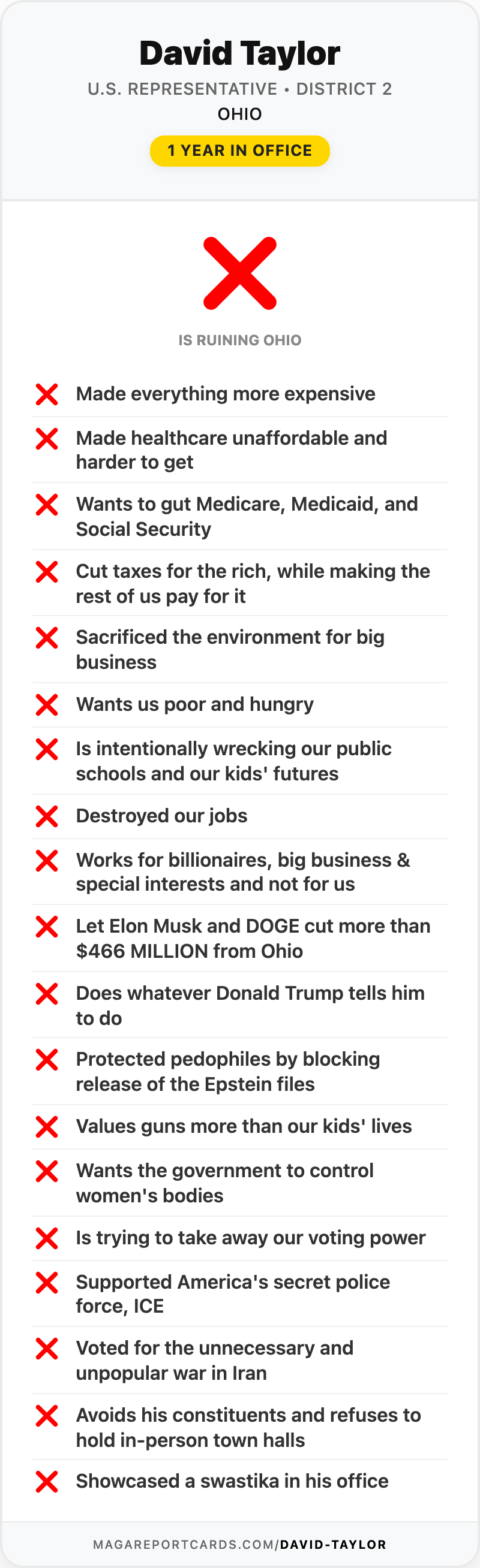
Taylor's district stretches across southern Ohio from Cincinnati to Marietta. In his first year he compiled a voting record that makes his constituents' lives harder, and his office spent months refusing to explain how a swastika-defaced American flag ended up hanging on its wall.
Now add this: while people in his district were absorbing higher health premiums and food-assistance cuts, their first-term congressman was in the top 8% of Congress for stock trading.
The bottom line
There is a simple fix, and Congress keeps refusing to pass it: members of Congress shouldn't own and trade individual stocks. They vote on laws that move share prices. They sit in briefings the public doesn't get. Even when every rule is followed, nobody outside can tell the difference between good timing and good information — and that uncertainty is corrosive on its own.
David Taylor was given a chance to say where he stands on that. He said nothing, and kept trading.
Source
- Freshman Ohio Republican emerges as one of the biggest stock traders in Congress — Jake Zuckerman, Signal Statewide, March 19, 2026. Photo: Mark Schiefelbein/AP.