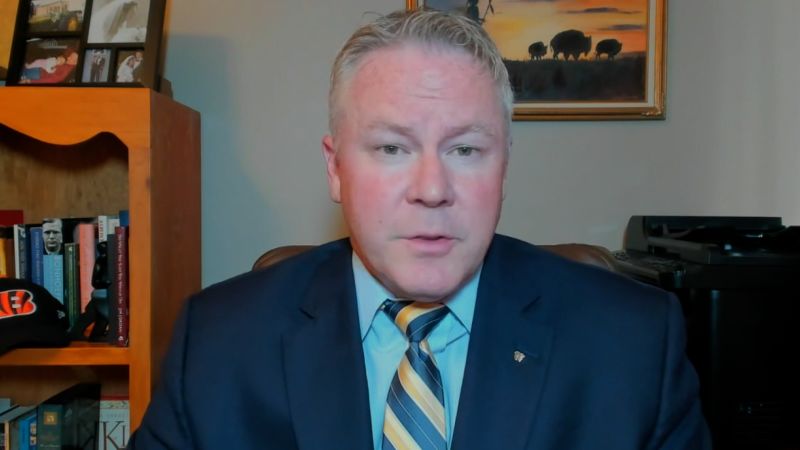
Two days after the Supreme Court overturned Roe v. Wade, CNN's Pamela Brown asked Warren Davidson a direct question about the law that had just taken effect in his state.
Ohio's "Heartbeat Bill" banned abortion at about six weeks — sometimes before a woman knows she's pregnant — with no exception for rape or incest. Brown asked what that means in practice:
"So my question to you is, what happens when a 12-year-old girl falls pregnant after being raped? Are you OK with her being forced to carry that fetus to term?"
Here is what Davidson said, from CNN's transcript of the June 26, 2022 broadcast:
"Well, under Ohio's law, you know, it doesn't ban things like abortifacient. So let's say someone who is raped, you don't know you were raped for two months?"
Brown pressed him again. He answered again:
"I fully support Ohio's law... I think it's a great law and it is a compromise. And like I say, rape is raised as an objection but the Heartbeat Bill already deals with that. I mean, anyone -- it's hard to conceive of somebody who doesn't know they were raped for two months."
You can watch the exchange.
The Ohio law he called great
Davidson's answer rested on a claim about the law: that it "already deals with" rape.
It doesn't. PolitiFact went through the statute and found the exceptions cover exactly one thing — a medical emergency. Abortion is permitted to "prevent the death of the pregnant woman or to prevent a serious risk of the substantial and irreversible impairment of a major bodily function." As PolitiFact put it flatly: "The law does not provide an exception for rape or incest."
His fallback wasn't a legal exception at all. It was that the law "doesn't ban things like abortifacient" — and an assumption about victims: that anyone who had been raped would know it, and act, long before two months had passed.
Four days later
On June 30, 2022 — four days after that interview — a 10-year-old girl from Columbus traveled to Indianapolis to end a pregnancy caused by rape. TIME reported that she was "nearly six-and-a-half weeks pregnant." The case had been reported to Columbus police on June 22.
She was past Ohio's line. Not by weeks. By days.
When the story surfaced, Ohio's attorney general, Dave Yost, said there wasn't a "whisper anywhere" of such a case, and the Wall Street Journal's editorial page cast doubt that the girl existed at all. Then Columbus police arrested a 27-year-old man who confessed to raping her at least twice.
Legal experts who looked at whether she could have gotten the abortion in Ohio told PolitiFact the answer was murky at best. One said plainly: "It is not clear by any means that a 10-year-old rape victim would be permitted to have an abortion if the child became pregnant and six weeks elapsed." Another pointed out that a doctor facing felony charges is not going to gamble on ambiguous statutory language — "legal plausibility is a dangerous zone to practice medicine when you're staring down the serious consequences of the law."
A 10-year-old child. Six-and-a-half weeks. The rest of her life, decided by a sentence Davidson called "a great law."
The other thing he said in that interview
Brown moved on to Ohio's infant and maternal mortality rankings, and asked what he'd do to protect the women and babies the ban would affect.
Davidson's answer identified the problem correctly:
"Ohio unfortunately we have over half of the live births in Ohio are on Medicaid. So we have a really disproportionate amount of our families that are growing are low-income families and I think that overwhelmingly accounts for, you know, the loss of life in labor and delivery."
He named Medicaid as the program paying for most of Ohio's births. Then he offered his own office's casework as the safety net — and added: "We haven't had any."
Three years later, he voted to cut it.
On May 22, 2025, Davidson voted no on Trump's budget bill, which passed the House 215–214. He said he was worried about the deficit. On July 3, 2025, when the same bill came back from the Senate, he voted yes and it passed 218–214.
That bill takes an estimated $33 billion in federal Medicaid funds out of Ohio over the next decade, and its Medicaid work requirements could cost as many as 356,000 Ohioans their health coverage by 2028. In a state where more than half of births are covered by Medicaid — his number, not ours — that is money coming out of labor and delivery.
Force the pregnancy, then cut the program that pays for it. We've laid out what the rest of that bill costs Ohio.
Ohio answered him
Sixteen months after that interview, Ohioans got to vote on it directly.
On November 7, 2023, they passed Issue 1, a constitutional amendment protecting the right to abortion, 56.8% to 43.2% in the certified count. It bars the state from banning abortion before viability. The six-week law Davidson called "a great law" — the one with no rape exception, the one a 10-year-old fell outside of by days — is unconstitutional in Ohio now because Ohio voters said so.
A margin of more than 13 points, in a state that has otherwise gone hard the other way. On this one, Ohio was not with him.
What this was really about
There is a version of the anti-abortion argument that at least reckons with the hard cases. Davidson didn't take it. Asked about a raped 12-year-old, he questioned the premise — you don't know you were raped for two months? — and then called the law that would trap her great.
Four days later, the case arrived. It was a 10-year-old, and Ohio couldn't help her.
We deserve better.
Source
Rep. Warren Davidson interviewed by Pamela Brown, CNN Newsroom, June 26, 2022 (CNN rush transcript; video clip here). Photo: CNN.