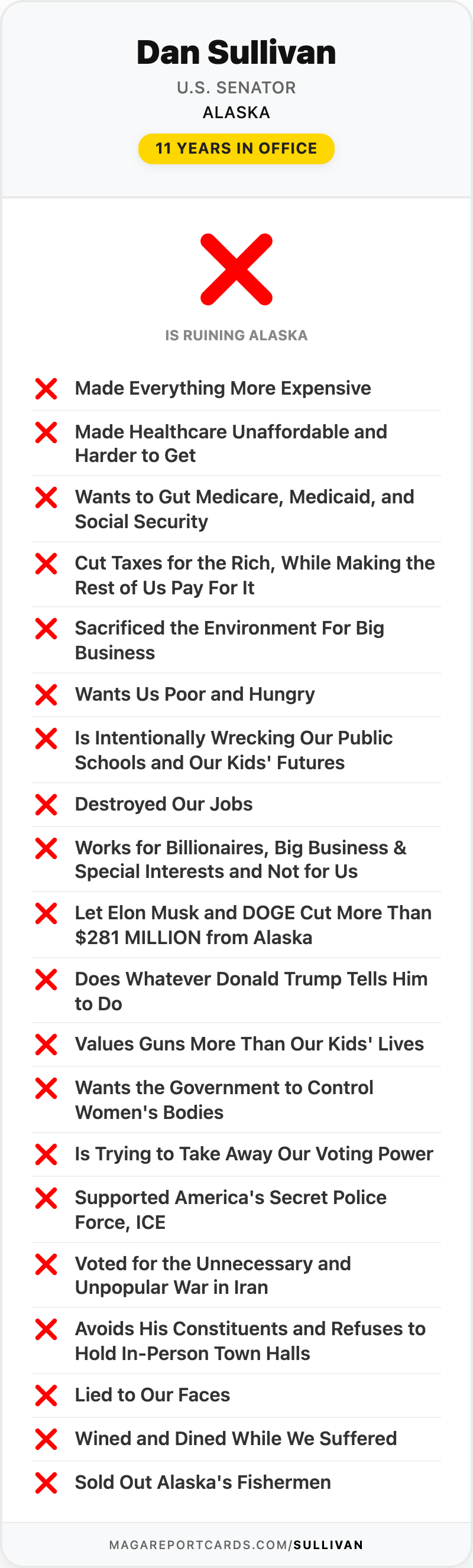
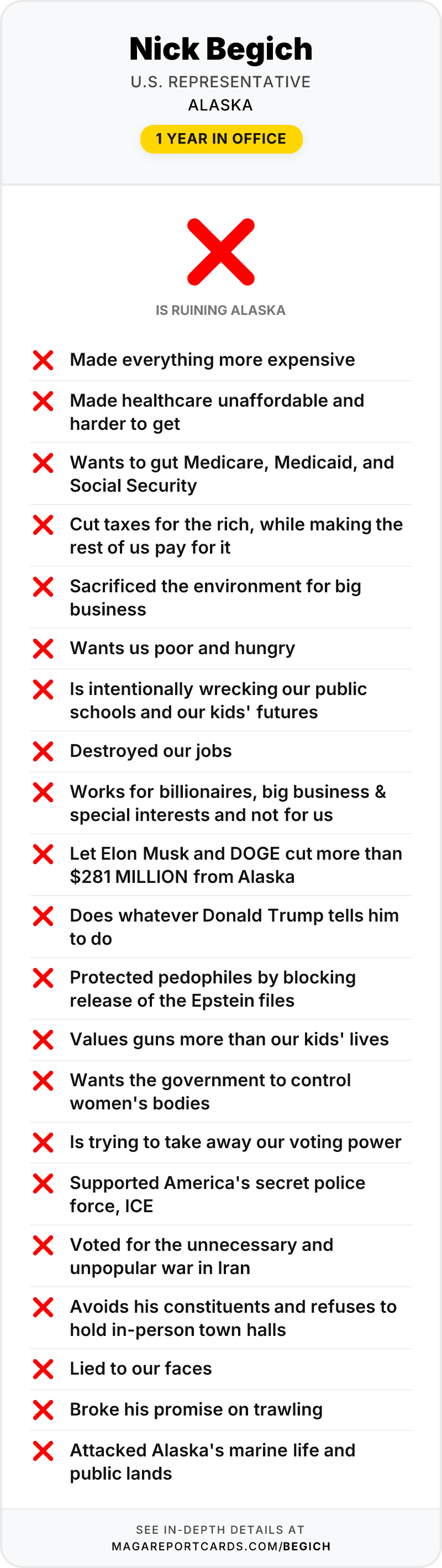
Alaska's two Republicans on the ballot had the same message this week: the Iran war is worth it.
On Tuesday, October 13, President Trump held a rally in Wasilla for Dan Sullivan. The Alaska Beacon reported that Trump and Sullivan both told the crowd the war was worth what it is costing Americans at the pump and the grocery store. Trump put it plainly:
"No matter what it is, it's a small price to pay for stopping them from having a nuclear weapon."
The next day in Anchorage, Nick Begich stood on a debate stage and defended the same war. His opponent, independent Bill Hill, said heating fuel costs more than $15 a gallon in some villages and asked, "How are people going to survive?" Begich said the war is necessary to deal with "a regime that chants 'death to America' in their halls of government," according to the Anchorage Daily News.
Both of their answers on cost came back to more oil and gas production.
What the war is costing Alaska
Trump started the war alongside Israel on February 28. Fuel prices have climbed in Alaska and across the country since then.
According to the latest state report cited by the Beacon, heating fuel in rural Alaska averaged $8 a gallon by August, up from $6.49 in January. That is the fuel that heats homes through an Alaska winter, and winter is coming.
It isn't just fuel. Consumer prices rose 3.7% over the past year as of September, up from August, the Beacon reported. Moody's chief economist Mark Zandi has put the war's cost to the average American household at about $1,200 over its first six months. And Congress's own budget office has said the war had already cost $38 billion by September.
Trump told the Wasilla crowd "we're very close to winning" and that "your prices are going to come tumbling down. They already are." The Beacon checked: national and state data have shown no significant drop in fuel prices over the past month.
Sullivan: the war is "temporary"
Sullivan's answer to high fuel prices at the rally was to change the subject to oil drilling.
"Ladies and gentlemen, the conflict in the Middle East is temporary. The true forever war is the national Democrats' war against Alaska oil and gas and our jobs. That's the forever war."
The conflict he calls "temporary" has run almost eight months. Sullivan has had plenty of chances to end it. The Beacon reports he has voted 14 times against War Powers resolutions that could limit or end U.S. involvement.
One of those votes decided the outcome. On September 24, the House had already passed a resolution ordering U.S. forces out of the war, and the Senate killed it 49 to 50. Sullivan voted no. Any single Republican who switched would have changed the result.
This also isn't the Sullivan Alaskans used to hear. Back in 2017, when Trump threatened North Korea, Sullivan said a war the president started first would need Congress's approval. We laid out that reversal here.
Begich: six votes, six times no
Begich has had six chances in the House to vote to end the war or rein it in. He voted no every time:
- March 5, H.Con.Res. 38 — failed 212–219. Begich: Nay.
- April 16, H.Con.Res. 40 — failed by one vote, 213–214. Begich: Nay.
- May 14, H.Con.Res. 75 — deadlocked 212–212. Begich: Nay.
- June 3, H.Con.Res. 86 — passed 215–208. Begich: Nay.
- July 23, H.Con.Res. 89 — passed 214–208. Begich: Nay.
- September 15, H.Con.Res. 93 — passed 220–204. Begich: Nay.
The April and May votes failed by a single vote. Begich's vote alone could have flipped either one. We covered how close those came.
At the debate, Begich said his plan for lowering costs is "more energy." That's a promise about oil that hasn't been drilled yet. The war he keeps voting for is raising Alaskans' bills right now.
In summary
At Trump's Wasilla rally for Dan Sullivan on October 13, the president called the war's costs "a small price to pay," and Sullivan called the war "temporary." The next day Nick Begich defended it on a debate stage. Sullivan has voted 14 times against War Powers resolutions, including the 49–50 Senate vote that killed the House's order to end the war. Begich voted no on all six House resolutions, two of which failed by a single vote. Rural Alaska heating fuel went from $6.49 to $8 a gallon between January and August.