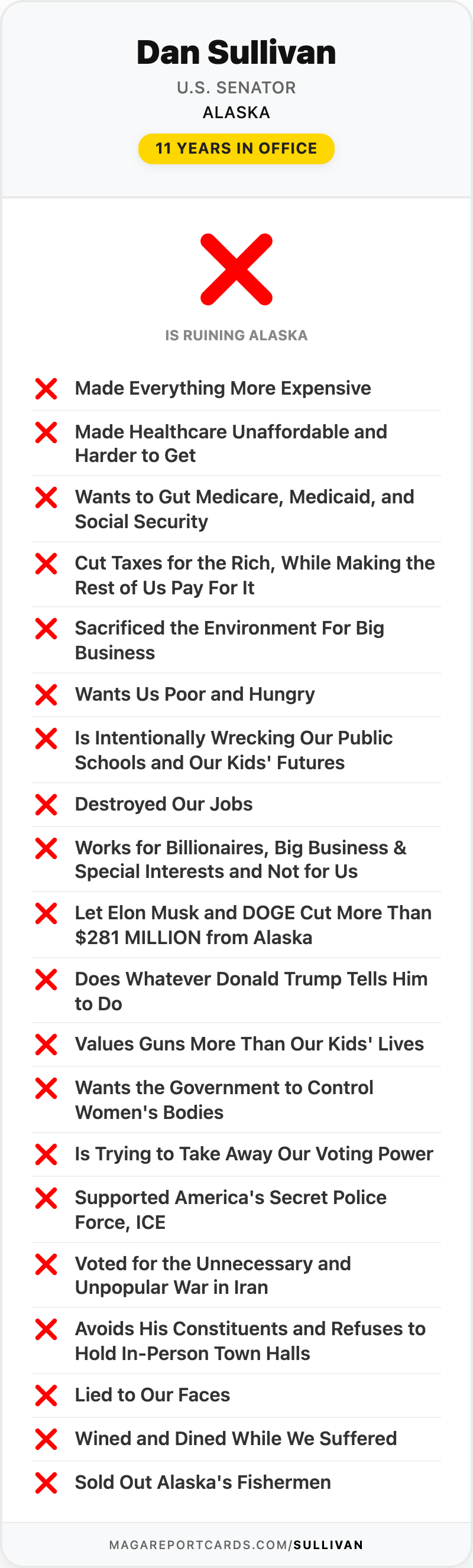
On September 24, 2026, the Senate had a chance to end the war with Iran. A resolution the House had already passed failed 49 to 50. Dan Sullivan voted no — and any one of the Republicans who voted no could have changed the result.
That wasn't a one-off. Alaska journalist Dermot Cole counts 14 votes Sullivan has now cast to keep the war going. He has argued that Congress simply has no business stepping in. But nine years ago, when a different war was on the table, Sullivan said the opposite.
What Sullivan said in 2017
In August 2017, President Trump threatened North Korea with "fire and fury." Sullivan called in to CNN's Out Front and told Erin Burnett that if the president started a war first, Congress had to approve it:
"If one of the options that they're looking at that would eventually materialize is a preemptive war on the Korean peninsula launched by the U.S., that would clearly, in my view, require the authorization from Congress. Article I makes this very clear."
Article I is the part of the Constitution that gives Congress — not the president — the power to declare war. Sullivan sat on the Armed Services Committee then, as he does now. He drew a clear line: a president can respond to an attack on his own, but starting a war takes a vote of Congress.
What Sullivan says now
Trump's war with Iran was never authorized by Congress. A 1973 law, the War Powers Resolution, says that once a president has been at war for 60 days, the fighting has to be approved by Congress. That deadline passed months ago.
Sullivan's answer has been that Congress shouldn't act while troops are in the fight. After one of his votes, Cole reported, Sullivan told reporters: "A war powers vote is about removing American forces from a region. And when there are troops in contact, I don't believe in doing that." In the spring, he said: "We've got troops in combat. We've got what I'm calling a freedom of navigation operation going on right now, which is dangerous."
That's a reason that can never run out. As long as the war goes on, there are troops in contact — so, by Sullivan's logic, Congress never gets to end it. Cole reports that Sullivan has also sided with Trump's claim that the War Powers Act itself is unconstitutional.
Nothing in Sullivan's 2017 standard said "unless troops are already there." It said starting a war requires Congress. Congress never voted to start this one.
Even Alaska's other Republican senator disagrees
Cole reports that Sen. Lisa Murkowski, along with Sullivan's Democratic challenger Mary Peltola, say Congress has to approve continuing the war. "I do not believe that any President should be making these kinds of substantive decisions unilaterally," Peltola said earlier this year.
He was one of 14
Sullivan wasn't alone on September 24. Thirteen other Republican senators we track also voted no. In July, when the Senate came one vote short of even debating the war, he voted no then too. But Sullivan is the one on the record in 2017 explaining, clearly, why a president can't do this on his own.
What the record shows
In 2017, Dan Sullivan said a first-strike war launched by the United States "would clearly, in my view, require the authorization from Congress. Article I makes this very clear." Congress never authorized Trump's war with Iran. Sullivan has voted repeatedly against resolutions to end it — 14 times by Dermot Cole's count — including the September 24 vote that failed 49 to 50.
Source
Sullivan calls for Iran war to continue for as long as Trump desires — Reporting From Alaska, September 27, 2026.