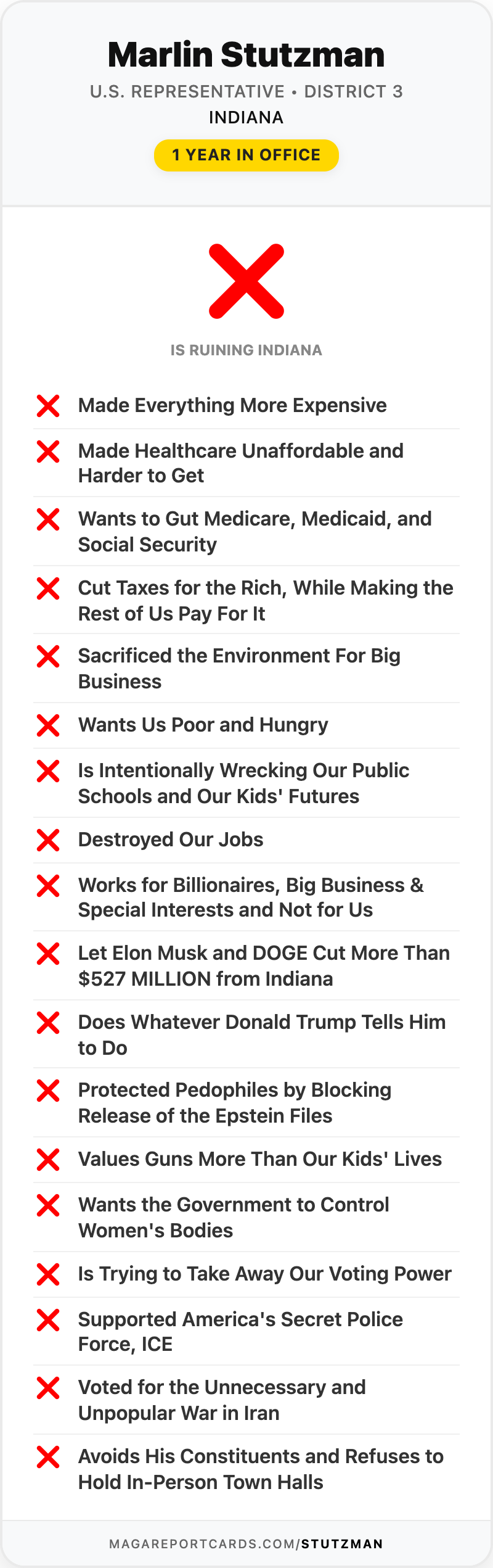
On September 1, a federal official inside the U.S. Postal Service told Congress that the system the agency was rushing to switch on that very day — the one that has to clear your mail ballot before it gets delivered — was built so badly it could "derail the midterm elections."
That evening, Marlin Stutzman went on CNN and said he agrees with the plan.
What the whistleblower said
The disclosure, released by Senator Richard Blumenthal of Connecticut, describes an agency that "discarded all best practices" racing to meet a September 1 deadline. Postal Service IT teams would get less than a week to test the finished system. "For a system that manages something as important as handling voting and ballots, four days of user testing is entirely unreasonable," the whistleblower wrote. Some officials inside the agency reportedly called the process a "shit show."
The mechanics are the part that should worry anyone who votes by mail. Under the rule, when election officials bring a batch of ballots to the post office, the envelopes get scanned against a federal portal. If a single envelope in the batch doesn't match, the Postal Service refuses to deliver the whole batch while the discrepancy gets sorted out.
North Carolina begins mailing ballots on Friday, September 4. Other states follow this month. Courts are still fighting over whether the rule is even legal.
What Stutzman said about it
CNN's Phil Mattingly asked Stutzman for his reaction. Stutzman's answer never engaged with the whistleblower's warning:
"We want to make sure that the voter rolls match up with those ballots that are coming in through the U.S. Postal Service. And there has to be accountability there."
He then reached for a number: that in Pennsylvania, New Jersey, California, and Nevada, "250,000 names were on the voter rolls that should not have been."
Mattingly pushed back. Officials at the Department of Homeland Security, he said, had privately told state officials that the Nevada figure was off dramatically — they had confirmed only about 600 of the names on Nevada's list. Why, he asked, should anyone believe a number published with no methodology behind it?
Stutzman did not withdraw it. "Well, there should be follow up," he said. "Let's be sure that we know for sure that the voter rolls are as clean as possible."
The claim at the center of it
Mattingly pressed him on the practical risk to his own constituents: a voter does everything right, one barcode in the batch doesn't match, the clerk has to haul the ballots back and resubmit them, and Indiana gives no grace period for late-arriving ballots.
Stutzman said he wanted those ballots counted. Then he said this:
"I understand and I agree with the decision that the President made regarding the matching of the names on voter rolls and the USPS, because that's where most of the fraud takes place."
That last clause is the whole argument, and it is not true. CNN's own framing of the segment stated the plain finding: experts say there is no evidence that widespread voter fraud has occurred in recent elections.
Stutzman offered no source for "most of the fraud." He offered a memory instead: his son, voting for the first time in 2024, had to cast a provisional ballot because the address on his driver's license didn't match his registration. That is a story about a young man being made to jump an extra hurdle. Stutzman told it in defense of adding more hurdles.
Indiana is not the problem he says it is
Mattingly made a point worth repeating, because it undercuts the whole appearance. Indiana already does everything the administration says it wants: you need an excuse to vote by mail, you need to apply, and you need to supply an ID number. Indiana is not the target of the new rule. Its voters get nothing out of it.
What they can get is the failure mode — a clerk's batch bounced back over one mismatch, close to a deadline with no grace period, in a state that counts nothing that arrives late.
Stutzman's answer to that was to pitch legislation. He named the SAVE America Act, which would require people to show documentary proof of citizenship — a passport, a birth certificate — to register to vote in federal elections. He allowed that it might not be in place for this election.
He is already on that bill. Chip Roy introduced it on January 30, 2026, Stutzman cosponsored it ten days later, and it has sat in the House Administration committee ever since. He had already voted for its predecessor, the SAVE Act, on April 10, 2025, when the House passed it 220-208. Voting-rights groups have warned for two years that the documents it requires are exactly the ones millions of married women, older Americans, and rural voters do not have on hand — a problem we have written about again and again.
What was actually asked, and what he actually answered
Strip the interview down and the shape is clear. He was asked about a whistleblower's specific, mechanical warning that whole batches of ballots could be refused. He answered with voter rolls. He was told his headline number had been walked back by the administration's own officials. He said there should be follow-up. He was asked whether his own constituents might lose their votes. He said mail ballots are where most of the fraud takes place.
What the record shows
Hours after a federal whistleblower told Congress the new Postal Service ballot system could derail the midterms and reject entire batches of ballots over one mismatched scan, Marlin Stutzman went on national television and endorsed it, telling viewers mail ballots are "where most of the fraud takes place" — a claim experts and CNN's own reporting say the evidence does not support. Told on air that the government had confirmed only about 600 of the names behind his 250,000 figure, he did not withdraw it.
Source
"Rep. Marlin Stutzman (R-IN), Is Interviewed About USPS Whistleblower: New Ballot System Could Fail, Hamper Midterms", The Lead, CNN, September 1, 2026.