Bayer has paid roughly $11 billion to about 100,000 people who say Roundup gave them cancer. At least 63,000 more lawsuits are still pending. For years the company has been trying to get Congress to make the whole problem go away with one paragraph of legislative text.
In the summer of 2025, that paragraph turned up in a spending bill. It was called Section 453, and the bill it was buried in belonged to Mike Simpson.
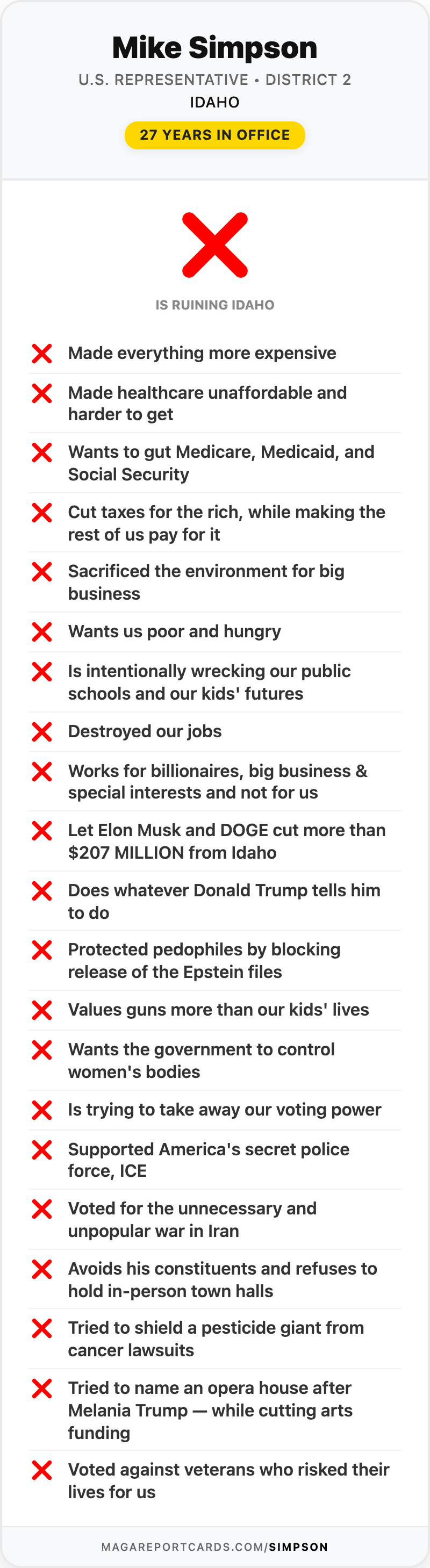
Simpson, who has represented Idaho's 2nd District since 1999, chairs the House Appropriations Subcommittee on Interior, Environment and Related Agencies. He is the person who writes the first draft of the bill that funds the EPA, the Park Service, and the agencies that decide what warning goes on a bottle of weed killer. He isn't a backbencher voting on someone else's language. He holds the pen.
What Section 453 did
The rider was short and its effect was enormous.
In plain terms, as its critics described it: if the EPA's approved label for a pesticide doesn't say the chemical causes cancer, then state and local governments couldn't require a different warning — and a person who got sick would find it difficult, if not impossible, to sue the manufacturer for failing to warn them.
That is the whole ballgame in the Roundup litigation. Juries have been finding Bayer liable precisely on failure-to-warn claims. The EPA does not classify glyphosate, Roundup's active ingredient, as a carcinogen; the World Health Organization's cancer agency reached a different conclusion in 2015, calling it "probably carcinogenic to humans." Section 453 would have made the EPA's label the last word.
The rider went further than warnings, too. As The New Lede reported, critics warned that the EPA itself could not update a warning without finalizing a whole new assessment first — a process that takes years and, as Rep. Chellie Pingree put it, is "often subject to intense industry pressure."
Bayer is not the only beneficiary. Syngenta is being sued by thousands of Americans who say its paraquat weed killer gave them Parkinson's disease. The same shield would have covered them.
He told the "MAHA moms" they didn't understand
When Pingree — the ranking Democrat on Simpson's own subcommittee — moved to strike the rider in committee in July 2025, Simpson spoke against her amendment and defended it.
He argued the rider would have a very limited impact and merely dealt with the "interstate commerce" part of labeling, and that it wouldn't stop a state from barring a chemical from being sold there. And then he addressed the people who had been calling his office about it — many of them from the "Make America Healthy Again" movement, the Trump-aligned health activists who have made pesticides a signature issue:
"I understand the confusion that is being spread. I know the MAHA moms have been calling … I think we ought to make America healthy again … but they're getting so much misinformation about what this does."
Simpson wagged his finger at Pingree and complained about "misinformation." The groups objecting to the rider included Food & Water Watch, whose senior food policy analyst Rebecca Wolf called the committee's decision a "despicable vote" that would let pesticide corporations "profit off dangerous chemicals" while the public is prevented from "being any the wiser about the risks to their own health."
Rep. Debbie Wasserman Schultz, a breast cancer survivor, called the rider "insidious" and "dangerous," saying she refused "to stand by while we let corporate lobbyists write language that muzzles states and leave families in the dark about real risks to their health."
Simpson's own committee voted the amendment down.
It took six months to get it out
Simpson's subcommittee is also where a second rider sat in the same bill: language barring the EPA from spending any money to "finalize, implement, administer, or enforce" its draft assessment of two of the most notorious PFAS chemicals, PFOA and PFOS. The EPA's January assessment had concluded there "may be human health risks" from PFAS-tainted sewage sludge spread on farmland — a problem that has hit farms, ranches and dairies across the country.
Pingree moved to strike that one too. Simpson said her amendment was "unnecessary" and that the EPA remained committed to addressing PFAS. That amendment lost as well.
Section 453 finally came out of the bill on January 5, 2026 — six months after Republicans quietly put it in, and only because Pingree spent those months and a wave of public pressure pushing to remove it. Her statement afterward is worth reading as a description of what Simpson's language would have done:
"This provision would have handed pesticide manufacturers exactly what they've been lobbying for: federal preemption that stops state and local governments from restricting the use of harmful, cancer-causing chemicals, adding health warnings, or holding companies accountable in court when people are harmed."
She also warned the fight wasn't over — that the same language would be looking for another vehicle.
She was right. Four months later, the House had to strip the same kind of shield out of the farm bill, 280 to 142. Agriculture Chairman Glenn Thompson had written it in and voted to keep it. This is one lobbying campaign moving from bill to bill, and Simpson gave it a home in his.
Who this hurts is not abstract in Idaho
Simpson belongs to the House Potato Caucus and the House Sugar Caucus, and sugar money is a steady part of his fundraising. He knows perfectly well who works his district's fields. The people who mix and spray these chemicals for a living are his constituents — and they are exactly the people a failure-to-warn claim exists for, because they have the highest exposure and the least ability to know what they were exposed to.
Simpson's answer to them was that the label the EPA already approved should be the only warning they ever get, and that if it turns out to be wrong, that's the end of it.
Meanwhile the pesticide industry's trade association, CropLife America, is among his campaign contributors. He is not alone in that: Iowa's Zach Nunn took $30,000 from pesticide makers and backed the same kind of shield — we wrote that one up too.
He had the pen, and he used it for Bayer
There's a version of this story where a congressman votes for a bad bill written by somebody else and can plausibly say he didn't read the fine print. This isn't that.
Simpson chairs the subcommittee. The rider appeared in his draft. When it was challenged, he defended it on the record, in his own words, and told the constituents objecting to it that they were confused. When a second rider protecting a PFAS assessment from enforcement was challenged in the same meeting, he defended that too.
The same appropriations gavel that Simpson used to try to put Melania Trump's name on an opera house — in a bill cutting arts and humanities funding by 35% — is the gavel that put a liability shield for the maker of Roundup into federal law's on-ramp.
Idahoans deserve a congressman who uses that power for them. We deserve better.
Sources
The New Lede, "After contentious US committee vote, Bayer and allies a step closer to new federal protections for pesticides", July 2025; Investigate Midwest, "Congress: 'Just say no' to Bayer on pesticide legislation", October 2025; Rep. Chellie Pingree, "Pingree Secures Major Win Against Big Chemical in EPA Funding Bill", January 5, 2026. Photo: Getty Images via The New Lede.