On April 30, 2026, the House of Representatives did something it almost never does: a big bipartisan majority reached into a bill written by the chairman of the committee and tore a page out of it.
The page protected pesticide companies from being sued by people who say their products gave them cancer. The chairman who put it there is Glenn Thompson, the Republican congressman for Pennsylvania's 15th District and chairman of the House Agriculture Committee.
The vote to strip it out was 280 to 142. Democrats and Republicans, together.
Thompson voted no. He wanted it to stay.
What the language actually did
Section 10205 of Thompson's farm bill barred any state, any subdivision of a state "or a court from directly or indirectly imposing or continuing in effect any requirements for, or penalize or hold liable, any entity for failing to comply with requirements that would require labeling or packaging that is in addition to or different from the labeling or packaging approved by the Administrator of the Environmental Protection Agency ... including any requirements relating to warnings on such labeling or packaging."
Read that again in plain English. If the EPA's approved label doesn't warn you that a chemical causes cancer, then a jury cannot make the company pay you for not warning you that it causes cancer.
That is not a hypothetical. For years, people have sued Bayer — and Monsanto before Bayer bought it — over Roundup and its active ingredient, glyphosate, and as CNBC reported the day of the vote, the companies have frequently been found liable for failing to warn of cancer risk. The EPA does not classify glyphosate as a carcinogen and does not require a cancer warning on the label. The World Health Organization's cancer agency reached a different conclusion in 2015, calling glyphosate "probably carcinogenic to humans."
So the fight is precisely about whether the EPA's label is the last word. Thompson's bill said it was.
Bayer certainly knew what it was losing. After the House stripped the language, the company told CNBC the removal was "a missed opportunity for Congress" and that "Congress has turned their backs on U.S. farmers."
Rep. Chellie Pingree of Maine, who was helping lead the push to take it out for Democrats, put it differently on the House floor:
"It preempts states' rights to regulate pesticide usage or labeling [and] provides a liability shield for pesticide manufacturers. Put simply, this language puts chemical company profits over the health of Americans."
Thompson's defense
Thompson told reporters the night before the vote that striking the provision would be "such a blow to the American farmer." He rejected the phrase "liability shield," saying the language would only stop "frivolous lawsuits" and that "bad actors" could still be sued.
Two problems with that.
First, the text doesn't say "frivolous." It says no court can hold "any entity" liable for failing to use a label different from the EPA's. It does carry one exception, and it is a narrow one: the shield lifts only if the company is in "material violation" of three provisions of federal pesticide law — knowingly falsifying a registration application or a required record, falsifying information about a pesticide test, or submitting data it knew was false to get a product registered — and has already been penalized by the EPA for doing it. Short of that, the shield covers the frivolous suits and the ones where a jury heard the evidence and decided the company hid something.
Second, farmers aren't the ones being sued. Bayer is. A provision that stops juries from awarding damages against a chemical manufacturer is worth an enormous amount of money to that chemical manufacturer, and precisely nothing to a farmer in Centre County — who still buys the same product at the same price either way.
The vote tells you which reading Congress found convincing. Thompson lost by 138 votes, in his own bill, with 73 Republicans voting against him.
Who pays him
Thompson's biggest financial backers are the industries his committee governs — crop insurance, the cattlemen, the Farm Credit system he oversees, the rural electric co-ops, and, at the top of the list, CropLife America, the pesticide industry's trade association.
Federal Election Commission records show CropLife America's political action committee has given Thompson's campaign committee, Friends of Glenn Thompson, $20,000 since 2023 — $10,000 in the last election cycle and $10,000 in this one.
Look at the timing of the most recent check.
- March 5, 2026 — the House Agriculture Committee, chaired by Thompson, approved the farm bill with the pesticide language intact, on a 34-17 vote.
- March 10, 2026 — five days later, CropLife America's PAC cut Friends of Glenn Thompson a check for $4,000. The PAC's own filing dates the disbursement to March 10; Thompson's campaign recorded it as received on March 18.
- April 30, 2026 — Thompson voted to keep the language in. The House voted it out anyway.
Nobody has alleged a crime here, and none of this is hidden. It's a disclosure form. That's the point: this is what the ordinary, legal, above-board operation of the House Agriculture Committee looks like, and the industry gets its money's worth in public.
Why the 280-142 vote may not be the end of it
The farm bill passed the House 224 to 200 and went to the Senate. If the Senate passes a different version, the two chambers negotiate a final text — and that is where a committee chairman's power is at its greatest and the public's visibility is at its least. There is no roll call on what gets put back into a bill behind closed doors. There is no amendment anyone can force to the floor. There is a room, and the chairman is in it.
The 138-vote margin was a message. It is not a lock.
Thompson, for his part, celebrated the bill's passage on X, calling it "a win for our farmers, ranchers, foresters, rural communities, and all Americans across our country" — a bill that a bipartisan majority had just had to sanitize before they'd vote for it.
This is the same chairman who wrote the SNAP cuts
The pesticide shield is not a one-off. It is what Thompson does with the gavel.
As chairman he also personally released the committee text that cut food assistance in Trump's budget bill — two months after telling Pennsylvania reporters there would be "absolutely no reductions in the nutritional benefits" and calling warnings about SNAP cuts "just misinformation." In his own district, 46,392 households rely on SNAP to eat.
And if you live in PA-15 and want to ask him about any of it face to face, you can't. Thompson has not held an open, in-person town hall since at least March 2025, and called the idea of attending one organized by county Democrats "not logical."
Seventeen years in Congress. The gavel on the committee that writes the rules for the food you eat and the chemicals sprayed on it. And when a bipartisan majority of the House said one of those rules went too far, the chairman was on the other side of the vote.
Source
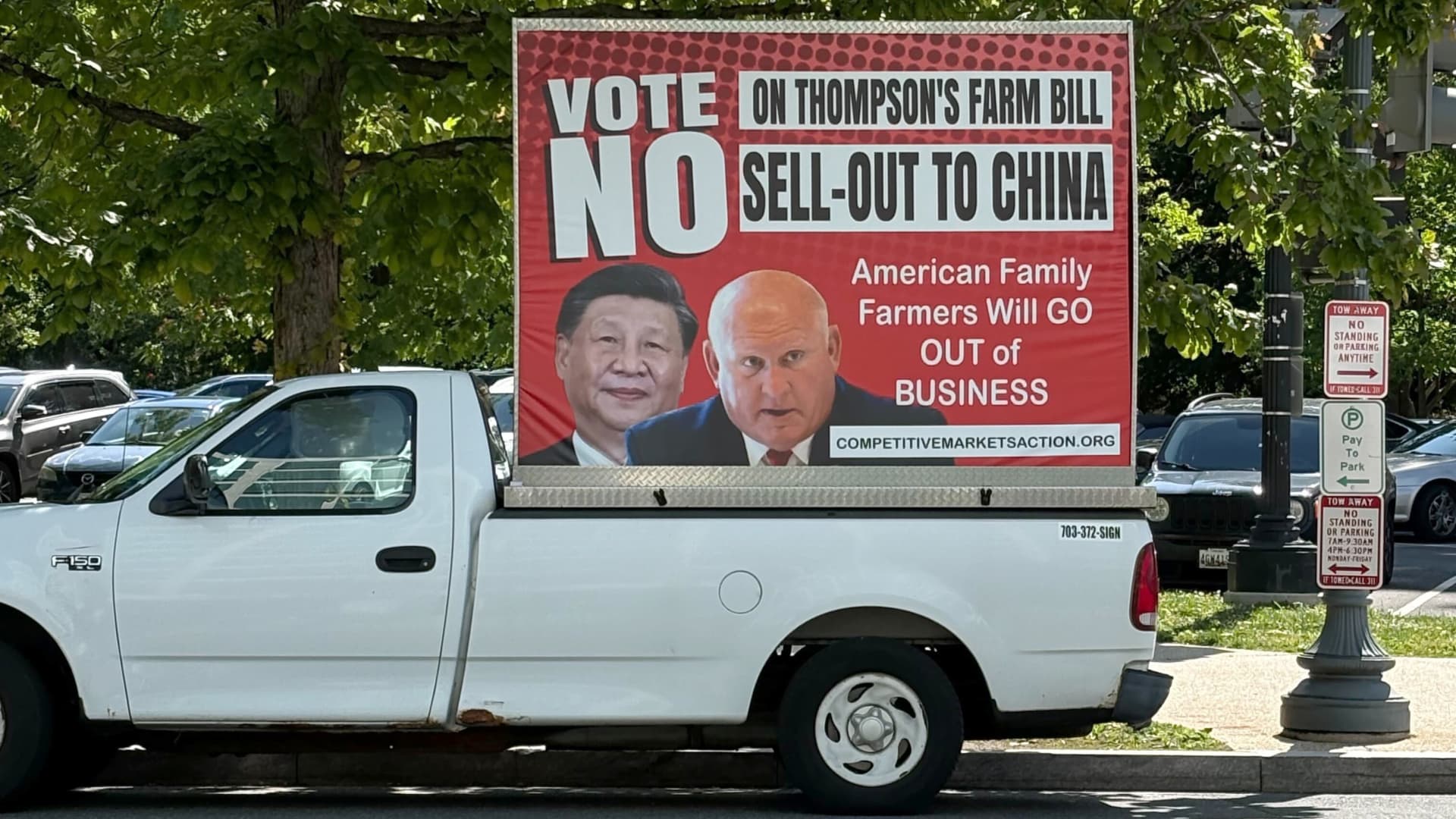
House strips MAHA-hated pesticide provisions from farm bill — CNBC, April 30, 2026. Photo: a sign protesting Chairman Glenn Thompson's farm bill in Washington, D.C., April 30, 2026, by Angela Greiling Keane / CNBC.