Congress does a lot of things in the dark. This one is in plain text on a government website, and it takes about thirty seconds to check.
On September 18, 2024, the House passed a bill by Georgia's Rick Allen about how the people who manage your 401(k) are allowed to pick investments. Its official title — the long, formal one that describes what the law actually does — was:
"To amend the Employee Retirement Income Security Act of 1974 to specify requirements concerning the consideration of pecuniary and non-pecuniary factors, and for other purposes."
Its short title, the name on the marquee, was the Protecting Americans' Investments from Woke Policies Act.
It died in the Senate.
On January 15, 2026, the House passed H.R. 2988. Its official title is:
"To amend the Employee Retirement Income Security Act of 1974 to specify requirements concerning the consideration of pecuniary and non-pecuniary factors, and for other purposes."
Not similar. Identical, word for word. Same sponsor. Same four divisions, same amendments to ERISA.
The new short title is the Protecting Prudent Investment of Retirement Savings Act.
Why the name change matters
Allen's whole public argument for this bill is that it takes politics out of your retirement account. His office announced the 2026 passage under the headline "Allen's Legislation Protecting Americans' Retirement Savings from Risky ESG Factors Passes House."
The last time he ran the same bill, he named it after the politics.
You cannot spend one Congress selling a bill as a strike against "woke policies," then the next Congress rename it "prudent" and insist the objection to it is partisan. The text is all but identical — the 2026 version adds a section ordering a government study of brokerage accounts, and otherwise does the same things to the same law.
What changed, twice over, was the naming. In 2024, Division A of the bill was the "Roll back ESG To Increase Retirement Earnings Act." In 2026 it is the "Increase Retirement Earnings Act." What he changed is what he thought would sell.
What the bill actually does to your 401(k)
Federal law already says the people managing your retirement money have to act solely in your interest. That's ERISA, and it's been the rule since 1974. Nobody is proposing to change it.
What Allen's bill changes is what your fund manager is allowed to look at.
It requires investment decisions to rest on "pecuniary factors" only. It permits non-pecuniary factors in narrow cases — mainly when the manager genuinely cannot tell two options apart on financial grounds — and it requires paperwork justifying it when they do.
In practice, that puts a manager who wants to weigh a long-term risk — a utility's exposure to climate rules, a supplier's forced-labor problem, a company's governance record — one lawsuit away from having to prove the risk was "pecuniary" enough. The safe move becomes: don't look.
The Congressional Sustainable Investment Caucus put it this way the day before the 2026 vote:
"We strongly oppose H.R. 2988 because it injects partisan politics into workers' retirement plans and ties the hands of the people responsible for managing those savings. … This bill would make it harder for fiduciaries to consider real financial risks and opportunities, limiting default investment options, and discouraging the responsible exercise of shareholder rights."
When the 2024 version came up, the White House budget office made the same point, saying the bill "undermines that longstanding framework":
"ERISA already requires fiduciaries to act solely in the interest of plan participants and beneficiaries. ERISA ensures that retirement advisors, plan trustees and administrators, and all other covered entities who are fiduciaries make investment decisions with the singular goal of protecting or growing hardworking Americans' life savings."
That is the tell. The law Allen says he's protecting already requires exactly what he says he wants. His bill's real work is narrowing what counts as a risk.
Both times, by a handful of votes
Neither version was popular. Both squeaked through.
| Bill | Date | Roll call | Result |
|---|---|---|---|
| H.R. 5339 — "Woke Policies" Act | Sept. 18, 2024 | 2024-427 | Passed 217–206 |
| H.R. 2988 — "Prudent Investment" Act | Jan. 15, 2026 | 2026-31 | Passed 213–205 |
Allen voted yes both times, as you'd expect of the sponsor. Both times it went to the Senate. The 2024 version never came back. The 2026 version is sitting in the Senate HELP Committee.
He is the chairman who writes these rules
This is not a backbencher filing a message bill.
In January 2025, Allen was named chairman of the House Education and Workforce Committee's Subcommittee on Health, Employment, Labor, and Pensions. Pensions is in the title. Retirement plan rules are his jurisdiction, and he wrote this one himself.
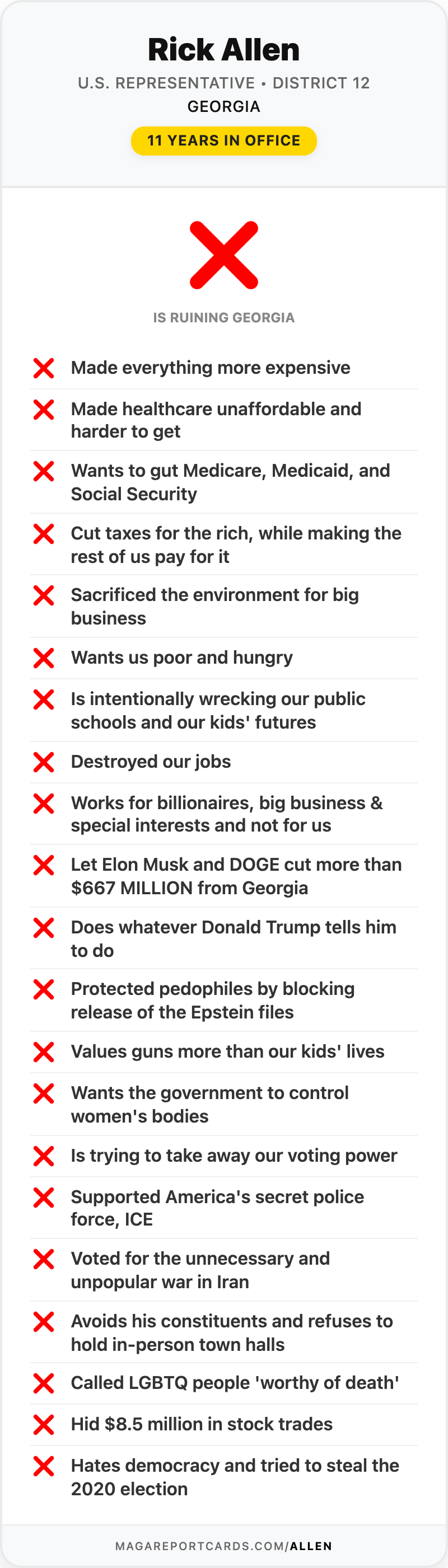
He also has a 0% score from the League of Conservation Voters for 2025, and a 1% lifetime score across eleven years in Congress. A congressman who has voted against the environment essentially every time it came up now wants your fund manager legally discouraged from pricing environmental risk into your retirement.
He is entitled to that view. He is not entitled to call it neutral after naming the same bill the "Woke Policies Act."
Meanwhile, the people whose retirement it is
Allen has represented Georgia's 12th District since 2015. In eleven years, constituents in Augusta say they have never gotten an in-person town hall out of him. On February 27, 2025, more than 100 of them staged a sit-in at his Augusta office to ask for one. Three weeks later, asked whether any were coming, Allen said: "We do that digitally. We do digital town halls."
So there has not been a room in the district where somebody could stand up and ask him the simple question: if this bill is about prudence, why did you call it the Woke Policies Act?
We deserve better.
Sources
- Congress.gov — H.R. 2988, Protecting Prudent Investment of Retirement Savings Act and H.R. 5339, Protecting Americans' Investments from Woke Policies Act (compare the official titles)
- Congressman Sean Casten, Sustainable Investment Caucus Statement Opposing H.R. 2988 (Jan. 14, 2026)
- Office of Management and Budget, Statement of Administration Policy: H.R. 5339 – Protecting Americans' Investments from Woke Policies Act (Sept. 17, 2024)
- ESG Dive, House GOP passes pair of anti-ESG bills targeting 'woke' investment policies (Sept. 20, 2024)
Photo: Official congressional portrait.