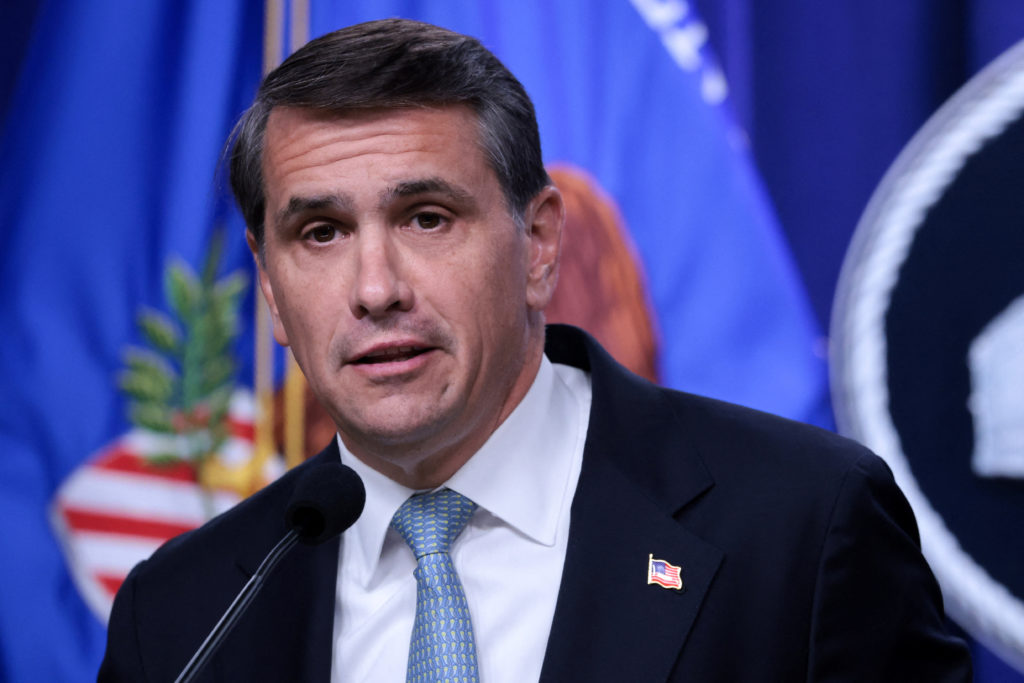
At 4:17 a.m. on Saturday, August 8, 2026, the United States Senate made Todd Blanche the attorney general of the United States.
The vote was 50 to 49. Every one of the 50 yes votes was a Republican. Every Democrat voted no. Two Republicans — Susan Collins of Maine and Lisa Murkowski of Alaska — voted no with them. Mitch McConnell of Kentucky did not vote.
One vote. That's the whole margin.
Todd Blanche was Donald Trump's personal criminal defense lawyer — and not a long time ago. He was hired in 2023 to defend Trump against criminal charges, he was a lead attorney on Trump's defense team at the hush-money trial in New York, and he defended Trump in the two federal cases brought by the Justice Department he now runs.
Fifty Republican senators looked at that and said: perfect, give him the whole building.
What they actually voted for
This wasn't a close call that turned on some technical dispute. The objections were enormous, they were public for weeks, and several Republicans raised them out loud before folding.
A $1.8 billion fund for Trump's supporters. Trump sued the IRS. Then he settled that lawsuit with his own administration. The settlement created a $1.8 billion "Anti-Weaponization Fund" to pay people who say the criminal justice system mistreated them — and Trump was explicit that he meant the people who attacked the Capitol on January 6. He called them "great American Patriots."
Tax audit immunity for the Trump family. The same settlement shielded Trump, two of his sons, and the Trump Organization from IRS audits and enforcement on past returns. A federal judge who handled the IRS case described Trump's lawsuit as an improper exercise in self-dealing. The union representing IRS workers went to court two days before the vote to try to block the immunity deal.
Prosecuting the president's enemies. Under Blanche, the Justice Department charged former FBI Director James Comey with threatening the president — over a photo of seashells arranged to read "86 47" that Comey posted online. It charged the Southern Poverty Law Center. It opened an investigation into the lawsuits E. Jean Carroll brought and won against Trump for sexual abuse and defamation. Comey's lawyers are asking a judge to throw his case out, accusing the department of misleading judges and withholding key facts.
Blanche's answer to all of this was two letters, written on August 2. One said the order creating the fund "is rescinded and shall have no force or effect." The other narrowed the tax immunity deal.
That was enough for fifty senators.
The letters aren't worth much
Here is the part nobody should skip past.
ABC News reported that the agreement Cornyn and Tillis accepted contains no language preventing the fund from being brought back under a different name or a different method. The Judiciary Committee advanced Blanche anyway on August 4, on a 12–10 vote along party lines.
Brandon DeBot of the Tax Law Center at NYU Law told NPR what the letters were worth:
"These assurances are not worth the paper they're written on. They don't pull back on the attempts to give the president and his affiliates unauthorized immunity from tax audits. And they don't do anything new to stop the president from trying to bring back the fund."
And the president himself spent the week before the vote saying he wanted the fund back. Trump told reporters the fund would have been "very fair," that it could have given "some solace" to Jan. 6 defendants, and: "I view that fund as a positive, and a lot of Republicans do too."
So the deal was: Trump says out loud he still wants it, his own lawyer signs a piece of paper saying it's cancelled, and the Senate calls that a win and goes home for a month.
Thirteen of them had already done this once
This is the fact that should follow every one of these senators around.
On March 5, 2025, the Senate confirmed Todd Blanche as deputy attorney general — the number-two job — by 52 to 46. Everything anyone objected to on Saturday morning happened after that vote, on the job that vote handed him.
Every single Republican we track who was in the Senate in March 2025 voted yes then, too. Blackburn, Capito, Cotton, Hagerty, Husted, Hyde-Smith, Marshall, Moody, Ricketts, Risch, Rounds, Sullivan, Tuberville — all yes, both times.
They didn't get fooled. They got exactly what they voted for, twice.
Susan Collins voted yes in March 2025 as well, and then announced a no vote on August 4 — hours after the two Republicans with real leverage had already given theirs away.
What Blanche did to the Justice Department
Before the vote, more than 1,200 former Justice Department employees — people who served across 14 administrations, including dozens of former U.S. attorneys — signed a letter to the Judiciary Committee urging senators to reject him.
Stacey Young, the founder and executive director of Justice Connection, the group that sent the letter, put it this way:
"Since his confirmation as Deputy Attorney General, Todd Blanche has shown time and again that his guiding star is fealty to the President, not the Constitution."
The letter's numbers are the part that should worry anyone who has ever called the FBI or reported a fraud. Under Blanche's watch, approximately 16,000 employees left the department, including more than a quarter of its attorneys. Hundreds were fired — some for declining to bring vindictive prosecutions, for refusing to lie in court, or for working on cases the president didn't like. Others were pulled off their real work to patrol streets in Washington, D.C.
The letter says the consequences reach far past the Justice Department's own hallways:
"They've meant that much of the department's vital work isn't being done, or isn't being done as well – leaving communities less safe, Americans' rights less protected, and our national security more vulnerable."
That is 1,200 people who spent their careers inside the Justice Department, serving under presidents of both parties, telling the Senate this man should not get the job. Fifty senators voted yes anyway.
The Epstein survivors told them, too
Murkowski, one of the two Republican no votes, said part of her reason was the Justice Department's handling of the Jeffrey Epstein files. She wasn't alone — Sen. Thom Tillis had pushed Blanche to meet with Epstein survivors, and Blanche finally did in July.
It did not go well. Afterward, survivor Annie Farmer said in a July 16 statement that she found Blanche "abrasive, condescending, and intentionally noncommittal to survivors," and survivors urged senators to block him.
Blanche was the public face of the Epstein files at the Justice Department. He is the official who personally sat down with Ghislaine Maxwell in a Florida courthouse for two days of interviews on July 24 and 25, 2025, after granting her limited immunity so she could talk without fear of being prosecuted over what she said. She told him she never saw Trump act inappropriately. Shortly afterward she was moved from a low-security prison in Florida to a minimum-security camp in Texas. Neither her lawyer nor the Bureau of Prisons has explained why.
Fourteen senators on this site voted to promote him. One of them, Dan Sullivan of Alaska, voted to keep the Epstein files sealed and then took checks from two men named in them.
The fourteen we track
Ashley Moody of Florida spent six years as her state's attorney general before Gov. Ron DeSantis appointed her to the Senate. She knows better than almost anyone in that chamber what it means for a chief law enforcement officer to be independent of the politician above him. She sits on the Judiciary Committee. She voted yes.
Marsha Blackburn of Tennessee also sits on Judiciary, and is running for governor while she does it.
Darline Graham of South Carolina has been a senator since July 14. Nobody elected her — Gov. Henry McMaster appointed her to the seat left vacant by the death of her brother, Lindsey Graham, on Trump's public recommendation. She has never held elected office in her life. She now sits on the Judiciary Committee, and the first bill she put her name on was one that would make it harder for millions of citizens to register to vote. Now she's voted to confirm the president's defense lawyer as attorney general.
Jon Husted of Ohio spent the same week writing a brand-new photo ID bill that the Senate voted on nineteen minutes after it confirmed Blanche. His state saw a steeper drop in Obamacare enrollment than any other in the country this year.
Tommy Tuberville of Alabama is running for governor while still holding his Senate seat.
And the rest voted yes without much comment: Shelley Moore Capito of West Virginia, Tom Cotton of Arkansas, Bill Hagerty of Tennessee, Cindy Hyde-Smith of Mississippi, Roger Marshall of Kansas, Pete Ricketts of Nebraska, Jim Risch of Idaho, and Mike Rounds of South Dakota.
The three who talked tough and voted yes anyway
The best part — if you like this sort of thing — is who made the noise.
Cornyn and Tillis spent two weeks holding the nomination hostage. Cornyn accused the Justice Department of having "stonewalled" him and said flatly, "They've simply refused to cooperate." Tillis said the fund was "an insult to the police officers and the people that defended us on January the 6th." Then he said, "It's done. It's been rescinded, and I am satisfied." Both of them voted yes.
Bill Cassidy of Louisiana was the final holdout. With Collins and Murkowski voting no and McConnell absent, Blanche could not afford to lose one more Republican. Cassidy listed the problems himself — the $1.8 billion fund, the tax immunity deal, the prosecutions of Trump's political opponents — and then said: "This is not a referendum on President Trump. It is a decision regarding Mr. Blanche in very specific circumstances."
Here's what those three men have in common. All of them are on their way out. Cornyn lost his May primary to Ken Paxton after Trump endorsed against him. Tillis isn't running again. Cassidy lost his primary this year to a Trump-backed challenger.
The only Republicans who used any leverage at all were the three with nothing left to lose. And they gave it away for two letters.
That tells you what the other 47 yes votes were really about.
What they did with the night
The Senate pulled an all-nighter to get this done. In the same session it confirmed Blanche, passed a stopgap funding bill, and held a pre-dawn vote on a photo ID requirement for voting. Then everyone went home for a month of recess.
They did not lower anyone's grocery bill. They did not lower anyone's rent, or premiums, or electric bill.
They stayed up until 4:17 in the morning to hand the Justice Department to the president's former defense attorney, and then they left town.
Sen. Dick Durbin of Illinois, the top Democrat on the Judiciary Committee, told them what the moment was before they voted:
"If there is ever a moment in history when we need an Attorney General above reproach, who is clearly dedicated to ending corruption, even at the highest level of our government, it's right now."
Fifty of them heard that and voted for the president's former defense attorney anyway.
We deserve better.
Source
Alanna Durkin Richer and Lisa Mascaro, "Todd Blanche narrowly confirmed as Trump's attorney general in overnight vote" (Associated Press via PBS News, August 8, 2026). Additional reporting from the Associated Press, NPR, and The Hill. Roll call from Senate vote #230. Photo by Jonathan Ernst/Reuters.