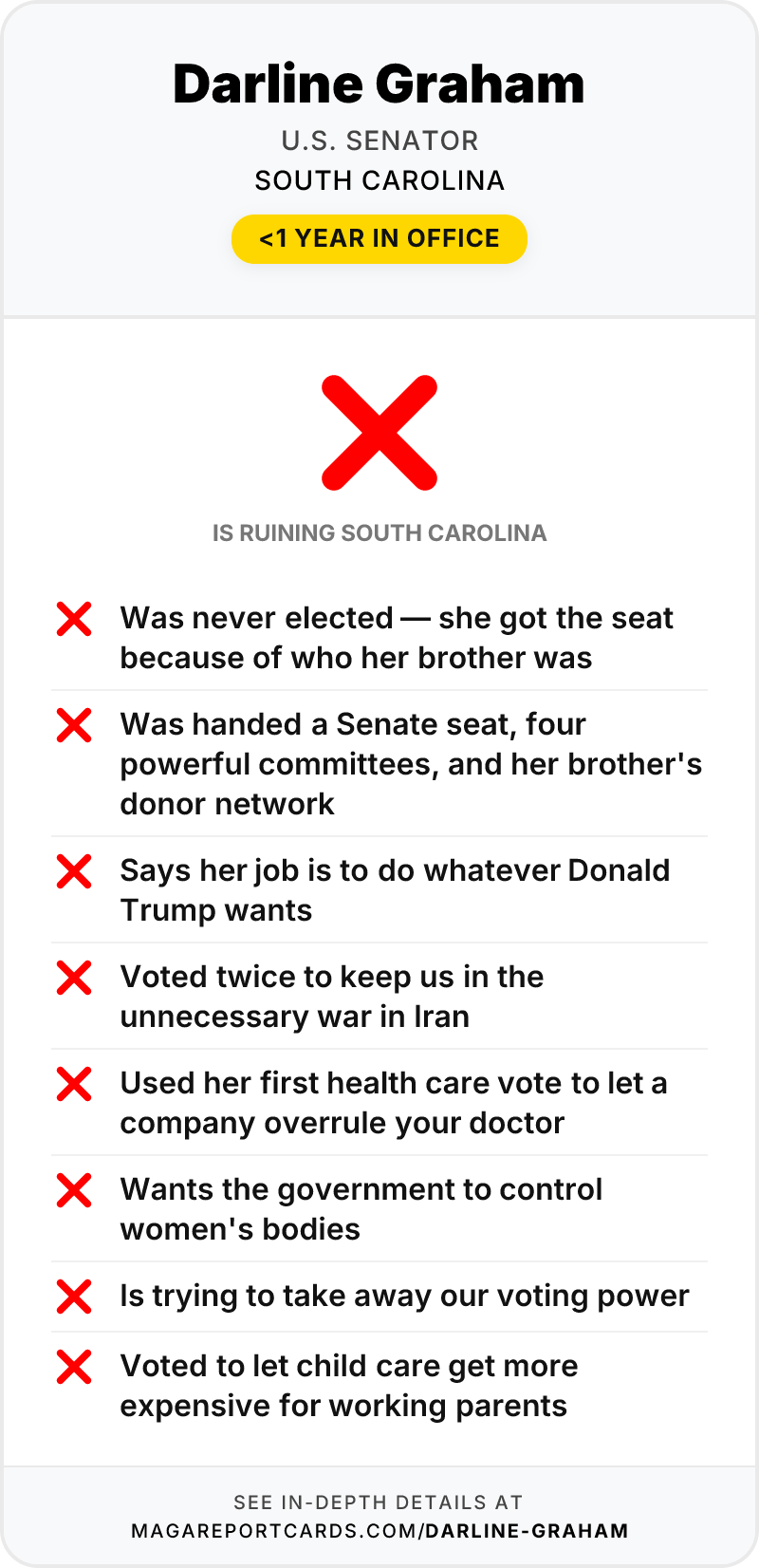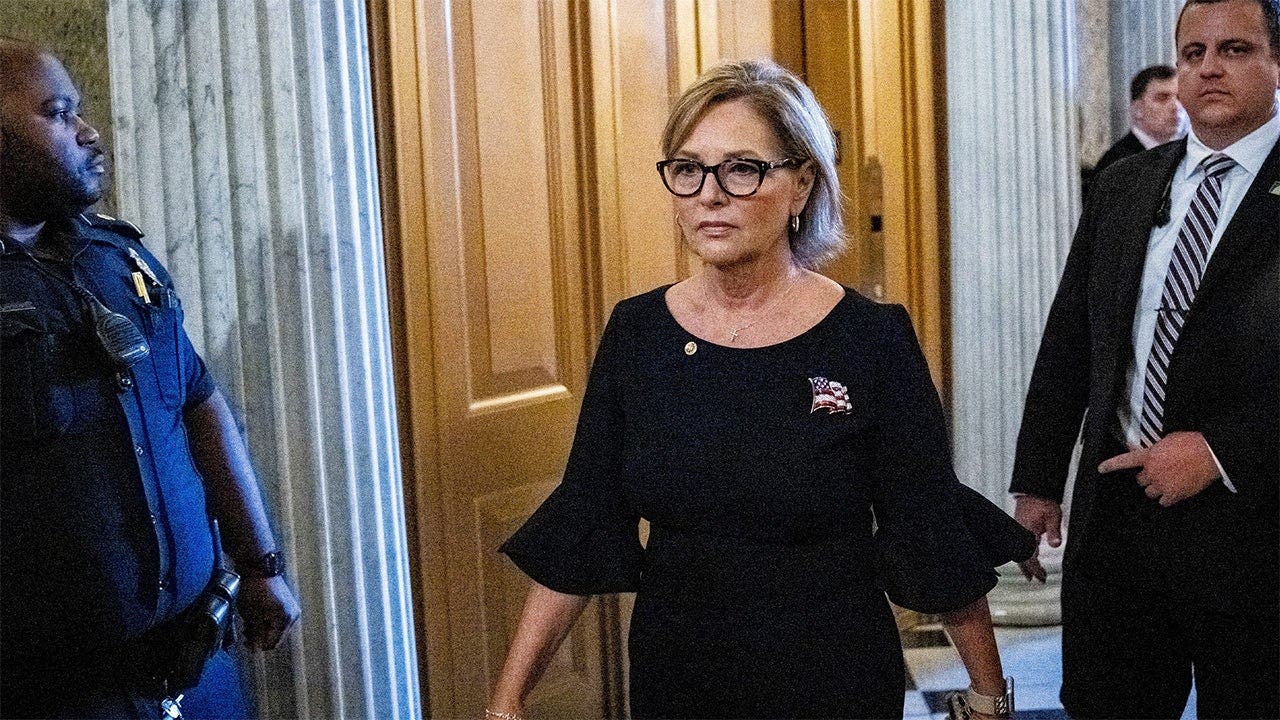
Darline Graham was appointed to the U.S. Senate weeks ago, after her brother Lindsey Graham died in July. She had, by her own account, "never had any desire to be a politician."
She has now been a senator for a few weeks. And she has already told South Carolina what she wants to spend that time on.
"I believe that if you have to show an ID to check out a library book, you should have to show one to vote. That's why the first bill I co-sponsored was the SAVE America Act. I am prepared to cancel the Senate's August recess and stay in Washington to get it passed and sent to President Trump's desk."
That's from an op-ed she published in Fox News on August 5. She repeated the priority in an interview with WYFF the same week.
Out of everything a brand-new senator could pick — health care, grocery prices, the flooding, the hospitals — the first bill she put her name on is a bill that would make it harder for eligible Americans to register to vote. And she's willing to cancel the Senate's vacation to do it.
It's not a library card
Start with the library card.
Graham's pitch is that voting should work like checking out a book: show a card. The bill she cosponsored, the SAVE America Act, does require photo ID to vote. It just isn't the ID most people are picturing, and it's only half the bill.
To vote, you'd need a photo ID that says on its front that you are a U.S. citizen. Most driver's licenses don't say that. If yours doesn't, you'd have to bring a second document proving citizenship — unless your state has been sending its voter rolls through the Department of Homeland Security's SAVE system every quarter since June 2025. Vote absentee, and you'd have to mail a copy of that ID with your ballot request and again with the ballot itself.
Before any of that, you have to be registered. Under the bill, a state can't process a registration "under any method" unless it comes with documentary proof of citizenship: a passport, a REAL ID that shows citizenship, a military ID with a service record showing a U.S. birthplace, or a photo ID paired with a birth certificate or naturalization papers. Register with the mail-in form, and you'd have to carry those papers to the election office in person. People without the documents get an attestation-and-other-evidence process that each state has to invent.
A library card gets you none of that. Whether the analogy is a misunderstanding or a talking point, the effect is the same: South Carolinians hearing "show an ID like at the library" are not being told what they'd actually have to produce.
Who this locks out
We've written before about what the SAVE Act's proof-of-citizenship rule does in practice. The numbers haven't changed.
- More than 21 million Americans of voting age don't have ready access to documentary proof of citizenship.
- 84% of women who marry change their surname — so their birth certificate no longer matches their legal name, and a mismatch can be enough to stop a registration cold.
- Registering by mail stops being enough: mail-in applicants have to bring their documents to an election office in person. That's a trip for people who work hourly jobs, don't drive, or live far from a registration office.
Graham is South Carolina's first woman senator. The bill she chose as her first cosponsorship is the one that hits married women hardest.
She also wrote, in the same op-ed, that she's "a mother, a grandmother and a wife" who knows "how to bargain shop" and bought her Capitol shoes "off the clearance rack at the Shoe Warehouse." A woman who took her husband's name and shops clearance racks is exactly the voter the SAVE America Act's paperwork trips up — a replacement birth certificate costs money and weeks, and the government will not be mailing her one.
The problem it claims to solve
The pitch for the SAVE America Act is that noncitizens are voting. In the same op-ed, Graham tied it directly to immigration: "I believe Joe Biden let 12 million illegal immigrants walk into our country, and President Trump and I are going to walk them right back out."
Noncitizen voting in federal elections is already a federal crime, and it is already vanishingly rare. When Georgia's Republican secretary of state audited the state's voter rolls in 2024, he found 20 noncitizens registered out of more than 8 million. The SAVE America Act's answer to a problem that size is a paperwork wall in front of tens of millions of citizens.
That trade — block a lot of real voters to stop a problem that barely exists — is the whole design. It's why the bill keeps getting pushed, and why it keeps stalling in the Senate.
"Cancel the recess"
The line that ought to stick is the offer to cancel August recess.
The Senate's summer break is when members go home and meet the people who sent them. Graham has been in the job a few weeks. She has not yet held a town hall as a senator. Her offer is to skip the going-home part in order to stay in Washington and pass a voting restriction.
That's a statement of priorities, and it's hers, in her own words, in her own op-ed. Not a vote she can explain away later. Not something an opponent said about her. The first thing she told South Carolina she'd fight for was a bill that makes voting harder — and she sold it with a library card.
South Carolina Republicans pick their Senate nominee in a special primary on August 11.
Source
Darline Graham's op-ed in Fox News, August 5, 2026 (photo: Fox News), and WYFF 4's interview.