On Wednesday, the Arkansas Hunger Relief Alliance stood up in front of reporters in Little Rock and read out the worst hunger figure anyone has put on this state.
37% of Arkansans say they don't have enough food to meet their needs. That is roughly 1.14 million people. The finding comes from the Arkansas Hunger Survey — 3,500 paper surveys and 1,700 phone interviews — run by the Alliance together with the six Feeding America food banks that cover the state.
Break it apart and it gets worse. 14% of Arkansans get no food assistance at all and still don't have enough to eat. Another 23% do get help — SNAP, WIC, a church pantry, a food bank giveaway — and still fall short. Only 47% of Arkansans meet their food needs on their own. Nationally that figure is 62%.
Another 400,000 Arkansans are eating today only because a food assistance program is standing between them and an empty kitchen.
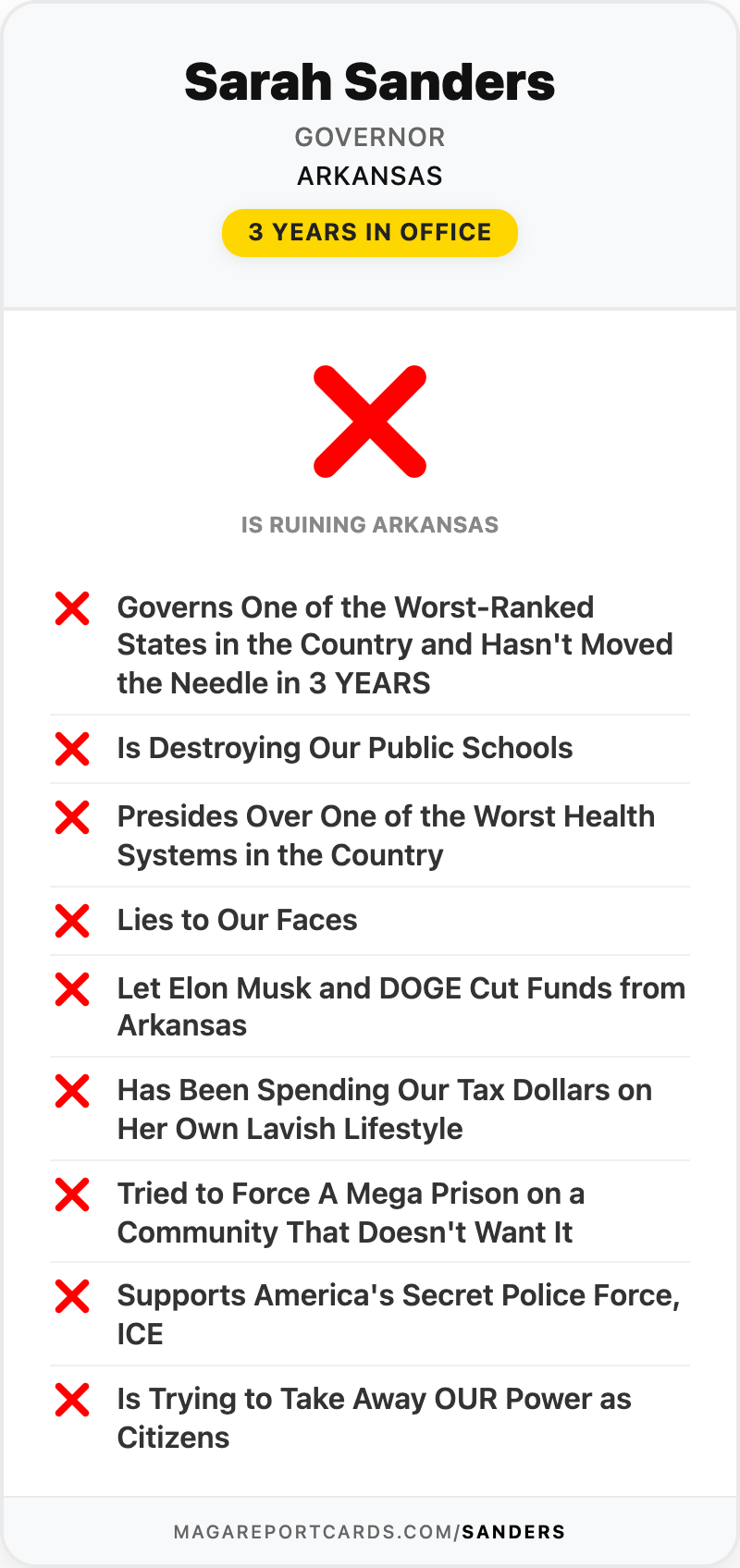
Sarah Sanders has been governor of Arkansas since January 2023. This is the state she runs.
The line on the chart has only gone one direction
Arkansas has come out the most food insecure state in the country in each of the federal government's last three reports — 16.6% of households over 2020–2022, then 18.9% over 2021–2023, then 19.4% over 2022–2024. The USDA averages three years of survey data to make a state estimate reliable, so those windows overlap. The direction doesn't change.
The state's own researchers put the number higher. In February, researchers at the University of Arkansas and the University of Arkansas for Medical Sciences published the Arkansas Health Survey — nearly 10,000 responses, reported down to each of the state's 823 census tracts — and found 28.8% of adult Arkansans food insecure, about 688,000 people. The Alliance's survey, taken in 2025 and published this week, puts it at 37%. Three different measures: households, adults, and everybody in the state.
Here is the part nobody has an easy answer for. Christie Jordan, CEO of the Food Bank of Northeast Arkansas, told the news conference that charity is not keeping up:
"Food banks across Arkansas have nearly doubled charitable food distributions in the last decade, yet food insecurity rates have continued to rise."
Sylvia Blain, who runs the Alliance, said the survey found no clean profile for who goes hungry here. Not education. Not employment. "It could be any of us," she said. "Many people are one paycheck, one car repair bill, one health emergency away from becoming food insecure."
"Just not this one part"
When Trump's budget bill was moving through Congress in the summer of 2025, Sarah Sanders picked a fight over it. A real one, in public, and she won it.
On June 26, 2025, she published an op-ed in the Washington Post under the headline "Yes, I support Trump's big, beautiful bill. Just not this one part." The one part was a provision blocking states from regulating artificial intelligence for ten years. The next day she led 17 Republican governors in a letter to Senate Majority Leader John Thune and Speaker Mike Johnson demanding it come out. On July 1 the Senate stripped it, 99 to 1, and her office put out a release taking the credit.
So we know exactly what it looks like when this governor decides a piece of a federal bill is bad for Arkansas. She writes the op-ed. She rounds up the governors. She calls the Speaker. And it works.
Now read the sentence she opened that op-ed with. This is the governor of the most food-insecure state in America, in her own words, explaining why the rest of the bill was good:
"President Donald Trump's one, big, beautiful bill will be a win for the American people by cutting taxes, moving welfare recipients off the path to dependency and onto the path to prosperity, growing the economy, and helping secure the border."
"Moving welfare recipients off the path to dependency" is what the food assistance cuts look like when you are for them.
That bill cut $187 billion out of food assistance over the next decade — the largest cut to SNAP in history. Arkansas Advocates for Children and Families estimates 25,000 Arkansans will lose their SNAP benefits because of it.
There was no op-ed about that. No letter. No 17 governors.
We have written before about the Medicaid half of this same story, now landing on the more than 211,000 Arkansans on the state's Medicaid expansion. The pattern in the food numbers is the same one.
Who lost their exemption
The cuts did not arrive as one big announcement. They arrived as paperwork.
A piece of the law stripped work-requirement exemptions from three groups: veterans, people without housing, and young adults who had aged out of foster care. Arkansas started enforcing it on November 21, 2025, under an emergency rule a legislative panel approved the day before. People who had never had to document 80 hours of work a month were given three months to start, or lose their groceries. The law also cut off some legally present immigrants, including refugees and people granted asylum.
The research on this is not ambiguous. SNAP work requirements reduce how many people get food assistance rather than raising how many people work.
Arkansas has been shedding people from the program for years anyway — roughly 35% of individuals and 23% of households since 2018, even as hunger got worse. Fewer people on food stamps in a state where more people are hungry is not a program working. It is a program shrinking.
The bill that comes due next year
The expensive part of the law was timed to land after the 2026 election, which we have laid out before. Arkansas is about to find out what that means.
Every dollar of food assistance handed out in Arkansas today is federal money — about $41 million a month. That is the arrangement the law ends.
Starting in October 2026, states pay 75% of the cost of administering SNAP instead of 50%. For Arkansas that is another $18 million to $23 million a year.
Then comes the second hit. For the first time in the program's history, states whose payment error rate runs above 6% have to pay a share of the benefits themselves. Arkansas's rate has been above 6% for years. The USDA released the official figures on June 24, 2026: Arkansas's error rate for the last federal fiscal year was 8.81%, down from 9.56% the year before, and still inside the band that makes a state cover 10% of its own benefit costs — about $50.7 million a year, starting in October 2027. Put the two together and Arkansas is facing up to $73 million in new SNAP costs it has never had to pay before.
Two things about that error rate matter.
The first is whose errors they are. When a state legislator asked the Department of Human Services in December whether the mistakes were being made by SNAP recipients or by state employees, the director of the Division of County Operations answered that there are more "agency errors than client errors." DHS is the agency Sarah Sanders's administration runs. Errors made at her department's desks are what set the size of the state's bill.
The second is that there is still no plan to pay it. The $6.7 billion state budget Sanders signed this spring did not address the gap, and the DHS budget stayed essentially flat at $1.86 billion. Asked how the agency would absorb the cost, a spokesman said officials were "continuing discussions." Blain, of the Hunger Relief Alliance, said what she has been waiting for is simple: "I believe it needs to be a line item to make sure that it's covered."
What Arkansas did find money for
On May 6, 2026, Sarah Sanders signed the state's fourth income tax cut since 2023.
Advocates had spent the spring telling legislators not to — that the food assistance shortfall was coming, and that the lower and middle classes see little from these cuts anyway. One of them, Valencia White, told reporters outside the Capitol what the arithmetic used to look like in her own house: "When they were younger, I would cry because my money didn't go as far as it should have, and I had to feed my children."
The surplus has been going the way the tax cuts push it. It was $698.4 million at the end of the 2024 budget year, $367.9 million a year later, and was projected to fall to $185.1 million by June 2026.
The state did find $1.2 million for a Chicago consulting firm called Sifter Solutions, whose job is keeping grocery stores supplied with an updated list of the products Arkansans on food assistance are no longer allowed to buy.
That is the governor's signature hunger policy. Since July 1, 2026, SNAP benefits in Arkansas cannot be used for soda — including diet soda — candy, or fruit drinks under 50% juice. Sanders has said taxpayers should not be "subsidizing poor health."
She launched it after a federal judge had already blocked the same idea elsewhere. U.S. District Judge Amy Berman Jackson threw out the USDA's approval of the equivalent pilot programs in Colorado, Iowa, Nebraska, Tennessee and West Virginia, ruling that they broke federal law and that the agency had skipped its own rules for setting them up. Arkansas went ahead regardless. "Arkansas is moving full speed ahead," Sanders said, "because we won't wait around while our people get less and less healthy and we spend more and more taxpayer dollars trying to fix the problem."
Two women who volunteer at a Fayetteville church food pantry told the Arkansas Advocate that the premise is wrong to start with — that people stretching a tiny benefit are not buying junk with it. "Most people that I see that use SNAP are using it to get nutritious stuff," Wannalitha Anderson said, "but trying to tell someone what they can and can't eat [is] not going to fix anything."
The other one, Jen Cole, is on SNAP herself. She gets $20 a month, and she told the Advocate how a month of it goes: olive oil for cooking and smoked paprika, which between them took most of the benefit. "So I got that and a couple of avocados and an onion, and that was it."
The things she did do
It should be said plainly: Sanders has not done nothing.
She kept Arkansas in the federal summer grocery program for children in 2024 and again in 2025 — it served 260,000 Arkansas kids in its first year — while other Republican governors turned the same money down. She has repeatedly pointed to the law giving every Arkansas student breakfast at school regardless of family income. During the government shutdown last fall she moved $1 million out of state reserves to the food banks, in two installments.
All of it is real. None of it required her to tell Washington no.
What the record shows
Arkansas has the worst hunger in the United States, and a survey released this week put it at 37% of the state — about 1.14 million people. The federal law behind the largest food-aid cut in American history is expected to take SNAP from 25,000 Arkansans and leave the state up to $73 million in new costs that no budget has accounted for. Sarah Sanders publicly fought exactly one provision of that law, and it was the artificial intelligence provision. In the same op-ed, she called the rest of the bill a win for "moving welfare recipients off the path to dependency."
Source
Byron Tate, "Survey: New food insecurity number nears 40%," Arkansas Times, August 26, 2026. Survey details from the Arkansas Hunger Relief Alliance.