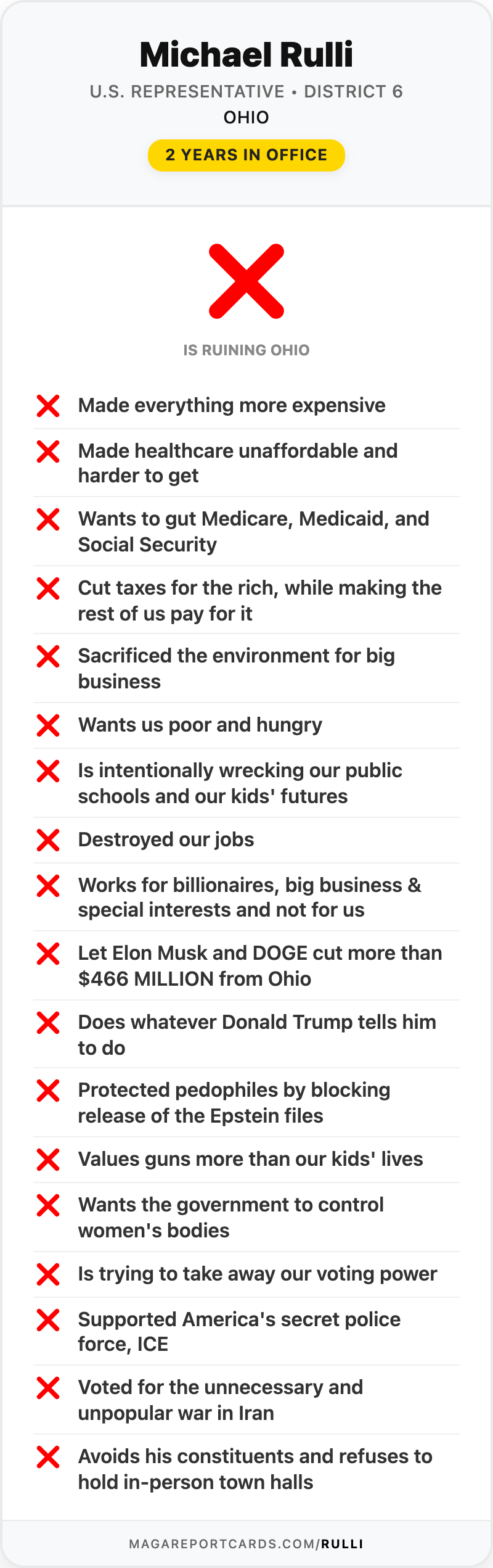
On August 11, 2026, NOTUS reported that Michael Rulli — the Republican congressman from Ohio's 6th District — failed to disclose 22 personal stock trades on time.
Not one. Twenty-two.
NOTUS named Palantir, Pfizer, Alphabet, Amazon, Apple, Meta, Microsoft, Nvidia and Oracle. The filing itself, signed August 7, 2026, adds six more companies: Coca-Cola, Eli Lilly, GE Vernova, Prudential Financial, ServiceNow and Thermo Fisher Scientific. Together the 22 trades are worth somewhere between $22,022 and $330,000 — Congress only makes members report trades in broad ranges, so that's as precise as the public gets. The oldest is a Pfizer sale from November 26, 2024.
He was months late on all of them.
The law is not complicated
There's a federal law called the STOCK Act, passed in 2012 after a national scandal about members of Congress appearing to profit from what they learn at work. It doesn't stop anyone from trading. It doesn't limit what anyone can own.
It says: if you buy or sell a stock, tell the public within 45 days.
That's it. That's the whole obligation. And the reason it exists is timing — voters are supposed to be able to check what a member bought against how that member voted, while the vote still matters. Miss the deadline and the check becomes impossible. The trade is done, the profit is banked, and nobody outside the member's household knew about it when it counted.
Rulli missed it 22 times.
Look at which committee he sits on
This is the part that turns a paperwork story into a real one.
Rulli sits on the House Energy and Commerce Committee — which, as NOTUS notes, has jurisdiction over telecommunications, consumer protection, drug safety, energy policy, and interstate and foreign commerce.
Now read the list of companies again.
- Pfizer and Eli Lilly — drug companies. Drug safety is his committee's jurisdiction.
- Alphabet, Meta, Apple, Amazon, Microsoft, Oracle, Nvidia — telecommunications, consumer protection and data policy are his committee's jurisdiction.
- GE Vernova — power generation. Energy policy is his committee's jurisdiction.
- Palantir — a defense and immigration contractor whose business depends on federal contracts.
Energy and Commerce is one of the most powerful committees in Congress. It holds the hearings, writes the bills, and issues the subpoenas that move exactly these companies' stock prices.
Nobody has accused Rulli of trading on inside information, and this post doesn't. The point is narrower and harder to wave off: the disclosure rule exists precisely so that voters can decide that question for themselves — and for months, on 22 separate trades, he didn't let them.
Then he voted to ban stock trading
Three weeks before the NOTUS story ran, Rulli voted for the Stop Insider Trading Act — a bill to bar members of Congress from buying individual stocks at all. It passed the House 232–198 on July 22, with every Republican voting yes.
So the sequence is: trade the stocks, skip the deadline 22 times, vote for the ban, and let the press find out afterward.
NOTUS asked his office about it. The office acknowledged the request and then didn't answer the questions — including the simple one of whether Rulli had paid a fine for the late filings.
The fine, if the Ethics Committee bothers to assess it, starts at $200.
He is not the only one. We went through every Republican on this site and found 45 who had missed the STOCK Act deadline at least once. Juan Ciscomani of Arizona was nine months late on a Treasury bond and voted for the same ban eight days after quietly disclosing it. Roger Marshall was more than 17 months late disclosing a family member's pandemic-era trades and then put his name on a bill against it.
Rulli's version is bigger than most: 22 trades on one late filing, up to $330,000, and a committee assignment that touches nearly every company on the list.
This isn't a man who needed the money
NOTUS also runs a project tracking the wealth of members of Congress. In May 2026 it reported that Rulli, a freshman, is one of the wealthiest members of Ohio's delegation, with a median estimated net worth around $26.5 million — commercial and residential property, including farmland, across northeast Ohio.
His office declined to answer NOTUS' questions for that story too, including whether he thinks members of Congress should own stocks at all.
Nearly three months later he voted that they shouldn't — while sitting on 22 undisclosed trades.
Who he represents
Ohio's 6th District runs down the eastern edge of the state, from the Mahoning Valley along the Ohio River. It includes East Palestine — Rulli's own office confirmed as much when he hosted Vice President JD Vance at the derailment site.
Most households there are not weighing whether to buy Nvidia. They're weighing groceries and utility bills.
The people in that district get one tool for checking whether their congressman is working for them or for his portfolio: a filing deadline. It costs him nothing to meet it. He blew through it 22 times, and when a reporter asked why, his office went quiet.
That's not an oversight. That's a decision about who is owed an explanation.
Source
An Ohio Congressman Violated the STOCK Act With 22 Late Disclosures — Dave Levinthal, NOTUS, August 11, 2026.