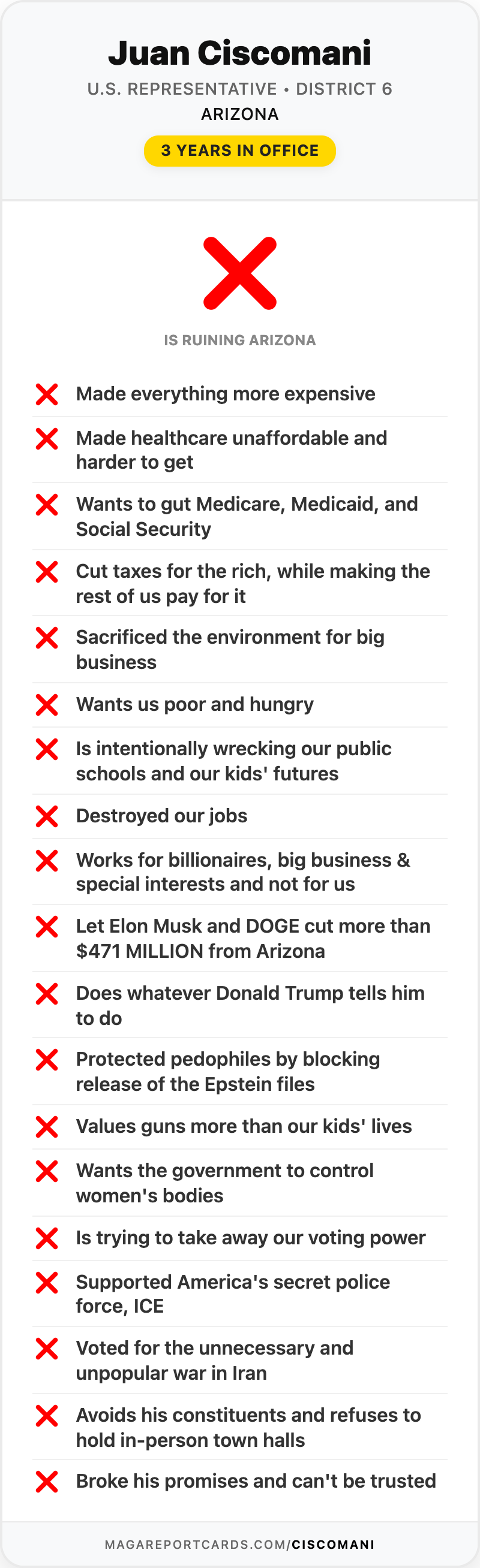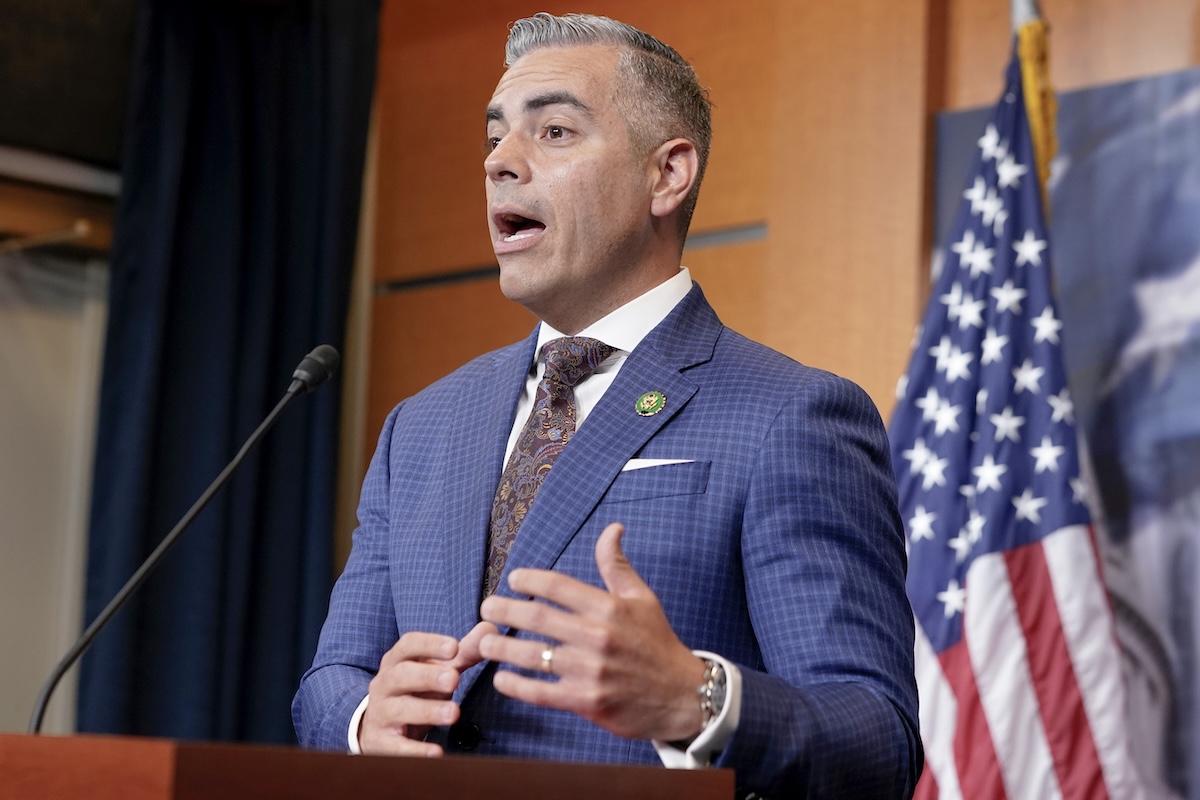
On July 22, 2026, the U.S. House passed a bill called the Stop Insider Trading Act. The next day, Juan Ciscomani — the Republican congressman from Arizona's 6th District, and one of the bill's cosponsors — put out a statement about what it meant:
"Members of Congress should not be getting rich because of their position in public office. The American people expect their elected officials to serve their communities, not use their office for personal financial gain. Members of Congress have access to information that is not available to the public, and that information should never be used to benefit their own stock portfolios."
That is a good standard. Here is the problem with Ciscomani holding it up.
Eight days before that vote, on July 14, 2026, Ciscomani filed his annual financial disclosure with the Clerk of the House. Buried in it was a U.S. Treasury bond worth between $15,001 and $50,000 that he and his wife had bought jointly on August 28, 2025.
He was supposed to have told us about that purchase within 45 days. He told us about it nearly eleven months later, and only because the annual form made him.
The one thing the law actually asks
There's a federal law called the STOCK Act — the Stop Trading on Congressional Knowledge Act. Congress passed it in 2012, after a national scandal about lawmakers appearing to cash in on what they learned at work.
The law doesn't stop members of Congress from buying anything. It doesn't cap what they can own. It asks them to do one thing: file a short form when they trade. Thirty days from when they find out about the transaction, or 45 days from the transaction itself — whichever comes first — for anything over $1,000. That form is called a periodic transaction report, and the whole point is timing. Voters are supposed to be able to line up what a member bought against how that member voted, while it still matters.
Missing that deadline is not rare. We went through every Republican on this site earlier this month and counted 45 of them who had blown it at least once. Ciscomani is one of the 45 — and his is the freshest entry on the list.
As the Copper Courier reported on August 7, no periodic transaction report for the August 2025 bond appears anywhere in Ciscomani's House filings. The purchase surfaced roughly nine months after the STOCK Act's deadline had already passed, in a yearly form he filed under an approved extension. Ciscomani did not respond to the paper's request for comment.
Be fair about what this is — and what it isn't
Two things are worth saying plainly, because we'd rather be right than loud.
A Treasury bond is not a hot stock tip. It's about the least exciting thing a person can buy. Nobody is suggesting Ciscomani made a killing off inside information on U.S. government debt.
And the bill he voted for wouldn't have banned this purchase anyway. The text the House passed restricts buying "covered investments" — securities issued by publicly traded companies. Treasury bonds aren't that.
So the violation isn't the trade. The violation is the silence. The STOCK Act's disclosure rule is the floor — the easiest, most basic version of "tell the public what you're doing with your money while you're writing their laws." Ciscomani cleared everything except that floor, for nine months, while cosponsoring a bill premised on the idea that Congress can't be trusted to police itself.
The penalty for a first-time late filing is a $200 fee. That's it. Which is exactly why the deadline is the honor system, and exactly why blowing through it says something.
He is not the first Republican on this site to try this sequence. Roger Marshall hid a family member's pandemic-era trades for more than 17 months, then in March 2026 signed on as an original cosponsor of a bill to ban members of Congress from trading stocks. The pattern is the same: break the easy rule quietly, then campaign on the hard one loudly.
What else was in the bill Ciscomani was so proud of
There's one more thing about the Stop Insider Trading Act that Ciscomani's press release didn't mention.
The bill that passed the House on July 22 wasn't only a stock-trading bill. Section 3 of the text as passed is titled "Requiring Voters to Provide Photo Identification." It would bar election officials from handing you a federal ballot in person unless you show a valid physical photo ID. And if you vote by mail, your ballot can't be counted unless you enclose a photocopy of a photo ID, or the last four digits of your Social Security number plus a sworn affidavit that you tried and couldn't get one, or a notarization from a notary public swearing you personally marked the ballot. Absent military voters and some voters with disabilities are exempt.
That is a very large change to how tens of millions of Americans vote, stapled to a bill about congressional stock portfolios. We wrote about how those two bills got welded into one when it happened.
It is also why the vote count looks the way it does. The bill passed 232–198 — every single Republican who voted, all 218 of them, plus 13 Democrats and one independent, against 198 Democratic noes. Rep. Seth Moulton, explaining his no vote, called it "a sham piece of legislation full of loopholes" and "a voter suppression bill in disguise."
Ciscomani signed on as a cosponsor on January 12, 2026 — the day it was introduced. His press release about it went out under the headline that he voted to ban stock trading by members of Congress. It says nothing about photo ID, mail ballots, or notaries.
Why any of this matters in Tucson
Ciscomani is running for a third term in a district that forecasters rate a toss-up. He talks a lot about being an independent, bipartisan voice — and there's a version of that record he genuinely earned.
But this is the part voters don't get to see unless someone digs it out of a PDF: he bought that bond eight weeks after voting for Trump's budget bill — the one that cut about $1 trillion from Medicaid over a decade and $186 billion from food assistance. Arizonans were absorbing that. The bond purchase was his own business, and it would have stayed unremarkable if he'd filed the form.
He didn't file the form. Then he asked for credit for a law requiring other people to.
The Copper Courier had to find it. He didn't answer when the paper asked about it. And the total consequence, if the Ethics Committee bothers, is $200 — less than a tank of gas is worth to most of the people he represents, and roughly nothing next to a bond of up to $50,000.
That's the accountability system Ciscomani says he's strengthening. He couldn't be bothered to meet the version of it that already exists.
Source
Did Juan Ciscomani violate an act meant to deter insider trading? — Sahara Sajjadi, The Copper Courier, August 7, 2026. Photo: AP Photo/Mariam Zuhaib.