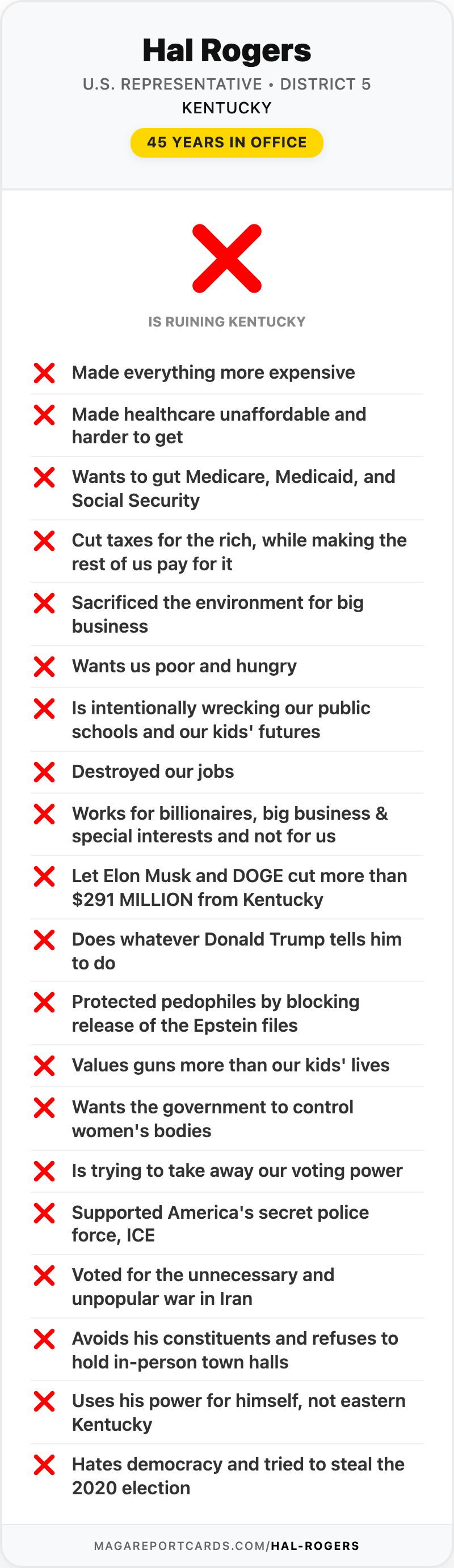
On July 3, 2025, the House sent Trump's budget bill to his desk. Hal Rogers voted yes, and then put out a statement about what he had just done.
He said the bill "strengthens Medicaid and SNAP benefits."
Rogers represents Kentucky's 5th District — the eastern Kentucky coalfield, one of the most Medicaid-dependent congressional districts in the United States. So it is worth checking that sentence against what the bill actually does to the people who live there.
What the analysts found
KFF, a nonpartisan health research organization, ran the numbers on the bill's effect on rural health care state by state. Kentucky came out worst in the country — a projected $10 billion decline in Medicaid payments to rural providers over ten years, and 130,000 rural Kentuckians expected to lose Medicaid coverage.
The Kentucky Hospital Association warned the law would eliminate 33,000 jobs as Medicaid underfunding pushed hospitals to cut services or close. Its president told the Kentucky Lantern the final version "effectively eliminates" the supplemental Medicaid payments Kentucky hospitals say are critical to staying open.
Then there's the hospital list. Using research from the Sheps Center at the University of North Carolina, the Kentucky Center for Economic Policy identified 35 Kentucky rural hospitals at heightened risk of closing — more than any other state. As they put it: for every ten hospitals at risk of closure in the country, at least one is in Kentucky.
Read the names on that list and you are reading a map of Hal Rogers's district:
- Whitesburg ARH Hospital
- Harlan ARH Hospital
- Middlesboro ARH Hospital
- Barbourville ARH Hospital
- McDowell ARH Hospital
- Mary Breckinridge ARH Hospital
- Highlands ARH Regional Medical Center
Whitesburg, Harlan, Middlesboro, Barbourville, McDowell, Hyden, Prestonsburg. Those are eastern Kentucky coalfield towns, and they are all in Hal Rogers's district. When a hospital closes in a place like Harlan, there is no second hospital across town.
The SNAP half of his sentence doesn't hold up either. The law trims future food assistance funding and pushes part of the cost onto states. 575,000 Kentuckians are on SNAP.
"Able-bodied adults... who choose not to work"
Rogers went further than one adjective. His statement explained the reasoning:
"The bill protects the longevity of Medicaid benefits for our most vulnerable population by slashing waste, fraud and abuse of the program. With 4.8 million able-bodied adults receiving Medicaid, who choose not to work, the bill enforces a 20-hour weekly work requirement for those individuals who do not have small kids. Without question, we are adding integrity and strength to Medicaid and SNAP assistance for those who need it most in the years ahead."
The phrase "who choose not to work" is doing all the work in that paragraph, and it isn't true.
KFF's analysis of Medicaid adults aged 19 to 64 — leaving out people on Medicare or receiving disability benefits — found that 92% are either working or not working because of caregiving responsibilities, illness or disability, or school. Sixty-four percent hold a full- or part-time job. The remaining 8% gave reasons including retirement or being unable to find work.
That is not a population choosing idleness. It's a population of people with jobs, people caring for a relative, people who are sick, and students.
And the thing that actually removes people from the rolls isn't a work test. It's paperwork. Kentucky's requirements start in January 2027, and the state is still working out how to run them. Emily Beauregard of Kentucky Voices for Health told WUKY this month that the state's Medicaid department "is still trying to understand how they'll implement these incredibly complicated new requirements," and that the paperwork and more frequent reporting will catch even the most vulnerable people. The Kentucky Center for Economic Policy found the counties most exposed are in eastern and southern Kentucky.
People who qualify will lose coverage anyway, because they missed a form.
He knew
The part of Rogers's statement that got less attention is the part where he says the quiet thing.
"While the House-version of the bill would have been far better for rural healthcare, the Senate added a $50 billion safety net for rural healthcare providers..."
He is telling you, on the record, that he understood the version he voted for was worse for rural hospitals than the one the House had written. He voted for it anyway.
And then:
"Ultimately, this is not the end of our reconciliation work, and as a cardinal member of the House Appropriations Committee, I will continue working to improve funding options for our rural hospitals and clinics."
Translated: he voted for something he knew would hurt hospitals in his district, and promised to try to fix it later using a different job. He has held that different job — senior appropriator — for three decades. If the fix were available, it would not be waiting on a promise.
Words versus arithmetic
There are two ways to read "strengthens Medicaid."
One is that Rogers believes work requirements make the program more sustainable, and everything else is a detail. The other is that he represents a district so safely Republican that the vote was never in doubt, and the statement was written for people who would never check.
Either way the arithmetic doesn't move. Kentucky is projected to lose more rural Medicaid money than any state in the country. Thirty-five of its hospitals are on a closure-risk list. At least seven of them are in his district. And 130,000 rural Kentuckians are expected to lose coverage in a place where losing coverage often means driving two counties over, or not going.
This is a habit with him. Kentucky has more black lung recipients than any state, they live in his district, and when local Republicans asked Washington to raise their benefits, Rogers wouldn't back the bill. He has spent 45 years being extremely effective at moving federal money — toward contractors, toward a $17 million airport with no airline, toward a national ID card plant in a town of 8,000. The hospitals can wait.
Rogers is 88 and running for a 24th term. Kentucky's rural hospitals may not get 24 more years.
Sources
- Kentucky Republicans in Congress hail passage of bill the state's hospitals call 'devastating' — Jamie Lucke, Kentucky Lantern, July 3, 2025
- Kentucky Faces the Nation's Highest Number of Rural Hospitals at Risk of Closure if Congress Cuts Medicaid — Kentucky Center for Economic Policy, June 17, 2025
- Understanding the Intersection of Medicaid and Work: An Update — KFF
- Eligible Kentuckians could lose coverage under Medicaid changes — Nadia Ramlagan, WUKY, August 10, 2026. Photo: KNC/Adobe Stock, via WUKY.