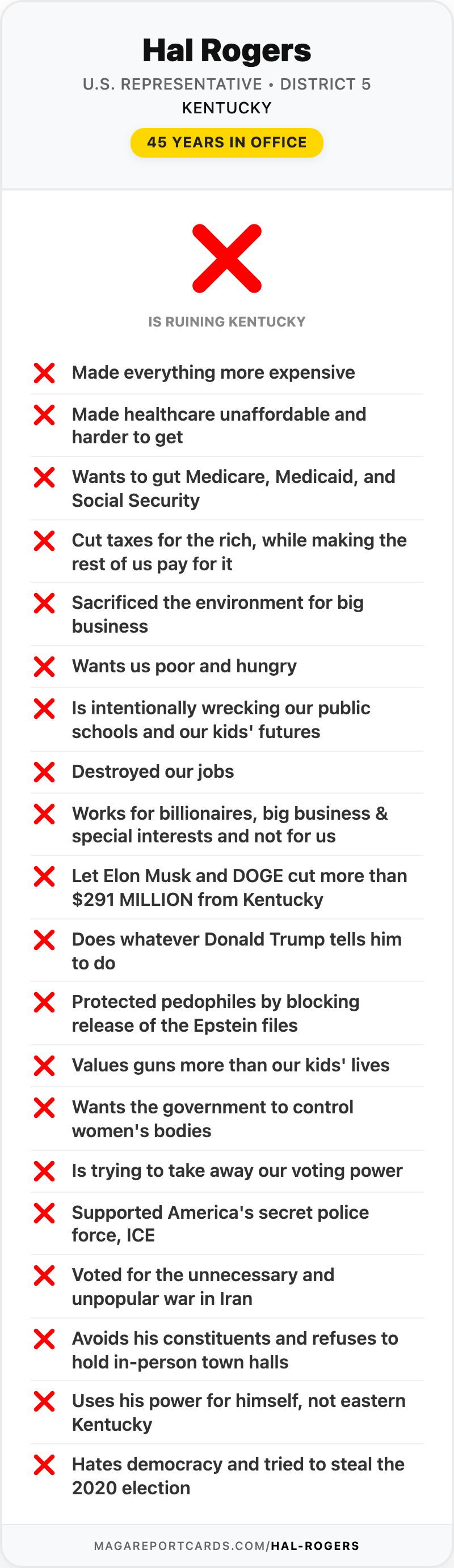
On May 19, 2026, Hal Rogers won the Republican nomination in Kentucky's 5th Congressional District, beating four primary challengers. He is 88 years old. He has been in Congress since 1981. If he wins in November, it will be his 24th term.
Forty-five years is long enough to judge somebody by results. So here are the results.
Kentucky has more economically "distressed" counties than any other state, according to the Appalachian Regional Commission's most recent county rankings. Distressed means the worst 10% of counties in the entire country. As James Branscome, a former ARC staffer, laid out in the Kentucky Lantern, in many eastern Kentucky counties the poverty rate runs at double Appalachia's own ten-year average, and federal transfer payments — Social Security, black lung benefits — make up well over half of taxpayer income. Rogers's district is the state's Appalachian coalfield: Harlan, Letcher, Perry, Owsley, McCreary, Knott, Pike and two dozen more counties like them.
That is what southeastern Kentucky looks like after nearly half a century of being represented by one of the most powerful appropriators in Washington.
It is not that Rogers failed to bring money home. The Lexington Herald-Leader nicknamed him the "Prince of Pork." The question is where the money went, and who else got paid along the way.
"Something stinks in Corbin"
In 2006, New York Times reporter Eric Lipton published an investigation into why the Department of Homeland Security, four years and tens of millions of dollars into building a tamperproof ID card for airport, rail and port workers, still hadn't produced a single one.
The answer he found was that the program kept taking detours through Hal Rogers's district. Rogers chaired the House subcommittee that controlled the entire Homeland Security budget.
The Times documented what those detours produced:
- Rogers inserted language into appropriations bills that pushed the government to use older green-card technology and to produce the new card in Corbin, Kentucky — a town of 8,000 in his district. Homeland Security had already identified a smart-card approach as more secure and more flexible. It had to spend $4 million on a study to compare them anyway. The study concluded the smart card was far superior.
- When contractors started printing prototype cards in Pennsylvania to save time, the government made them ship the equipment to Corbin, because Rogers's mandate had been written into the contract. Only about 5,000 test cards were being printed. It added cost and caused another delay.
- John Rogers, the congressman's son, was hired as a computer systems administrator by Senture, a Kentucky call-center company that landed Homeland Security work on the program. Rogers had attended Senture's ribbon-cutting in 2003 and arranged financing for a $4 million department contract for the company in 2004. His son said the job "has nothing to do with who my father is."
- Since 2000, a Virginia trade association — the American Association of Airport Executives — had paid for more than $75,000 in travel for Rogers and his wife: six trips to Hawaii, four to California, one to Ireland. In one year alone he spent two weeks traveling on their tab. Political Money Line ranked him seventh out of all 535 members of Congress in travel gifts accepted over five years.
- Rogers's staff spent years pressing Homeland Security to hire that same trade association for the ID card program. When the department wouldn't, Rogers put language in the 2006 appropriations bill ordering it to. The association promptly went looking for investors willing to put up as much as $25 million to share in the for-profit venture it created to cash in.
- In all, the Times found, about $100,000 in contributions had come to Rogers from parties with at least some ties to the ID card effort.
An industry official called the arrangement "sleazy." A watchdog called it "a perversion of every part of the contracting process." A securities analyst who followed the ID card industry put it more bluntly: "Something stinks in Corbin."
The no-bid contract was killed days before the story ran, after competitors complained to Congress. The mandate requiring the cards be made in Corbin was not.
Rogers's public response to all of it was a statement saying he had been "extremely frustrated with the slow, wandering pace of the program." He declined to say anything else.
The pattern, in his own words
When the Herald-Leader called him the Prince of Pork, Rogers had an answer that explains a lot:
"I'm two people. I'm a national legislator and I'm a local Congressman."
The Center for Public Integrity reported in 2010 that Citizens for Responsibility and Ethics in Washington alleged Rogers had steered roughly $30 million in 2009 earmarks to companies that gave $48,000 to his political committees. It also noted that in 2010 alone he ranked fourth in the House with 34 earmarks worth more than $68.3 million.
Two more from that era, reported by ABC News' Jonathan Karl and quoted by HuffPost as he was about to take the Appropriations Committee gavel:
- A tiny airport near his hometown got $17 million in federal dollars and had so little traffic that its last commercial airline service ended.
- Rogers pushed through a $5 million measure for conservation groups working with endangered wild cats. One of the few groups eligible was the Namibia-based Cheetah Conservation Fund — which employed his daughter.
None of this was illegal. That's the thing worth sitting with. Steering federal money toward your donors, your district's favored firms, and the occasional organization that employs your own child is, under the rules Congress writes for itself, ordinary business.
Who pays him now
Rogers chairs the Appropriations Subcommittee on Commerce, Justice, and Science and sits on the Appropriations Subcommittee on Defense. His five biggest PAC donors since 2020 are the defense contractors whose federal contracts those subcommittees fund: Boeing, RTX, Northrop Grumman, Lockheed Martin and General Dynamics. Blue Origin is on the list too.
The job is the same as it was in 2006. The committee is bigger.
What eastern Kentucky got instead
Here is the part that should decide the November election.
Rogers represents one of the most Medicaid-dependent districts in America. In July 2025 he voted for Trump's budget bill and put out a statement claiming it "strengthens Medicaid and SNAP benefits" — while Kentucky's hospitals called the same bill "devastating."
His district is the heart of black lung country. Kentucky has more black lung benefit recipients than any state. Local Republicans in eastern Kentucky have been publicly asking Washington to raise those benefits, and Rogers won't back the bill.
He is not an obscure backbencher who couldn't deliver. He is the Dean of the House, a former chairman of the full Appropriations Committee, a man who has been able to move federal money at will for four decades. He moved a national security program to a town of 8,000 people because he could. He moved $17 million to an airport with no airline.
And after all of it, his constituents live in the counties the federal government itself classifies as the worst-off in the country.
Forty-five years. Twenty-four terms, if voters give him one more. Somebody in Kentucky's 5th has done very well out of that arrangement. It isn't most of the people who live there.
Sources
- In Kentucky Hills, a Homeland Security Bonanza — Eric Lipton, The New York Times, May 14, 2006
- Hal Rogers: Appropriations Committee? — Peter H. Stone, Center for Public Integrity, November 4, 2010
- Hal Rogers, 'Prince Of Pork,' To Be Appointed GOP Chairman Of House Appropriations Committee — HuffPost, December 7, 2010
- Why US should not abandon its debt to Appalachia — James Branscome, Kentucky Lantern, July 14, 2025