There is a rule on the books that would let the U.S. Postal Service stop delivering your ballot.
It works like this. Before a state can mail out ballots, it has to send the design of its ballot envelopes to the Postal Service for approval, with a unique barcode on each one. It also has to upload the name and address of every single voter who asked for a mail ballot into a federal computer system. If the state doesn't get the approval, or doesn't upload the list, mail carriers won't deliver its ballots.
On Friday, September 4, 2026 — 60 days before the midterms — a federal judge blocked that rule from taking effect this fall.
Twelve Republican attorneys general were in that courtroom arguing the other way.
What the judge found
U.S. District Judge Indira Talwani in Massachusetts issued a 49-page preliminary injunction. She ruled the Postal Service had no power to write the rule in the first place:
"Unauthorized by the Elections Clause, the Final Rule clashes with Congress's statutory scheme, and is unconstitutional where it intrudes not only on Congress's Elections Clause powers but also that power left to the States."
Then she weighed the harm on each side. On one side, she wrote, "immediate implementation of the Final Rule issued less than seventy days before the November 2026 election threatens disenfranchisement of millions of United States citizens who seek to vote by mail." On the other side, she found, "the record includes no evidence relating to fraudulent mail voting to support the rushed implementation of the Final Rule."
That is the whole case in two clauses. Millions of people could lose their ballots. Nobody put any evidence of the fraud in front of her.
She was blunt about what the rule would do to real people: "any minor malfunction will result in the denial of mail ballots," which made disenfranchisement for the plaintiffs' members "practically inevitable."
Twelve Republican states asked to be the test case
Back on April 21, 2026, Missouri Attorney General Catherine Hanaway announced that she was leading a coalition of 12 states into the case to defend President Trump's March executive order. Her press release names them: "Attorneys General from the following states joined the Missouri-led filing: Alabama, Florida, Indiana, Kansas, Louisiana, Montana, Nebraska, Oklahoma, South Carolina, South Dakota, and Texas."
"We thank President Trump for issuing a vital, protective executive order," Hanaway said. The coalition told the courts the order simply gave states "optional resources."
It stopped being optional. By last week the Postal Service had turned it into a binding rule, and at Thursday's hearing the twelve states' lawyer, Missouri Solicitor General Louis J. Capozzi III, made a specific request: if the judge was going to block the rule, she should at least not block it in their states. Letting states like Texas and Missouri go ahead, he argued, would show how the system works in the real world.
Talwani did not take that well.
"So, we're going to do a test run on this election?"
"In some states," Capozzi answered.
"We're not talking about an intellectual puzzle game. We're talking about people's right to vote."
She pressed him on what his own states would actually get out of it. According to CBS News, she asked: "How does USPS holding up the ballots help you? You want the voters in your state to be disenfranchised?"
She refused the request. Had she granted it, the Postal Service could have refused to deliver ballots in those twelve states if they fell short of the new requirements.
Eleven of them wouldn't put it in writing
Here is the part that gives the game away.
Twelve states went to court to say this rule is workable. Between them, they filed one piece of sworn evidence saying so — a single page from the Missouri Secretary of State.
Davin Rosborough, the ACLU lawyer for the League of Women Voters of Massachusetts, laid it out after the hearing:
"The only evidence that the states who intervened on the defendant's side put in [the record] was a single one-page declaration from the Missouri Secretary of State saying, in vague terms, 'I think we can comply.' Alabama, Texas, none of the other states put in anything…"
"I think the failure to put anything in writing — and under penalty of perjury — speaks volumes," he added.
A court declaration is signed under penalty of perjury. Eleven attorneys general were willing to argue in court that their states could handle this. Not one of them was willing to swear to it.
Texas argued for it. Texas election officials swore against it.
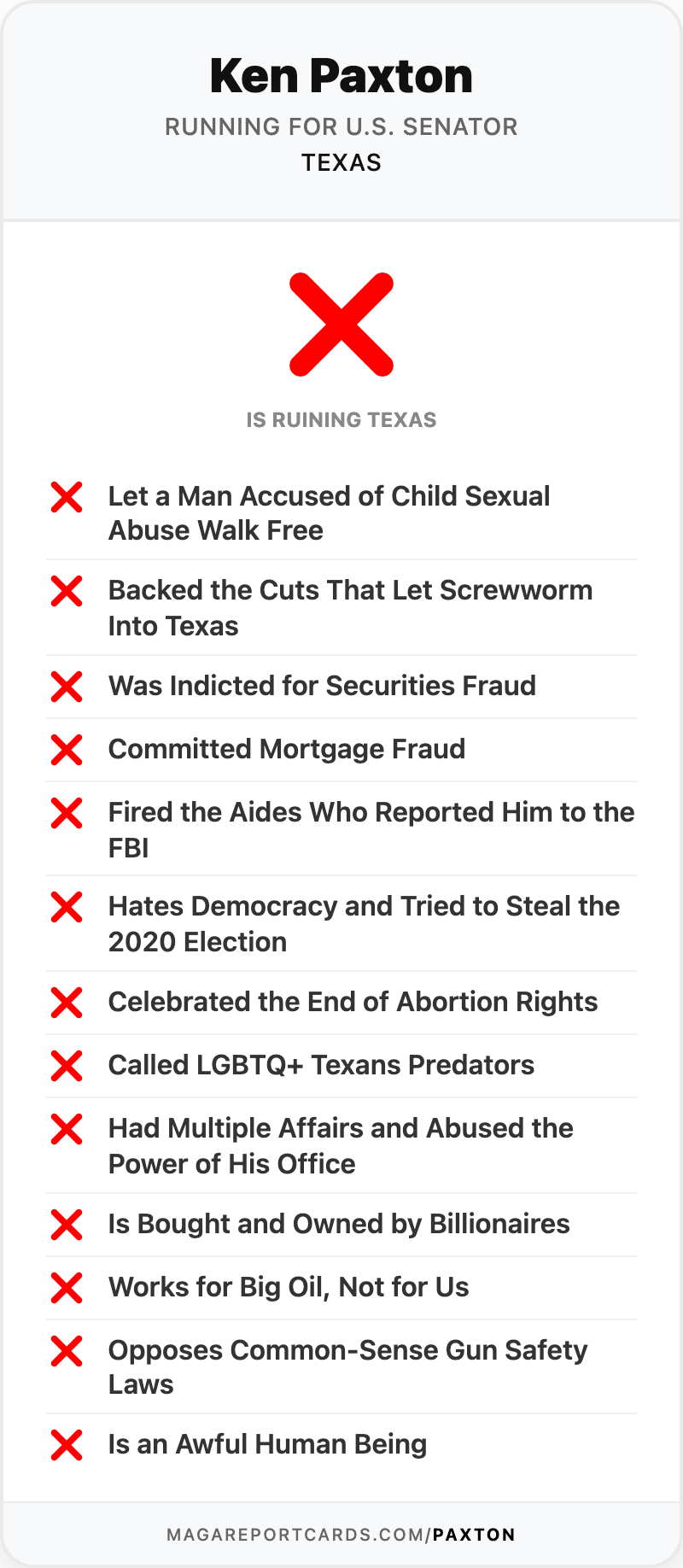
Texas is one of the twelve. Its attorney general is Ken Paxton, who is also running for the U.S. Senate this year.
While his office was on the side defending the rule, local election officials from Texas's own Travis and Harris counties — home to Austin and Houston — filed sworn declarations telling the judge the rule would result in disenfranchised voters. Talwani pointed that out from the bench.
This is the same attorney general who has spent years telling Texans that people who shouldn't be voting are voting. He spent more than a year hunting for noncitizens on the rolls, and NBC News found the whole effort produced three prosecutions statewide — only one of them from the list of 53 names his office was handed. At least five people on that list of 53 had already been listed as American citizens in earlier court records. In August he also won back a Texas mail-ballot ID rule that got the application or ballot of roughly one in seven mail voters thrown out in the 2022 primary, and called it a "major win."
So Texas's top lawyer fought in federal court for a rule his own counties' election administrators had sworn would cost voters their ballots — and filed nothing under oath saying his state could run it.
The fraud isn't there
The Justice Department and the Postal Service say the rule standardizes election mail and stops noncitizens from voting. The judge looked at what they actually submitted and found no evidence of mail voting fraud in the record. CBS News reports flatly that the administration "has not put forth evidence of widespread voter fraud."
President Trump has voted by mail in Florida this year.
What happens next
The Justice Department appealed to the 1st Circuit Court of Appeals the same day the injunction came down, and this is widely expected to reach the Supreme Court again. It already went there once: on August 24 the justices lifted an earlier block on procedural grounds, saying the states had sued before the rule was final. The Postal Service had issued that final rule three days earlier, on August 21 — which Talwani found violated her earlier order, though she declined to hold anyone in contempt given the Supreme Court's ruling.
Her new order carries teeth. It requires the government's lawyers to give written notice to Postal Service officials and to tell them they will be held in contempt if they violate it.
Meanwhile, a federal official inside the Postal Service has told Congress the ballot system the agency built to run all this was assembled so badly it could "derail the midterm elections". At Thursday's hearing, the government's declaration about the system's readiness didn't address that warning at all. "We've seen no denial from the Postal Service that the whistleblower said anything that was inaccurate," said David Becker of the Center for Election Innovation & Research.
Even Republican election administrators want no part of it. "Election officials across the country from both parties are holding our breath today," said Utah Lt. Gov. Deirdre Henderson, a Republican and her state's chief election officer. "It's hard to describe the level of chaos, confusion, and uncertainty we experienced during the 36 hours the rule was briefly in effect last week."
What the record shows
Twelve Republican attorneys general, including Texas's Ken Paxton, intervened in federal court to defend a rule that would let the Postal Service refuse to deliver mail ballots in states that don't comply — and asked the judge to let it run in their own states as a test 60 days before an election. Eleven of the twelve filed no sworn statement that their state could comply. The judge found the record contained no evidence of mail voting fraud, and found that putting the rule into effect now would disenfranchise millions of Americans.
Source
Jacob Knutson and Jim Saksa, "In major win for voters, judge blocks Trump's mail voting restrictions for midterms," Democracy Docket, September 4, 2026.