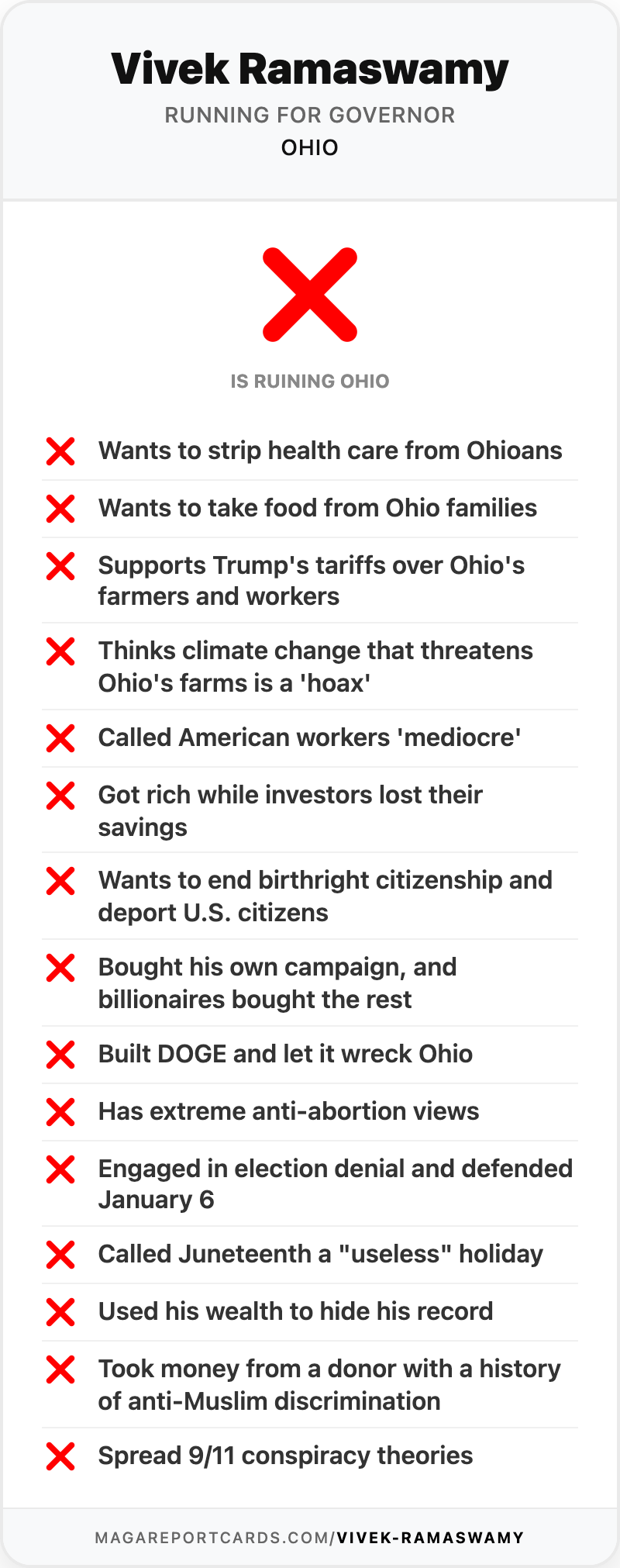
Vivek Ramaswamy wants to be governor of Ohio. Until this week, he had put out no plan on data centers — which he says are the second-most common concern he hears from Ohioans, behind only property taxes.
Cleveland.com, which spent months pressing him, puts it more bluntly: for months he "refused to tell Ohio voters where he stood on the most pressing issues facing the state, relying solely on attack ads to win people over."
That goes too far. Ramaswamy has long said he wants to eliminate the state income tax, and in July he said repealing the tax on capital gains would be his first step. What he hadn't done was say what he'd do about data centers.
He finally put out that plan this week — and cleveland.com credits its own pressure for getting it.
He was the last one standing
Here's the part that makes this hard to spin.
According to cleveland.com, Libertarian candidate Don Kissick had already put his platform out freely, and Democrat Amy Acton, after what it calls her own stretch of stonewalling, had released her plans.
Ramaswamy, it says, was the sole holdout.
Three candidates are on the ballot to govern a state of nearly 12 million. Two had told voters what they'd do. One was running attack ads.
What it took
Chris Quinn, who hosts cleveland.com's "Today in Ohio" podcast, described the campaign it took to get the plan:
"It just is an appalling state of Ohio media that we are the only voice saying, 'Hey, you've never held elected positions. Nobody knows what you stand for. We're going to keep pointing out to everybody that you refuse to state it.' That was relentless pressure and it did break them."
Read the middle of that quote again: "you've never held elected positions."
Ramaswamy is asking Ohio to hand him the governor's office as his first elected job. That is a legitimate thing to run on — outsiders run and win. But a candidate with no record in office has only one way to tell voters what he'd do, and that's to say it out loud. On data centers, he waited until August.
Cleveland.com's chief politics writer Jeremy Pelzer has written a dozen stories on where the candidates stand on this issue — "usually with candidates refusing to say."
A dozen stories. By cleveland.com's account, that's what it took.
What he finally said
The position he broke silence with is on data centers, and on their effect on electricity costs, land use, and local communities.
As podcast host Lisa Garvin summarized it, Ramaswamy would stop new data center construction unless the facilities agree to offer free electricity to nearby residents, help fund homeowner tax relief, and meet new environmental standards. He says most Ohio counties would fall inside a "benefit zone," where residents near a data center wouldn't pay electricity bills tied to the power those facilities use — either by crediting homes with excess power or by having the data centers reimburse customers directly. He also wants tax abatements redirected back to homeowners as rebates.
Garvin's reaction was not a rave:
"It sounds reasonable, but it also sounds we're creating an unregulated utility at the same time."
We looked at this promise when he first floated it. There is no law that does any of it. The whole thing runs through utility regulators the governor appoints — which is why it matters that energy PACs gave his campaign $97,468 this year, most of it after the giving became a public story. Acton took nothing from those PACs.
Now voters can actually compare
The useful thing about all three finally being on record is that the differences are visible:
- Kissick would halt all new data center construction until permanent legislative rules exist, eliminate the tax incentives, and oppose eminent domain.
- Acton would let data centers proceed under state-set restrictions, limit them to brownfields or former industrial sites, and — alone among the three — require 100% union labor and community benefit agreements for the construction jobs.
- Ramaswamy takes the middle: no outright ban, but conditions. In Garvin's words, "he wants to avoid both an outright ban and a free for all."
That's a real debate Ohioans can have. They could have been having it months ago.
The pattern here isn't about data centers
One plan, released in August after what a single newsroom calls months of pressure, is not a detailed platform.
And this is a candidate who already has a documented habit of expensive promises that don't survive contact with arithmetic — his property tax plan would blow roughly a $4 billion hole in Ohio's schools, police, and fire departments.
The reason a candidate leans on attack ads instead of detailed plans is that attack ads can't be checked against a record. A plan can.
The part that should worry Ohio
Quinn's framing deserves the last word, because he wasn't really talking about Ramaswamy. He was talking about what happens when nobody asks.
Cleveland.com says it was "the only voice" pushing. Other newsrooms "stayed quiet." One outlet, on one issue, says it got an answer.
Ohio is choosing a governor in November. If it took a dozen stories and a daily podcast to extract a data center plan from one candidate, the question isn't whether he'll be accountable in office.
It's who's going to be left to ask.
Source
"Ohio data center regulations: comparing the 3 governor candidates' plans," Today in Ohio, cleveland.com, August 2026.