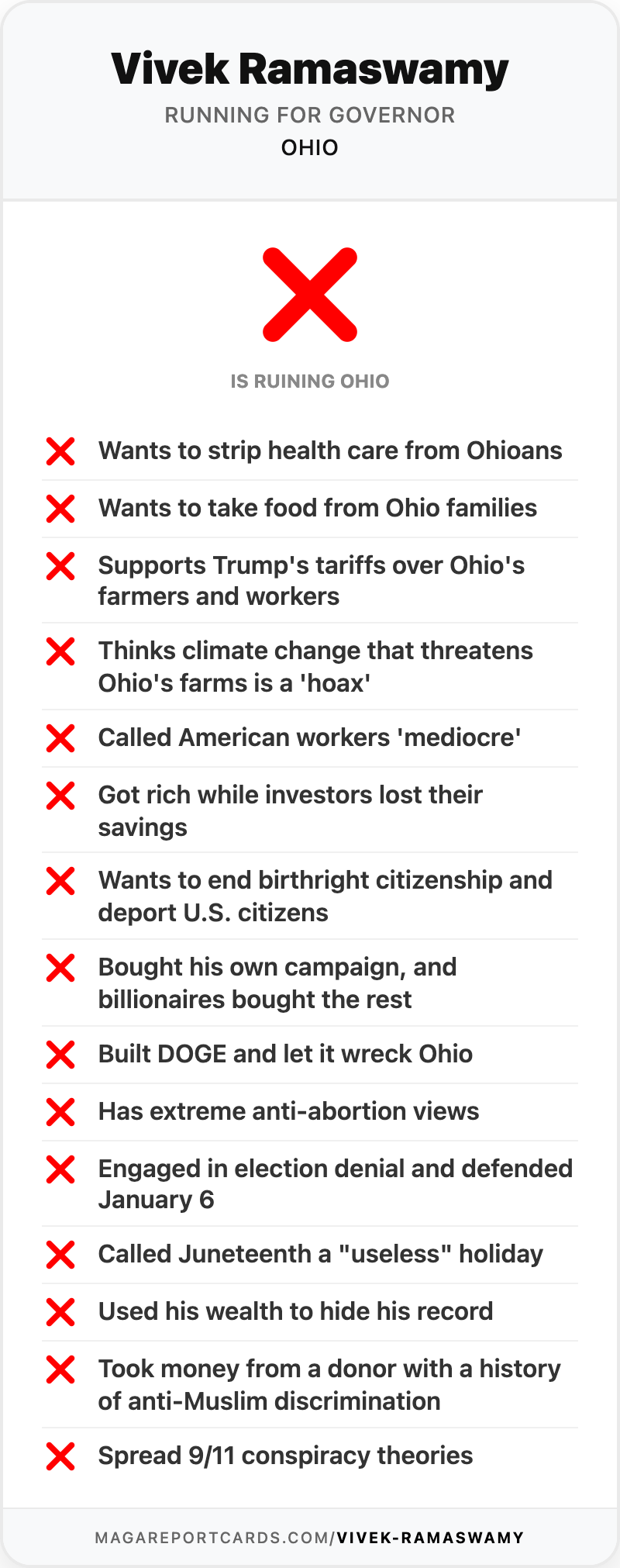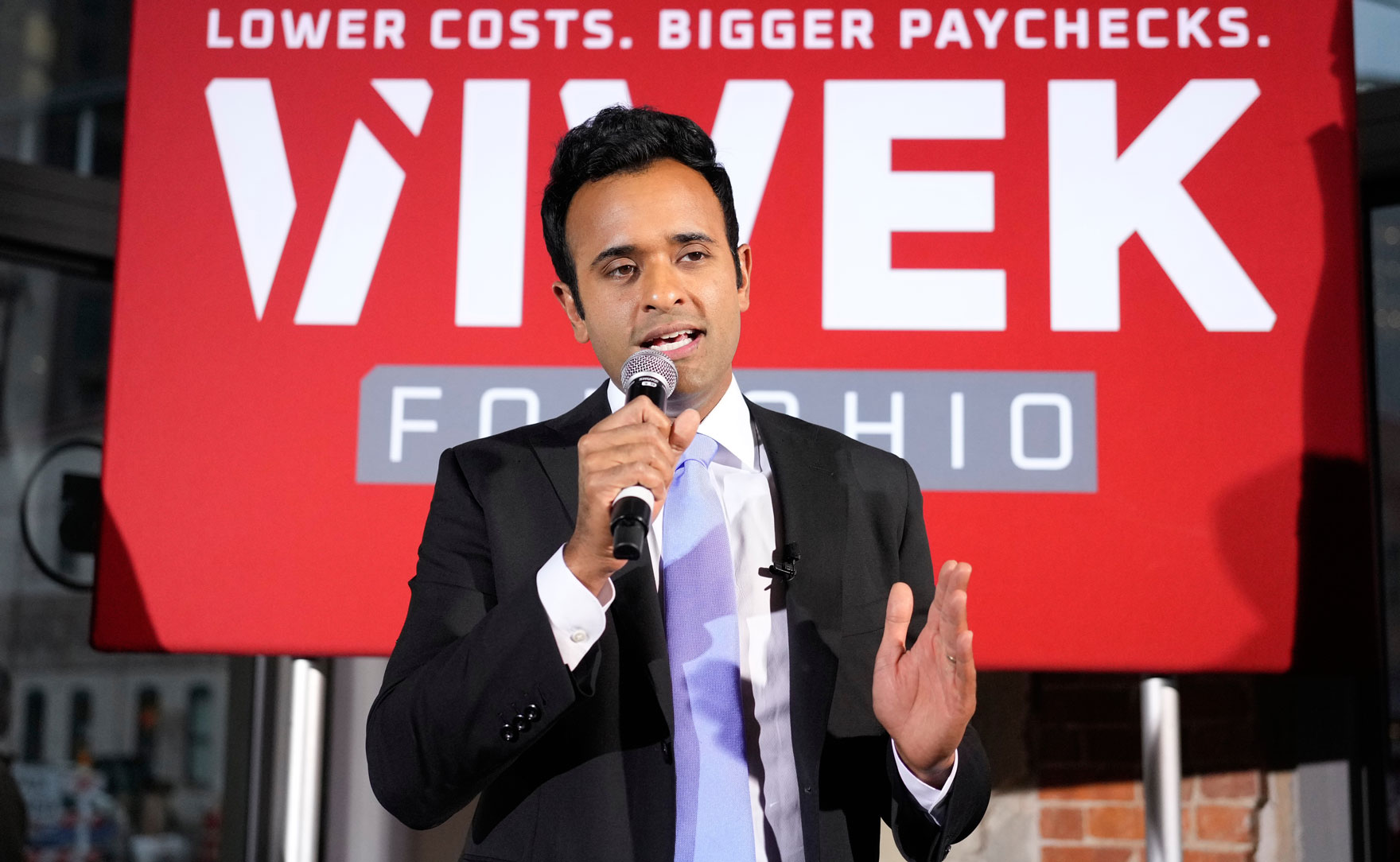
Vivek Ramaswamy wants to be governor of Ohio, and one of his biggest promises is that he'll roll property taxes back to where they were before the pandemic, then cap how fast they can grow — starting with his very first budget next year.
Homeowners are frustrated with property taxes. That frustration is real. But somebody finally sat down and worked out what the promise would actually cost, and the number is enormous.
$4 billion a year. Then $6.6 billion.
Researchers at Innovation Ohio ran the numbers. Because Ramaswamy has never said which year he'd roll back to, they used 2021 — right before property values started spiking.
Here's what they found, as reported by WOSU:
- First two-year budget: $4 billion a year in lost revenue.
- Second budget: $6.6 billion a year.
- That second number is about 60% of everything Ohio's state income tax brings in.
And here's the kicker on that last point: Ramaswamy also wants to eliminate the state income tax.
So the plan is to take away roughly two-thirds of one revenue source, and all of another, at the same time.
That money is not abstract. It's your kid's classroom.
Property taxes in Ohio don't go to some fund in Columbus. They pay for local things — the most local things there are.
Innovation Ohio president Michael McGovern put it plainly:
"That's cuts to our schools, meaning bigger class sizes, eliminating programs, not keeping buildings up. That's cuts to local safety programs. That means police and fire are going to get defunded."
Read that last sentence again. A Republican candidate for governor is proposing a plan that a budget analysis says would defund police and fire departments across Ohio.
Ohio schools are already short. When lawmakers declined to fully fund the Fair School Funding plan in the current budget, districts lost an estimated $2.75 billion. Ramaswamy's proposal would come on top of that hole, not instead of it.
How does he plan to pay for it?
This is where it stops being a policy and starts being a wish.
Ramaswamy says the money will come from two places: downsizing government, and growing Ohio's population to 15 million people.
That is a 36% increase in Ohio's population. He hasn't said whether he means over four years or eight.
For scale: the fastest-growing state in America between 2024 and 2025 was South Carolina, and it grew 1.46%.
To get anywhere near his number, Ohio would have to grow year after year at a rate no state in the country has come close to — while the schools, police departments, and fire departments that make a place worth moving to are being cut by billions.
That is the plan. Cut first, and hope millions of new residents show up to cover it.
He has told us what he thinks government is for
None of this should be a surprise, because Ramaswamy has been unusually honest about his views.
He has said Medicaid and Medicare "were mistakes" and that Medicaid "has harmed the very people that it was created to help." Medicaid covers about one in four Ohioans — roughly 3 million people.
He has called Medicaid "permanent welfare" and pushed work requirements, in a state where the Medicaid cuts in Trump’s budget bill are projected to take coverage from about 255,000 people by 2034. He wants the same requirements applied to all public assistance, including the food aid that nearly 1.4 million Ohioans depend on.
The work-requirement idea rests on a premise that isn't true. 85% of families getting SNAP had someone working in the past year. Their wages are just too low. And research shows stricter requirements don't increase employment — they mostly generate paperwork that knocks eligible families off the rolls.
This is the same man who co-founded DOGE with Elon Musk. Cutting is not a side effect of his agenda. It is the agenda. The property tax plan is that instinct applied to your local school district.
What relief could actually look like
There are ways to help homeowners without gutting local budgets, and they're already on the table in this race.
Ramaswamy's Democratic opponent, Amy Acton, has proposed raising the income limit on the homestead exemption, plus credits of up to $1,000 for homeowners whose property tax bills jump more than 4% — help aimed at the middle-income owners who actually need it. She's also called for fully funding the school formula that's currently $2.75 billion short.
You can argue about whether that goes far enough. What you can't argue is that it's the same thing. One approach targets relief at the people squeezed hardest. The other cuts $6.6 billion a year across the board and hopes a population boom no state has ever managed shows up to fill the gap.
Ohio homeowners deserve real relief. They don't deserve to pay for it with their kids' classrooms and their fire departments.
Source
Karen Kasler, "Vivek Ramaswamy's property tax rollback would mean billions in cuts, says progressive Ohio group", The Statehouse News Bureau / WOSU Public Media, July 31, 2026. Photo: Carolyn Kaster / AP.