On Thursday, August 13, a man who used to guard Vivek Ramaswamy's family stood up in federal court in Columbus and pleaded guilty to running a fentanyl and methamphetamine operation out of a house in Logan County, Ohio.
Justin Salsburey, 44, admitted to conspiring to distribute at least 500 grams of methamphetamine and at least 40 grams of fentanyl. His wife, Ruthann Rankin, 39, pleaded guilty the week before. Both face 10 years to life in prison.
The drugs came in the mail. Roughly 260 packages arrived at their Bellefontaine home between August 2024 and December 2025 — about one every other day for seventeen months. Investigators watched the couple collect the parcels and stack narcotics in a cooler on the porch for buyers to pick up. Salsburey also drove to a post office in Dublin to mail fentanyl and meth pills to customers; in one case he sent 52 parcels to a single man in a Cleveland suburb. When officers searched the house, they found fentanyl pills, meth pills, suspected steroid vials, and about a dozen guns.
Rankin told authorities she had helped sell steroids and Adderall pills, and that her husband started selling steroids and progressed to other drugs.
What Ramaswamy promised, and what was actually happening
When Ramaswamy launched his campaign for governor in Cincinnati in February 2025, he told the room he wanted to "end the epidemic of depression, anxiety, fentanyl, opioid usage, and suicide that has festered in" Ohio.
Two years earlier, running for president, he had a bigger idea. In Iowa in May 2023 he said that if America could kill Osama bin Laden and ISIS leaders abroad, then "we are ready to use our military to annihilate the Mexican drug cartels south of our own border."
That's the pitch: a strongman answer to a problem happening somewhere far away, to somebody else.
Here is where the fentanyl actually was. It was arriving by U.S. mail, at a house in western Ohio, collected by a man employed by the security firm Ramaswamy's campaign was paying to protect his own family. No cartel. No border. No military strike would have touched it.
What was in the house in Bellefontaine
TiffinOhio.net reported that, according to the criminal complaint, the December 30 search of the home turned up 264 grams of fentanyl pills, 938 grams of methamphetamine pills, and 19 grams of MDMA. TiffinOhio ran that 264 grams through the Drug Enforcement Administration's benchmark for bulk fentanyl — one kilogram has the potential to kill 500,000 people — and reported a potential death toll of 132,000. That benchmark is for fentanyl distributed by the kilogram, not for the gross weight of pressed pills, which are mostly filler. The DEA's own figure for counterfeit tablets is 0.02 to 5.1 milligrams of fentanyl each, with 42% of the pills it tests carrying a potentially lethal dose.
The number that isn't in doubt is the one Salsburey admitted to in court: a conspiracy to move at least 40 grams of fentanyl and at least 500 grams of methamphetamine. Ohio recorded 4,452 unintentional drug overdose deaths in 2023, and fentanyl was involved in 78% of them.
The campaign kept paying
This is the part Ramaswamy has never explained.
Salsburey was arrested on December 30, 2025. The story broke publicly on January 8, 2026. That same day — nine days after the arrest — Ramaswamy's campaign paid Salsburey's employer, ARK Protection Group, $12,000, according to campaign finance records filed with the Ohio Secretary of State.
On January 16, campaign spokesperson Connie Luck put out a statement saying the family had "begun the process of relieving Ark Protection Group of their responsibilities."
Four days after that public announcement, on January 20, the campaign paid ARK another $2,000.
All in, Ramaswamy's campaign paid ARK Protection Group $75,971 between April 2025 and that final January payment — $14,000 of it after the arrest of the bodyguard.
ARK Protection Group closed on January 21 — one day after that final payment.
Ramaswamy did not respond to a request for comment about the payment that landed after he said he was done with the firm.
He passed the background checks. He never had the license.
The campaign's defense in January was that Salsburey had cleared multiple screenings. Spokesperson Connie Luck said in a statement that the family "was alarmed to hear this disturbing news," and that Salsburey had passed FBI and Ohio Bureau of Criminal Investigation background checks and drug tests, with the most recent check run in September.
There was one thing he never had. The Rooster reported on January 15 — the day before the campaign said it was cutting ties — that at the time of his arrest, Salsburey had no registration with Ohio's Department of Homeland Security to work as a private security officer at all. That made it illegal for him to work as a bodyguard in Ohio, let alone carry a weapon.
He wasn't the only one. The same report found that a second ARK guard, photographed on Ramaswamy's detail at the University of Cincinnati in December and still working it in Chillicothe on January 12, was also unlicensed. A third, a Dayton realtor moonlighting on the detail, was unlicensed too. Two more ARK guards were working on expired weapons licenses.
Ohio asks a bodyguard for 20 hours of training, a $72 fingerprinting fee, and a $40 background check. It asks a barber for 1,800 hours.
The man who wants to run Ohio's government did not check whether the armed men guarding his own family had cleared a 20-hour class.
The pattern: don't answer, don't itemize, don't explain
None of this is out of character.
Ramaswamy spent months without a data center plan, running attack ads instead, until, by cleveland.com's account, its pressure got one out of him. His campaign put more than $509,000 on a credit card and reported it to the state as a lump sum with no vendors and no purchases listed, which is not how Ohio law works. The super PAC backing him ran more than $10 million through Ohio's public records with the purpose field left blank.
Now there's $14,000 that went out the door to a security firm after its employee was arrested in a federal fentanyl trafficking case, and $2,000 of it after the campaign told the press it had cut ties. Ramaswamy hasn't said why.
What Ohio actually needs from a governor
Ohio doesn't need a candidate who talks about sending the military after cartels. It needs one who will keep treatment available for the people already caught in this.
Medicaid is the backbone of that treatment. In 2024, 40% of Ohio's Medicaid expansion population — 314,031 people — had a primary mental health or substance use disorder diagnosis, and Medicaid paid for 45% of buprenorphine treatments nationwide in 2021–2023. Buprenorphine is one of the main medicines used to treat opioid addiction.
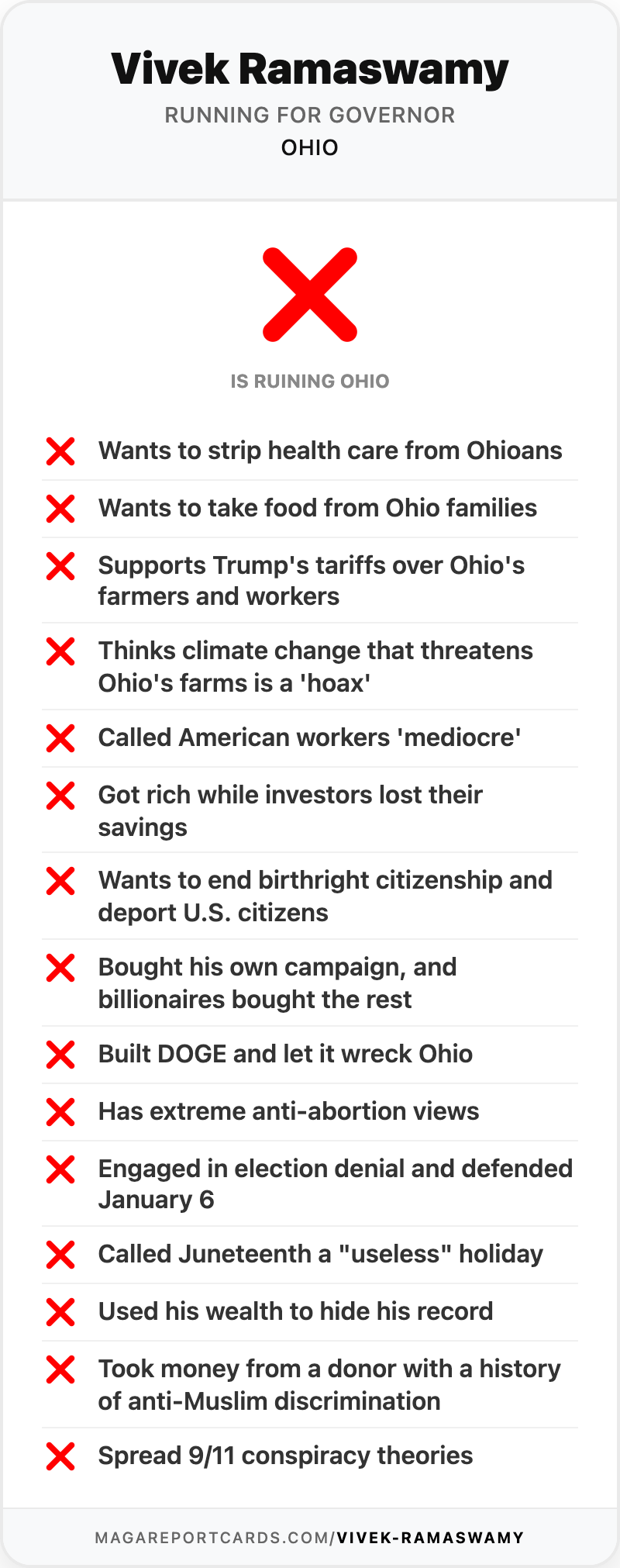
Ramaswamy's answer is to shrink it. At that same launch speech, he backed Medicaid work requirements and called their absence part of a "war on work". More than 90% of adults eligible for Medicaid expansion are already working or exempt from such rules, as the Ohio Capital Journal noted in the same story. The Medicaid cuts in Trump's budget bill are separately projected to take coverage from about 255,000 Ohioans by 2034, according to the Joint Economic Committee. And asked on a podcast in October 2024 whether Medicare and Medicaid were mistakes, Ramaswamy answered "I believe they were."
You cannot promise to end the fentanyl epidemic and then take away the insurance that pays for treating it. That isn't a policy disagreement. It's the whole promise, going in reverse.
The bodyguard's guilty plea is a story about one man and one very bad set of choices. The $2,000 check is a story about Vivek Ramaswamy — about a candidate who says the right words about fentanyl, doesn't check who he's paying, and doesn't answer when someone asks.
Source
Former bodyguard for Vivek Ramaswamy, wife, plead guilty to federal drug trafficking charges — Jared Clayton Brown, WOSU 89.7 NPR News / WVXU, August 13, 2026.