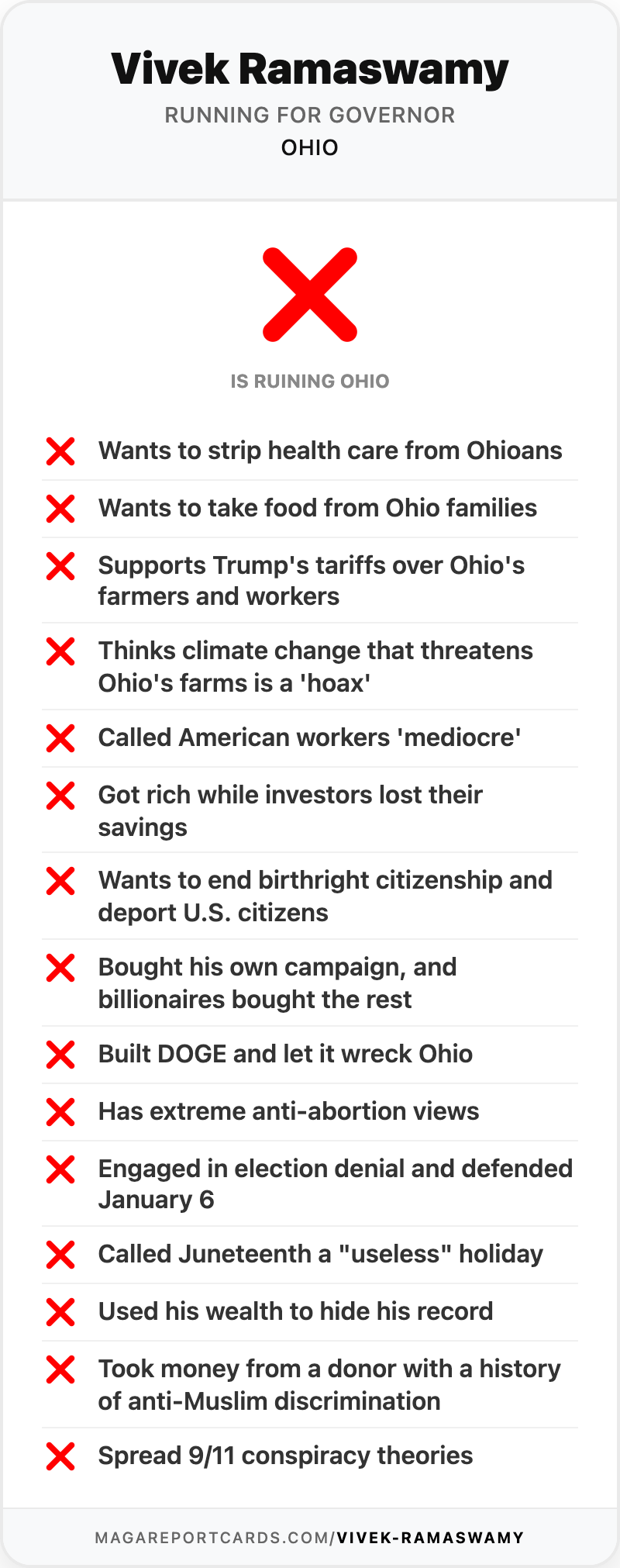
The man who wants to run Ohio's government is hiding how he spends his own campaign's money.
A June 2026 investigation by the Ohio Capital Journal found that Vivek Ramaswamy's campaign for governor has put more than $509,000 on a credit card — and told the public almost nothing about what that money paid for. Since April alone, the campaign ran up $280,892 on an American Express card. On its official reports, all of that spending shows up as a plain monthly credit card bill. No vendors. No purchases. Just a number.
That's not how Ohio law works.
The law says itemize. He didn't.
Ohio campaign finance rules require campaigns to disclose each individual transaction — not just the total, but who got paid and what they bought. For any expense of $25 or more, the state wants a receipt or other proof. Ramaswamy's campaign reported lump sums instead, and it isn't clear it has provided that proof.
Not everyone is alarmed. Phil Richter, the former head of the Ohio Elections Commission, called it "not that out of the ordinary" as long as the campaign eventually backs up the spending. But most of the experts who watch this stuff for a living were blunt about it.
"You can't avoid disclosure by putting campaign expenses on the credit card."
That's Brendan Fischer of the Campaign Legal Center, who looked at how other Ohio campaigns report and concluded Ramaswamy is "an outlier." When a leading candidate reports six figures in credit card payments with no detail, he warned, "voters lose the ability to evaluate whether campaign funds are being spent on legitimate campaign expenses or personal indulgences."
Brendan Glavin of the nonpartisan research group OpenSecrets said Ohio's rule isn't even unclear: "It's unambiguous that you're supposed to itemize each transaction." Catherine Turcer of Common Cause Ohio put it simplest of all — voters shouldn't have to file public records requests just to see basic spending. "There's no reason for there to be any hoops."
The Ohio Capital Journal asked the campaign for the missing details back in April. Eight weeks later — long enough for the campaign to blow through another reporting deadline with more unexplained $90,000-plus credit card bills — it still had no answer.
He knows exactly how to do this — he just chose not to
Here's the part that turns a paperwork problem into a credibility problem. Ramaswamy is not confused about the rules. He has followed them before.
During his 2024 run for president, his campaign itemized its spending transaction by transaction. The reports listed individual expenses right down to a $1,250 payment to a junior fife and drum corps for a campaign event in New Hampshire. He knew how to show his work. In Ohio, running for governor, he simply stopped.
This is the same Vivek Ramaswamy who built his national brand as an anti-establishment "outsider" promising honesty and accountability — the man who co-founded DOGE with Elon Musk, the project sold to the public as a crusade against waste and for transparency in how government money is spent. Now he wants Ohioans to trust him with the state's checkbook while he refuses to open his own.
And the referee works for his team
It would be one thing if a tough, neutral watchdog were on the case. There isn't one anymore.
Last year, Ohio Republicans eliminated the Ohio Elections Commission — the politically independent body that used to investigate campaign finance violations. In its place they created the similarly named Ohio Election Integrity Commission, housed inside the office of Secretary of State Frank LaRose.
LaRose is a Republican. He has endorsed Ramaswamy. And his office is the one now responsible for deciding whether Ramaswamy's campaign broke the law.
When the League of Women Voters fought the change, this is exactly what it warned about: "Allowing elected officials and their allies to oversee violations of the rules that govern their own campaigns sets up a system ripe for favoritism and selective enforcement." Asked whether it had requested the missing documents or opened any inquiry, LaRose's office didn't respond.
State Sen. Bill DeMora, a Democrat who has spent years working as a campaign treasurer, said the double standard is obvious: if the Democratic nominee had hidden big credit card bills this way, he believes the Secretary "would pursue it aggressively." Instead, the requests sit unanswered.
Why this matters to Ohio
This race is on track to be the most expensive governor's race in Ohio history. Ramaswamy has already spent $28.3 million — more than Mike DeWine spent in his entire 2018 campaign — with four months still to go. The half a million on the credit card is a small slice of that. But it's the slice no one is allowed to see.
Campaign finance disclosure isn't red tape. It's the only way voters and donors can check whether a candidate spends money honestly — before they hand him power over a state budget worth tens of billions. A man asking to be trusted with all of that is, right now, refusing to answer a simple question: what did you buy with the $500,000?
Ohioans deserve an answer. We deserve better.
Source
This post is based on reporting by Nick Evans for the Ohio Capital Journal: Ohio GOP candidate for governor has put $500,000 on the campaign credit card. Photo by Nick Evans, Ohio Capital Journal.