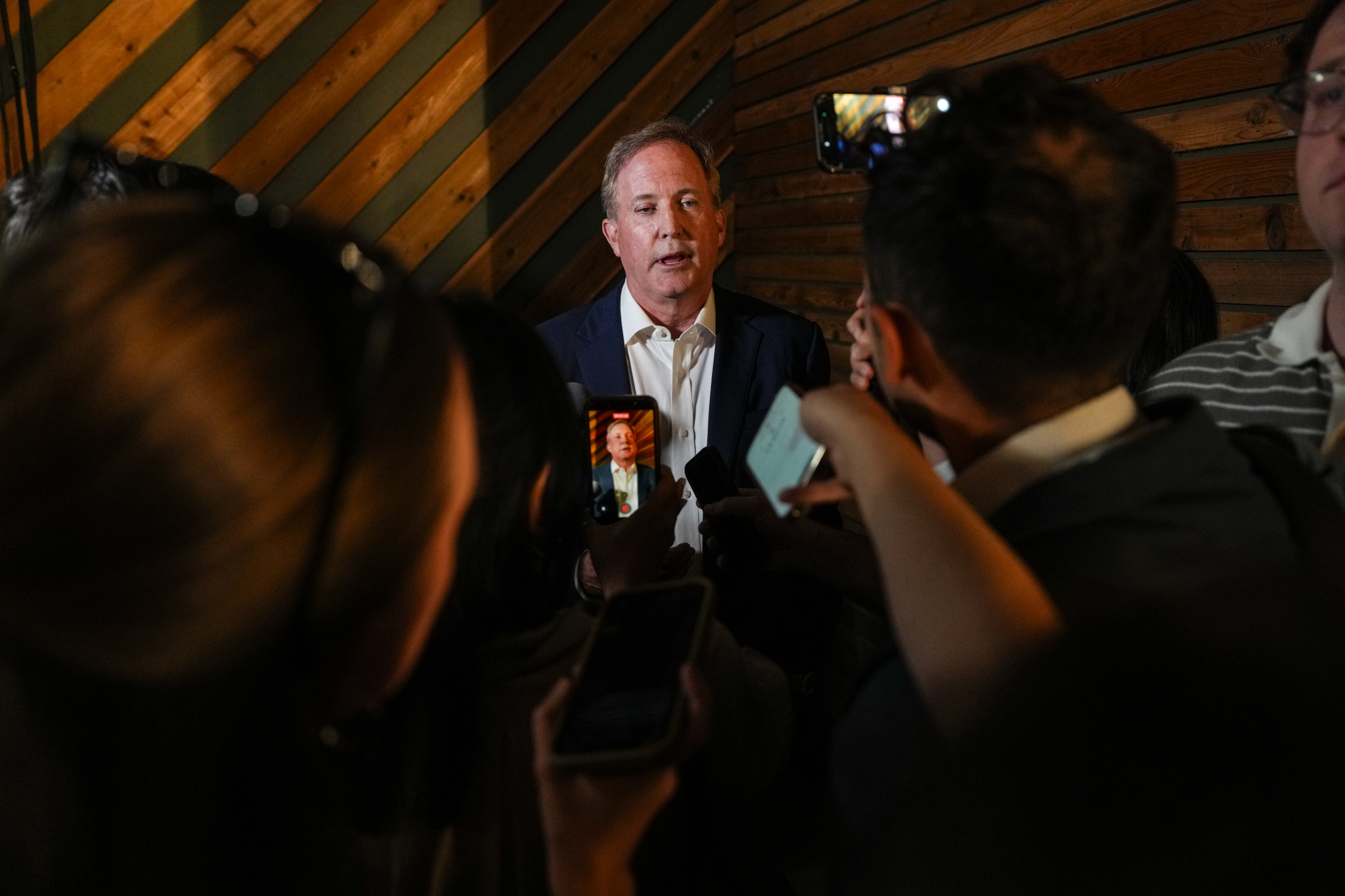
On Wednesday, August 5, Ken Paxton stood on stage at White Oak Music Hall in Houston and told a crowd he had a plan to make life cheaper.
Give him this much: he said the word out loud. President Trump has spent the summer dismissing "affordability" as a word "made up by the Democrats", and told his own Cabinet last December that "the word 'affordability' is a con job by the Democrats." Paxton at least admits the problem is real.
Then he told Texans what he'd do about it. And that's where it falls apart.
What's actually in the plan
Paxton's "Protecting the Texas Promise" agenda is a stack of new tax deductions. According to the rollout, it includes:
- A $25,000 deduction for out-of-pocket medical expenses and insurance premiums — plus another $25,000 per dependent
- A $50,000 deduction for first-time homebuyers and for down payments when you move to a new primary residence
- A $5,000 deduction for "healthy living" expenses — gym memberships, nutrition, sports for your kids
- Doubling the child tax credit from $2,200 to $4,400
It sounds generous. Read the fine print.
The catch: you have to itemize
Three of those four are deductions, not credits. To claim a deduction, you have to itemize your tax return instead of taking the standard deduction. Only the child tax credit — the one item on the list anybody can claim without itemizing — escapes what follows.
Almost nobody does that anymore. In tax year 2022, about 10 percent of taxpayers itemized. The other 90 percent took the standard deduction and moved on.
And here's the part Paxton doesn't mention: his own party is why. The 2017 Republican tax law nearly doubled the standard deduction on purpose, so most families wouldn't have to keep shoeboxes of receipts. It worked. The share of returns that itemized fell from 31 percent in 2017 to about 10 percent in 2022.
So who's left in that 10 percent? The Tax Policy Center breaks it down, and it is not close:
In tax year 2022, nearly two-thirds of tax returns reporting adjusted gross income (AGI) over $500,000 itemized deductions, compared with 10 percent of those with AGI between $50,000 and $100,000 and two percent of those with AGI under $30,000.
Read that again. If you're a Texas family making under $30,000 a year — the family most crushed by grocery prices and rent — there is a 98 percent chance you cannot use a single one of those deductions. The deductions are aimed at the two-thirds of $500,000-and-up returns that itemize.
There's a second catch. Most of this already exists. The IRS already lets you deduct medical and dental expenses above 7.5% of your income — if you itemize. Homeowners can already deduct mortgage interest and property taxes. Paxton isn't opening a new door for working Texans. He's widening a door most of them can't reach the handle on. We've seen this move before: a candidate builds a campaign around a tax break that's already on the books and that he never bothered to claim himself.
Conservative economists say it will make prices go up
You don't have to take a liberal's word for it. The Washington Examiner reported that "supply-side economists are panning" the plan because it "cuts against the long-sought Republican goal of broadening the tax base while lowering overall rates."
Adam Michel of the libertarian Cato Institute told the paper the proposal is "a distinct departure from the traditional Republican tax reform agenda." Will McBride of the Tax Foundation was blunter: "this is piling on subsidies on top of subsidies … it's like trying to put out a fire by setting the place on fire again."
The reason is basic. Housing and healthcare are expensive because there isn't enough of either. Handing people more money to spend on a fixed supply of houses and doctors doesn't lower the price — it raises it. That's not a Democratic talking point. That's what the Republican tax world is telling him in public.
George Callas, who spent 15 years on Capitol Hill and served as senior tax counsel to Republican Speaker Paul Ryan, told the Houston Chronicle the agenda is "not only ineffective, but counterproductive." He also said Paxton isn't the inventor of this genre: "He's not a pioneer here." Callas traced it to "Trump's lack of interest in good tax policy and successful campaigning on 'no tax on "blank."'"
That's the whole playbook. Pick a thing, promise not to tax it, don't ask what happens next. Republicans have been running the same script on tips for two years.
His answer on how it gets paid for is that it pays for itself
Paxton has an answer, of a kind. He told reporters in Allen, per the Dallas Morning News, that "I never believe that tax cuts necessarily mean you have less money in the Treasury, because often if people are able to keep more of their money, they spend it, and it runs through the economy." The Mercatus Center's Joshua Rowley, in the same story, said his proposals "aren't things that are going to expand the size of the economy, especially relative to the revenue loss." That matters right now more than it usually does.
The Congressional Budget Office projects the federal government will spend about $1.0 trillion on interest payments on the national debt in fiscal 2026 — more than the $885 billion it spends on national defense. All that debt pushes interest rates up. Higher interest rates mean higher mortgage rates. Higher mortgage rates mean the house Paxton says he wants you to buy costs more every month for thirty years.
A $50,000 down payment deduction you can't claim doesn't fix that. It makes it worse. This is the same trick we've documented from Republicans who call themselves debt hawks right after voting for trillions in new debt.
Now look at Paxton's actual record on these exact issues
The plan is a bad plan. What makes it worse is that Paxton has spent eleven years as Attorney General doing the opposite of what it promises.
On medical costs. Paxton wants to give you a deduction for out-of-pocket health expenses. As Attorney General, he led the multi-state lawsuit to strike down the entire Affordable Care Act — the law that caps out-of-pocket costs and bars insurers from turning you away. The Texas Observer reported at the time that more than 4.5 million Texas adults under 65 have pre-existing conditions that would likely have made them uninsurable without those protections. Texas already has the highest uninsured rate in the nation for both kids and adults — 13.6% of Texas children and 21.6% of Texas adults, both roughly double the national rate. On top of that, KFF projects that 480,000 more Texans will be uninsured by 2034 because of Trump's budget bill, and that Texas will lose $27.9 billion in federal Medicaid funding over ten years. A $25,000 deduction does nothing for a person with no insurance card.
On housing. Paxton is offering a $50,000 tax break tied to your primary residence. Public records show that Ken Paxton has claimed three different properties as his primary residence on mortgage documents — one outside Dallas and two in Austin — which the Associated Press reports locked in lower interest rates. On two other properties, the AP found the Paxtons may have broken mortgage terms by renting them out, including a "5 bedroom luxury cabin" in Broken Bow, Oklahoma, carrying a $1.2 million mortgage and listed on Airbnb. Knowingly making false statements on mortgage documents is a federal and state crime, and Paxton's office is one of the primary agencies tasked with investigating mortgage fraud in Texas. He wants to write "primary residence" into the federal tax code. He has a documented history with that phrase.
On the grocery bill. Paxton cheered on the DOGE cuts and attacked fellow Texas Republican John Cornyn for questioning them. Those cuts gutted the programs that had kept the flesh-eating New World screwworm out of the United States since 1966. In June 2026 the USDA confirmed the first Texas case in sixty years, in a calf in Zavala County. Texas has a $15 billion cattle industry, and beef prices were already at record highs before any of this.
On who he actually works for. When Paxton does move fast on someone's costs, it tends to be someone who wrote a check. The chair of the Texas Tech Board of Regents gave $274,300 to a committee backing his Senate run, and one day later Paxton's office sent the Big 12 a letter warning that sanctioning Texas Tech would be "unlawful" and could cost the conference "substantially more than $200 million." Meanwhile the broader Republican donor class has been ducking his calls because of his scandals.
What a real affordability plan would look like
Callas pointed to bipartisan permitting reform — making it easier to build power plants and transmission lines, which is how you actually lower an electric bill. The column lists three more: end the war in Iran so fuel and fertilizer move again, drop the tariffs that tax everything you buy, and pass an immigration bill so the people who build houses, grow food, and staff hospitals can legally do it.
None of that is on Paxton's agenda. Every one of those requires taking on Trump.
That's the tell. Paxton's plan isn't designed to lower your costs. It's designed to let him say the word "affordability" in a campaign ad without ever crossing the man who runs his party. We deserve better.
Source
Evan Mintz, "Ken Paxton's economic agenda could actually make things more expensive," Houston Chronicle, August 10, 2026. Photo: Jacob Lujan / Houston Chronicle.