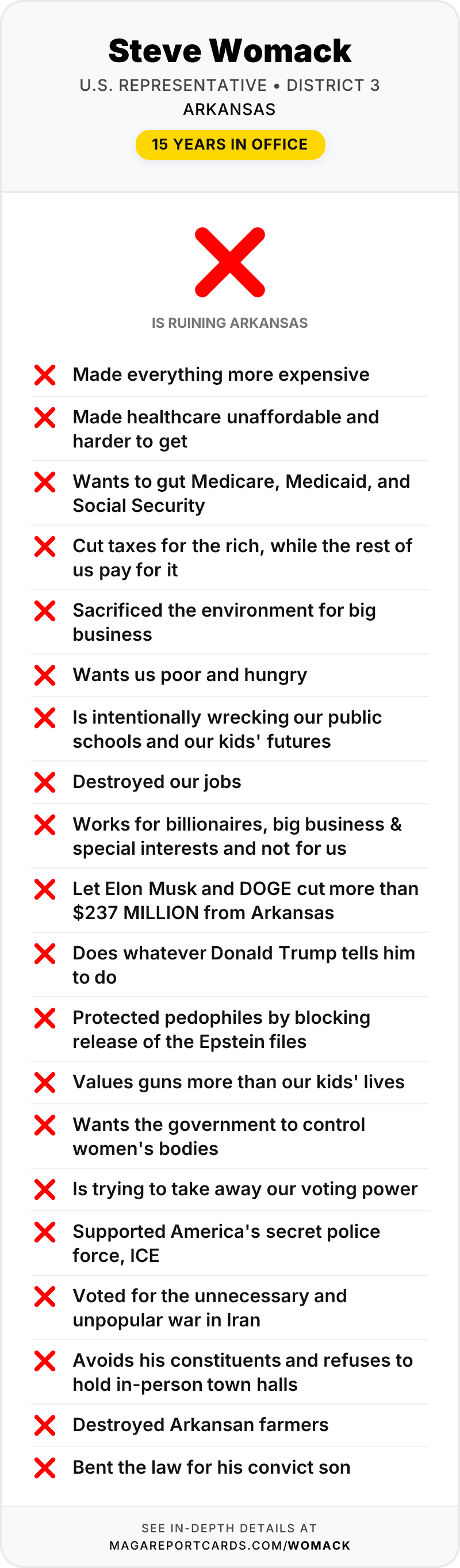
On June 24, 2026, Steve Womack introduced the Budgeting for a Better America Act, a bipartisan bill to fix how Congress handles money. According to the Committee for a Responsible Federal Budget, the bill would move Congress to two-year budget resolutions, add debt and deficit information into the budget process, create a "Fiscal State of the Nation" hearing, and set up a commission to recommend how to get the deficit down to 3 percent of the economy within ten years.
The budget watchdog group praised it. Its president, Maya MacGuineas, said the members behind it "deserve real credit for putting forward a serious bipartisan bill to help Congress budget more responsibly."
This is Womack's brand. He chaired the House Budget Committee in the 115th Congress. He co-chaired the 2018 Joint Select Committee on Budget and Appropriations Process Reform with Democrat Nita Lowey, and its recommendations make up much of this bill. He is Arkansas's designated grown-up on the national debt.
So let's talk about what he did on July 3, 2025.
The $3.4 trillion vote
That day, Womack voted for the One Big Beautiful Bill Act — Trump's budget bill. The Congressional Budget Office's final score found the law will add $3.4 trillion to the debt over ten years, and that's before counting the extra interest owed on all that new borrowing.
Womack put out a press release the same day. It is about five hundred words long. It lists the tax provisions. It lists $9 billion for servicemember quality of life, $21 billion for munitions, $12 billion for readiness, $7 billion for air superiority. It lists $46.5 billion for border barriers, $4.1 billion for Border Patrol hiring, $6.1 billion for border technology, $12.5 billion for air traffic control.
Count the mentions of the deficit, the debt, or how any of it gets paid for.
Zero.
The closest it comes is a section header claiming the bill "prevents waste, fraud, and abuse." What's under that header isn't waste or fraud. It's Medicaid work requirements, Medicaid cost-sharing for people just above the poverty line, and new SNAP restrictions. That's not eliminating waste. That's taking health coverage and food away from poor people and calling the savings a cleanup.
Here's Womack's own quote from that release:
"I'm proud to vote for this bill that delivers on the clear direction Americans gave us in November."
The man who chaired the Budget Committee, on the largest single addition to the national debt in years, had nothing to say about the debt.
The part where the trap closes
Read the first bullet of his own press release. The bill works by:
"Making the 2017 Trump tax cuts permanent—protecting the average taxpayer from a 22 percent tax hike."
Womack voted yea on the Tax Cuts and Jobs Act on December 20, 2017, when it passed the House 224–201. Then in 2025 he voted to make those cuts permanent — which is the single biggest reason the bill scores at $3.4 trillion.
And now, eleven months later, he wants a commission to figure out how to close a hole that size.
Think about the order of operations. First you lock in the tax cuts forever. Then you set up a bipartisan commission with a mandate to get deficits down to 3 percent of GDP. The revenue side is off the table by law. So there is exactly one place the commission can look.
It can look at the spending. Which means Medicare, Medicaid, Social Security, food assistance, and housing — the same programs Womack has already been cutting with his own gavel.
He's already showing us what he'd cut
You don't have to guess. Womack chairs the Appropriations subcommittee that writes HUD's budget, and this June he brought forward a bill that cuts homeless assistance grants by $256 million and public housing by $1.3 billion — while finding $875 million to prepare for the 2028 Olympics.
He also voted for the health care provisions that, together with the health insurance tax credits that expired at the end of 2025, will leave 28,000 more people in his own district uninsured by 2034 — and in January 2026 he joined every Arkansas Republican in voting against restoring those credits.
That's the actual fiscal philosophy. Borrowing for tax cuts and border walls is prudence. A rent voucher is a spending problem.
Why this matters more from him than from anyone else
Plenty of members of Congress vote for debt and then complain about debt. What makes Womack different is that he has spent his career claiming the referee's jersey.
He chaired the Budget Committee. He co-led the budget-process reform committee. He belongs to the Bipartisan Fiscal Forum. When the Committee for a Responsible Federal Budget wants a Republican to stand next to, they call him.
That reputation is worth something, and he spends it. It's how a $3.4 trillion vote gets waved through as a serious person's decision. If the House's designated deficit hawk says the bill is fine, who's left to say it isn't?
Process reform is not nothing. Biennial budgeting and better debt data are genuinely reasonable ideas. But a commission is also the oldest move in Washington: it converts a choice you already made into a problem someone else has to solve later — usually by cutting something from people who don't have lobbyists.
The bottom line
Steve Womack has represented northwest Arkansas since 2011. The last in-person town hall on his own congressional calendar was in Harrison on September 3, 2019 — seven years ago. Since then he has taken constituents' questions down a phone line.
If he did hold one, somebody would surely ask the question his press releases keep dodging:
If the debt is the emergency you say it is, why did you vote to add $3.4 trillion to it — and why is the plan to pay for it always our health care, our food, and our housing, and never the tax cuts you made permanent?
Source
Committee for a Responsible Federal Budget, "Bipartisan Fiscal Forum Leaders Introduce Budgeting for a Better America Act", June 24, 2026. Photo: U.S. House of Representatives.