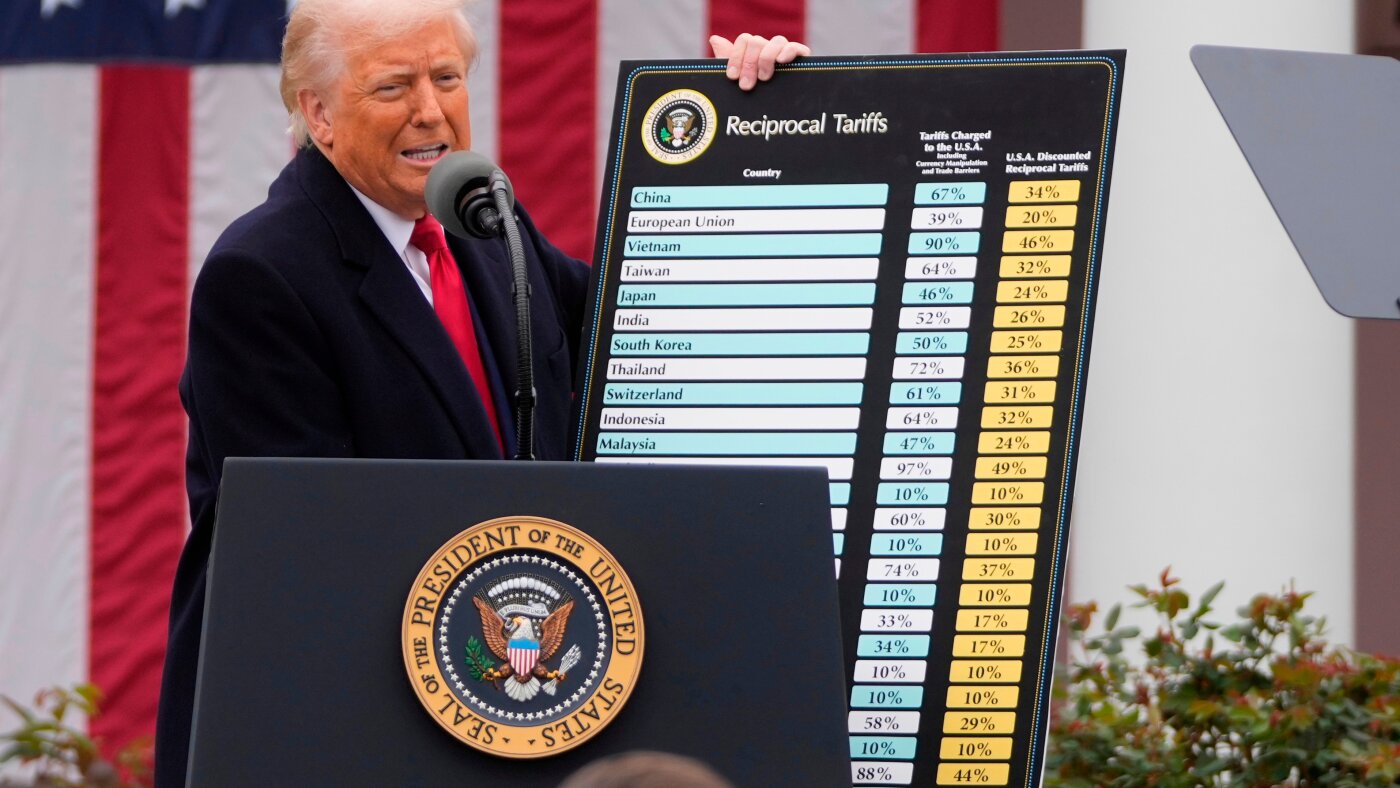
Here's the thing nobody in the White House wants you to remember: a tariff is a tax. And this week, President Donald Trump signed off on a big new one.
On Thursday, the administration announced new double-digit tariffs on dozens of trading partners. Starting Friday, the U.S. will charge taxes of 10% to 12.5% on imports from 60 countries — nations that account for 99% of everything we import. The official reason is that those countries haven't done enough to stop goods made with forced labor. But strip away the justification and the mechanics are simple, and they land on you.
Who actually pays
The plain explanation of how tariffs work is right there in the reporting. As the Associated Press put it: "Tariffs are paid by companies in the United States that import foreign products. The importers usually try to pass along the cost by charging consumers higher prices."
That's it. The tax isn't paid by China or India or Vietnam. It's paid by American businesses when goods cross the border — and they pass it on to you at the register. Trump can call it whatever he wants. On your grocery bill, your hardware-store receipt, and your kid's back-to-school shopping, it shows up as a higher price.
And it adds up. In April, the nonpartisan Yale Budget Lab estimated that Trump's tariffs would cost the average American household somewhere between about $760 and $1,500, depending on which ones stay in place. That's not a rounding error. That's a car payment. That's a month of groceries. That's money out of your pocket, handed to the government as a hidden tax.
The timing tells you everything
Read the calendar. Trump is rolling out a brand-new round of price hikes with the Nov. 3 midterm elections just months away. The AP flat-out called it what it is: "the administration is taking a risk in rolling out new tariffs ahead of the Nov. 3 midterm elections," at a moment when "Americans are already frustrated by the high cost of living."
Frustrated is right. For two years, the promise from Trump and his allies in Congress was that they'd bring prices down. Instead, the signature economic policy of this administration is a tax that pushes prices up, and they're doing it on purpose, again, right before you vote.
This is Trump's second try — the courts already said no once
If this feels like déjà vu, that's because it is. Trump's first version of these tariffs was so sweeping that the Supreme Court struck it down in February. He had invoked a 1977 emergency law, the International Emergency Economic Powers Act, to tax imports from nearly every country on Earth — and the Court ruled that law didn't give him the power to do it. The government even had to pay refunds to importers who'd already been charged.
So he tried a temporary workaround, then reached for yet another law — Section 301 of the Trade Act of 1974 — to make the tariffs stick. And more are coming: his trade office has launched a new probe into 16 more countries that make up 70% of U.S. imports.
This is a president who got told "no" by the highest court in the land and simply went looking for a different door. The one branch of government that's supposed to check that behavior? It's been holding the door open.
Republicans in Congress could stop this. They chose not to.
Here's the part that should make every voter angry, no matter their party. Congress — not the president — holds the constitutional power over tariffs. Republicans control both chambers. They could end this any time they wanted. They've done the opposite.
When Democrats forced votes in 2025 to cancel Trump's tariffs, nearly every Republican senator voted to keep them. One resolution died on a 49-49 tie, and Majority Leader John Thune then moved to bury it for good. On that vote, only three Republicans — Rand Paul, Susan Collins, and Lisa Murkowski — broke ranks. As Collins put it, the tariff policy is "too broad and doesn't distinguish between our allies and our adversaries." Everyone else lined up behind higher prices.
The House was even worse. In 2025, House Republicans didn't just vote to keep the tariffs — they rewrote the rules so members couldn't even vote on them at all, adopting resolutions that blocked any floor vote to terminate Trump's tariff "emergencies." Senator Paul, a Republican, called his own party's maneuver exactly what it was: "trickery, chicanery, deceitfulness, dishonestness."
That's the record. Given a chance to protect their own constituents from a tax hike, Republican leaders in Congress used procedural tricks to make sure no one could stop it.
The bottom line
You'll hear a lot of noble-sounding language about forced labor and human rights, and forced labor is a real and serious problem. But even the human-rights experts the AP interviewed said it's "reasonable to be skeptical of the motivation" here — though they said the levies could make an impact — and one warned the bans could turn out to be "thin slips of paper with no enforcement."
Meanwhile, the guaranteed part — the part that isn't up for debate — is the tax. Sixty countries. Ninety-nine percent of imports. Hundreds to over a thousand dollars out of the average family's budget. Rolled out months before an election, by a president the Supreme Court already slapped down once, and protected every step of the way by Republicans in Congress who could have said no.
They keep telling you they're fighting for lower costs. Watch what they actually do.
Source
- "Trump to impose double-digit tariffs on dozens of countries," the Associated Press, via NPR, July 23, 2026.


