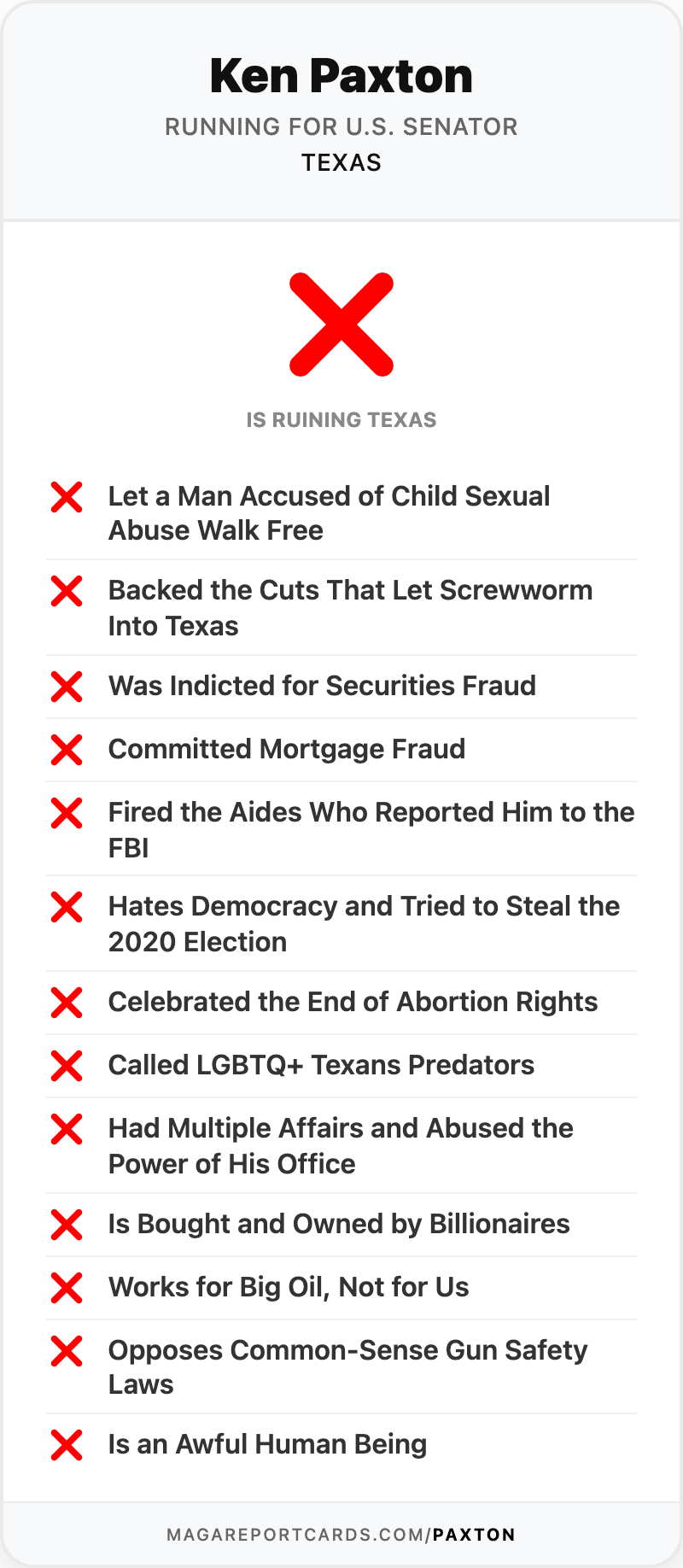
In 2007, cancer was killing about 35,000 Texans a year. So Texas did something about it.
Republican Governor Rick Perry pushed a plan to spend $3 billion in public money on cancer research and cancer prevention. It was called the Cancer Prevention and Research Institute of Texas. Republicans and Democrats backed it together. The Republican state representative who introduced the bill called it "one of the most positive actions we can take this session, to cure cancer in our lifetime."
It passed both chambers of the Texas Legislature overwhelmingly. Then it went to the voters, and 61% of Texans said yes.
Ken Paxton said no. Twice.
He Was One of 26
Paxton was a state representative from Collin County at the time. About two dozen of the Texas House's 150 members voted against the cancer program each time it came up. Paxton was one of them — one of just 26 no votes on the measure putting it on the ballot, and one of 24 against the bill that organized the institute.
He never explained why. According to Mother Jones, which dug up the votes, Paxton did not take part in any public debate on the bill. He did not respond when asked about it now.
Some lawmakers did raise a real objection at the time — they didn't like that the state would borrow money to pay for it. One Democrat proposed paying for it out of the regular budget instead. When that idea failed, most of the lawmakers who had backed it decided a disagreement over financing wasn't worth killing a cancer program over.
Paxton didn't. He voted no anyway.
What He Voted Against
Nineteen years later, we know exactly what that program did.
By the state's own count, it has detected 58,507 cases of cancer, funded 282 child and teenage cancer research projects, and pulled in an additional $12.5 billion in outside funding. The institute says it has helped "save tens of thousands of lives."
Texans liked it enough to do it again. In 2019, voters approved a second $3 billion — by an even bigger margin than the first time. Today it is a $6 billion, 20-year program, and the state describes it as "the largest state cancer research investment in the history of the United States."
That is the thing Ken Paxton voted against. Not a partisan bill. Not a culture-war fight. A cancer program that his own party's governor proposed, that his own party's legislature passed, and that his own state's voters approved twice.
The Same Session, the Other Cancer Vote
The cancer institute wasn't the only cancer measure Paxton opposed that year.
In that same 2007 session, Perry had used an executive order to require the HPV vaccine for sixth-grade girls. HPV is a virus, and it is linked to 99% of cervical cancers. The vaccine prevents it.
Paxton co-authored HB 1098, the bill that stripped Perry of the power to require it. Conservative activists had campaigned against the vaccine, arguing in part that protecting girls from a sexually transmitted infection would encourage them to have sex.
The bill passed. Perry let it become law. And Texas has been paying for it ever since.
The University of Texas System's own public health office, in its analysis of CDC survey data for 2016, found Texas ranked 47th out of the 50 states and the District of Columbia for up-to-date HPV vaccination. The share of Texas teens who had gotten at least one dose ran 10.6 points below the national average for girls and 11.7 points below for boys.
Cervical cancer is one of the few cancers we know how to prevent outright. Texas has been close to last in the country at doing it.
He Has Not Changed
You might argue that 2007 was a long time ago, and people's views move.
Paxton's haven't. As attorney general, he is now formally investigating the American Academy of Pediatrics — the country's largest group of children's doctors — over its childhood vaccine advice, in the middle of the worst measles outbreak the country has seen in thirty years.
And when Trump's budget bill passed the House last year — the one that cut more than a trillion dollars from health care programs to pay for tax cuts, and that one study projected could mean a million fewer cancer screenings — Paxton cheered it on X. He called it "an incredible moment for our nation's future" and "HISTORIC legislation."
Federal cancer research is being cut right now. Mother Jones notes that the Trump administration has pulled hundreds of millions of dollars out of medical research, including $500 million in mRNA work, and points to a New York Times piece from last fall warning that Trump "is shutting down the War on Cancer."
Paxton has put no distance at all between himself and that.
Why This Matters in November
Paxton is asking Texans to send him to the U.S. Senate, where he would vote on federal cancer research funding, on Medicaid, and on whether people can afford treatment at all.
He is running on affordability. We've already looked at what his affordability plan actually is — a stack of tax deductions that about nine out of ten taxpayers can't claim, because you have to itemize your taxes to use any of them.
Here's the simplest way to put it. Texas built the biggest state cancer-fighting program in the country. It has found more than 58,000 cancers. Republicans built it, Democrats backed it, and voters approved it twice.
Ken Paxton voted against it — and then voted to make it harder to prevent cervical cancer, too.
His full record is the one Texas Republicans nominated him on. This is another line in it.
Source
Tim Murphy, "A Texas Program Has Poured Billions Into Cancer Research. Ken Paxton Voted Against It.", Mother Jones, August 19, 2026. Illustration: Mother Jones; photo by Zach D Roberts/NurPhoto/ZUMA.