On August 5, Ken Paxton announced that his office is formally investigating the American Academy of Pediatrics — the largest professional association of pediatricians in the country — for what he calls "Deceptively Promoting Childhood Vaccines for Financial Gain."
Here is the accusation, in his own words:
"Parents deserve vaccine recommendations that are driven by science and the best interests of their children, not by financial gains or bribes from Big Pharma. My office will fight to protect kids' health and uphold transparency in the medical industry alongside President Trump and Secretary Kennedy. If the American Academy of Pediatrics is giving medical guidance that is fueled by financial incentives, we will expose and put an end to this unlawful behavior."
He has issued a Civil Investigative Demand — a legal document compelling the AAP to hand over records.
Now hold that thought about medical guidance "fueled by financial incentives," because we're going to come back to it.
What's actually happening in Texas right now
The AAP's response, from CEO and Executive Vice President Mark Del Monte, put the timing where it belongs:
"As the nation faces its worst measles outbreak in 30 years, including more than 750 cases in Texas, the AAP continues to support pediatricians and parents with evidence-based information about immunizations, while Ken Paxton's 'investigation' serves only to undermine public health, sow confusion, and put more children at risk of preventable disease."
Read that number again. The 750-plus Del Monte cites is Texas's own record: the state's 2025 outbreak reached 762 confirmed cases, the most Texas had seen since 1992. And the country is now having its worst measles year in three decades — more cases in 2026 than in all of 2025.
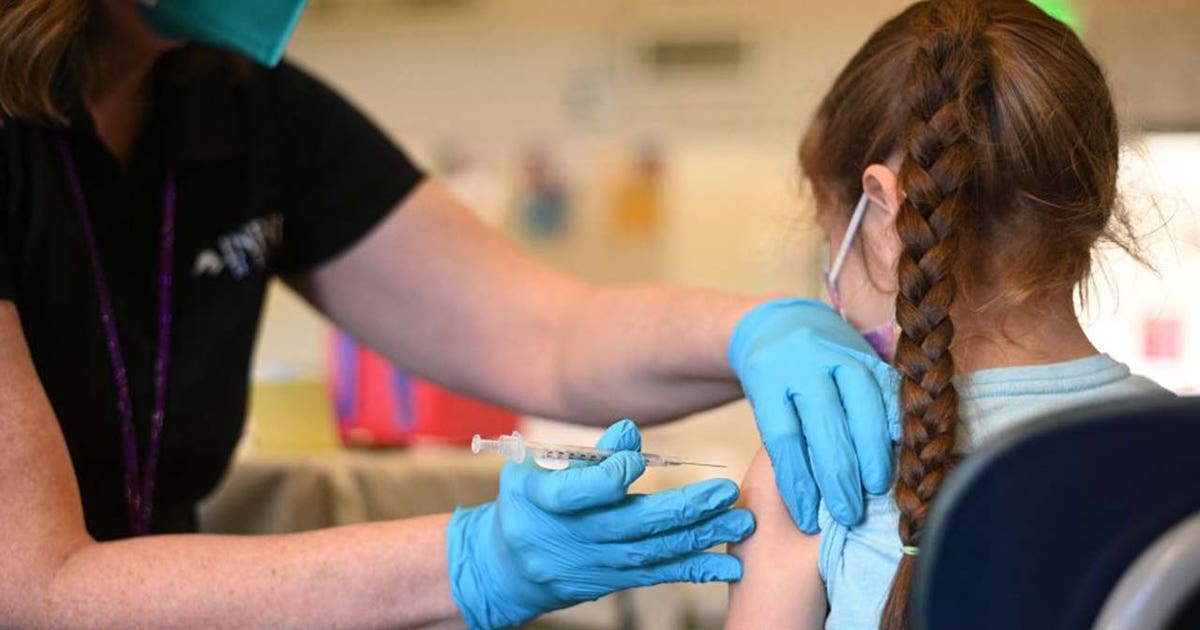
Measles is not a mystery disease. The CDC says two doses of the MMR vaccine are about 97% effective at preventing it. Children get measles when vaccination rates fall.
So Texas's chief law enforcement officer looked at a measles outbreak in his own state and decided the problem to attack was the pediatricians telling parents to vaccinate.
What the AAP actually did
Paxton's own press release lays out the sequence, and it is worth reading carefully, because it undercuts him.
The AAP has helped develop the CDC's childhood vaccine schedule since 1995. Then, in 2025, HHS Secretary Robert F. Kennedy Jr. began changing that schedule and reconstituted the federal advisory committee that had historically made vaccine recommendations. The AAP sued, arguing the changes lacked a scientific basis and that the committee's reconstitution was unlawful. In August 2025, for the first time in its history, the AAP published its own evidence-based immunization schedule and urged insurers to cover the vaccines on it.
That is the conduct under investigation: a doctors' group publicly disagreeing with a political appointee about vaccine science, and continuing to recommend vaccines.
Paxton's theory of wrongdoing is that the AAP's corporate donors include pharmaceutical companies, so its recommendations must be bought. He states it plainly in the release: if the only time the AAP has ever broken with the CDC is when its top donors faced financial loss, "that is a fact that simply cannot be overlooked."
There is another explanation for why a group of pediatricians would break with the CDC for the first time in its history: the CDC schedule changed, and they thought the change was wrong. Paxton doesn't consider it.
He also skips the obvious point that under his theory, every doctor who recommends any medicine made by a company that gives to any medical association is suspect. That is not a legal standard. It's a tool.
Now, about donor money buying official action
Paxton's whole case rests on the idea that money from interested parties corrupts the advice you give the public.
He should know.
Last month we reported that a Texas Tech regent gave $274,300 to a committee backing Paxton's Senate run — and one day later, Paxton's office threatened to sue the Big 12 on Texas Tech's behalf. One day.
He also sued to strip federal protection from the dunes sagebrush lizard, a 2.5-inch reptile whose habitat sits on top of Permian Basin oil. Big Oil won.
This is a man who says he can smell it when someone's public position tracks their funders' interests. He is an expert. He has done the reading.
And the standard he is applying to the AAP — an association whose donor list is disclosed and whose recommendations are published with citations — is one he has never once applied to himself.
The record behind the badge
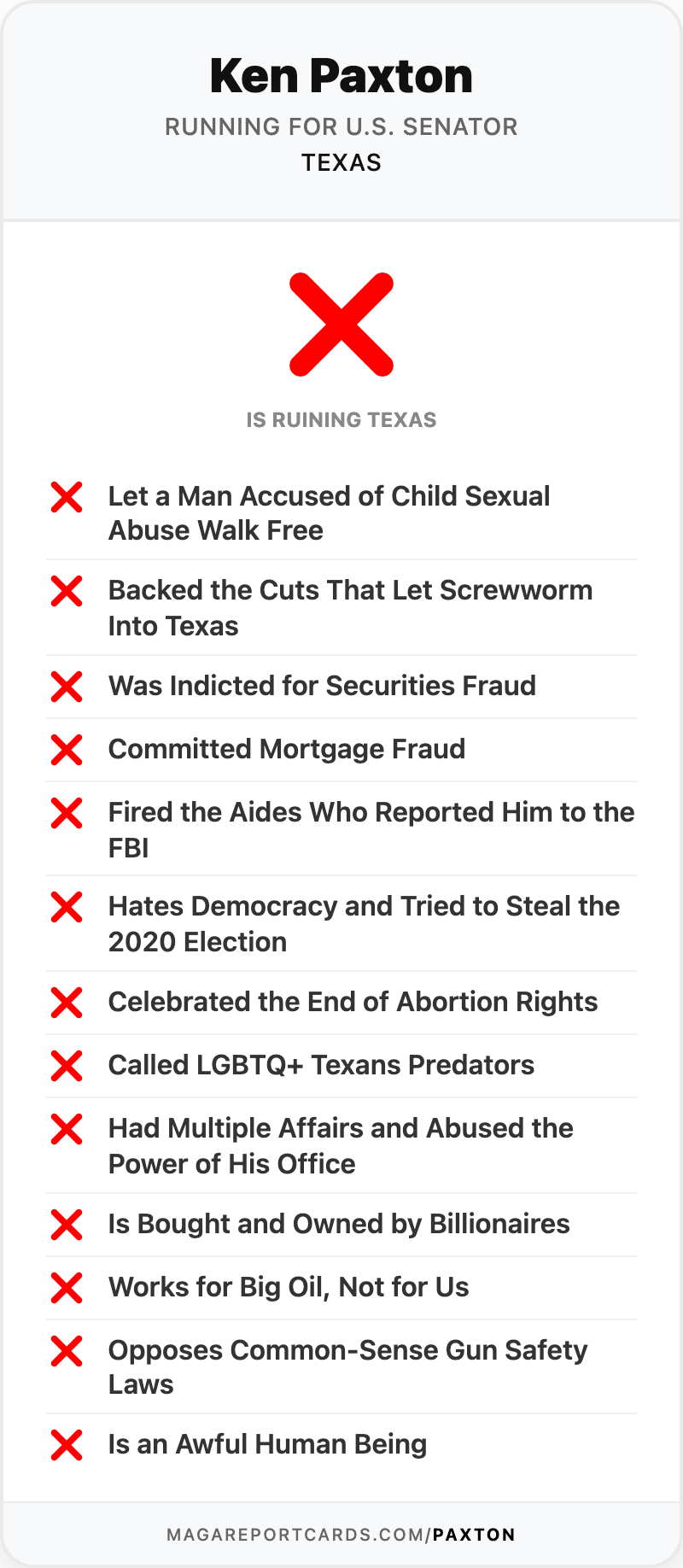
None of this is a first offense. Paxton is the attorney general who:
- Was indicted on three felony counts in 2015, two of them securities fraud, and dragged the case out for nearly nine years before cutting a deal in 2024 — community service and restitution, charges dropped, no acquittal, no jury.
- Was impeached by the Texas House 121 to 23 in 2023, with more than two-thirds of his fellow House Republicans voting to impeach him.
- Ran an office that a judge ruled violated the Texas Whistleblower Act, with $6.6 million owed to the aides who reported him — a bill Texas taxpayers, not Paxton, will pay.
That is the person now demanding that pediatricians prove their integrity.
Why this one is different
Most of Paxton's investigations are aimed at institutions he wants to punish — hospitals, universities, companies, cities. This one has a body count risk attached.
The AAP is where a huge share of American pediatricians get the guidance they hand to parents in the exam room. When the state's top lawyer announces that this guidance may be criminal fraud, that message reaches parents in the middle of a measles outbreak. Some of them will hesitate. Some of those children will not get vaccinated.
Paxton is now running for U.S. Senate, and this is a preview of what he'd bring to Washington. He is not investigating whether Texas kids are getting sick. He is investigating the people trying to stop it.
Texas is coming off its worst measles outbreak since 1992, the country is having its worst measles year in three decades, and Texans have an attorney general who thinks the pediatricians are the problem.
Source
Attorney General Ken Paxton Investigates the American Academy of Pediatrics for Deceptively Promoting Childhood Vaccines for Financial Gain — Office of the Texas Attorney General, August 5, 2026. AAP response via FOX 7 Austin.