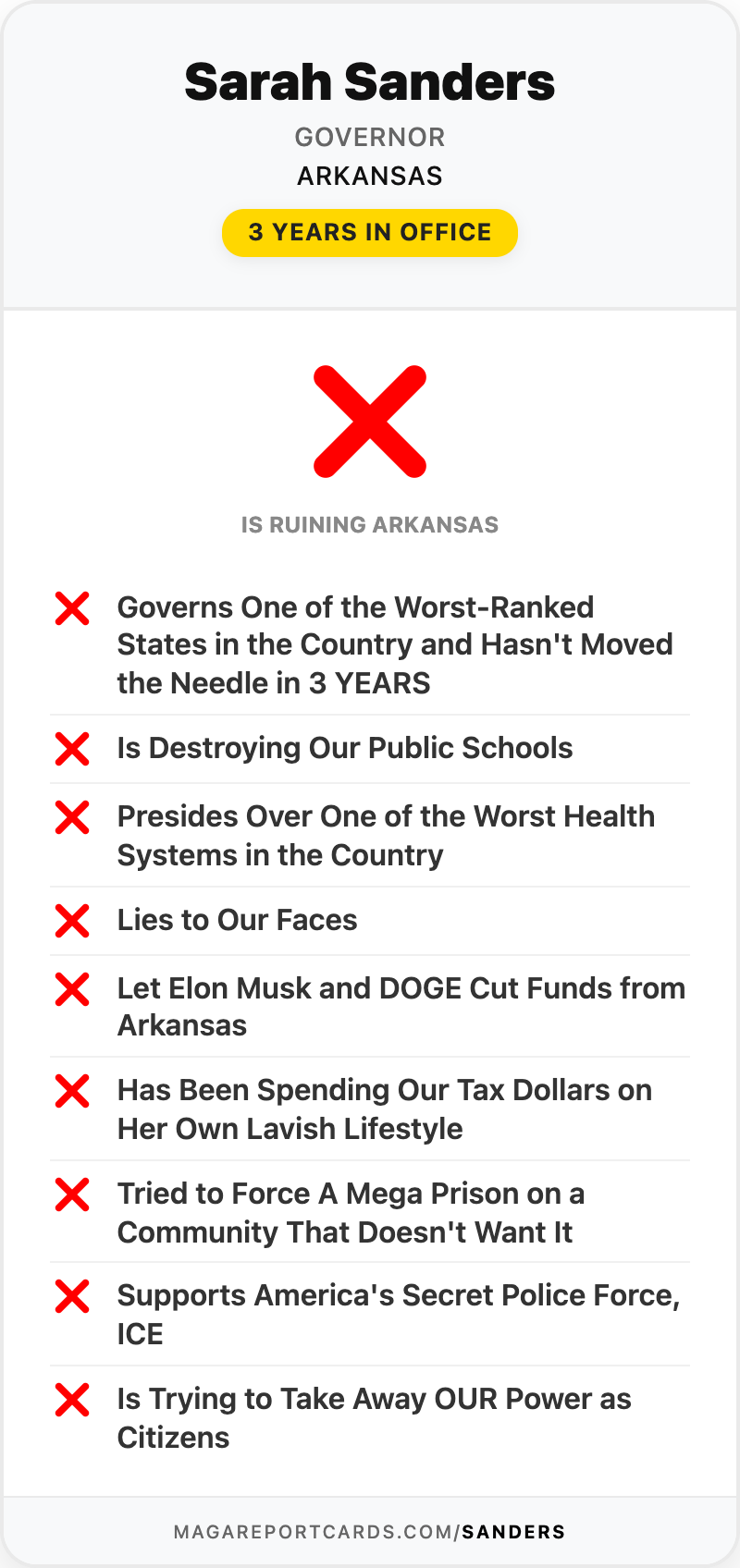
Last week, the Trump administration told every state it could take six more months before it starts cutting people off Medicaid under the new work rules. Sarah Sanders' Arkansas isn't taking them.
The Arkansas Department of Human Services, which answers to the governor, still plans to enforce the work requirement starting January 1, the Arkansas Advocate reported Monday. A department spokesman said the agency is "reviewing the details" of the extra time but has not changed its plan.
That's the same state where the last Medicaid work requirement took coverage away from more than 18,000 people.
What the delay was for
The work rules come from Trump's budget bill. Most Medicaid enrollees between 19 and 65 will have to prove they work, volunteer or go to school at least 80 hours a month to keep their health insurance.
The delay came after warnings that states don't have the systems in place to track that. Officials in several states have said they aren't sure how to tell whether someone meets the rule or qualifies for an exemption. The exemptions are long: pregnant people, parents of dependent children, people with serious medical conditions, people in foster care or who aged out of it, people just released from jail, and more. Every one of those is a box someone has to check correctly — or a person loses coverage they were supposed to keep.
The federal Medicaid agency announced the six-month grace period a day after two top congressional Democrats warned that states needed more time to keep eligible people from being cut off. As we wrote then, the delay is optional and temporary, and the law itself didn't change. Arkansas could have used every day of it. It's choosing not to.
Arkansas has done this before
Arkansas was the first state to put a work requirement on its Medicaid expansion, during Trump's first term. More than 18,000 Arkansans lost their coverage before a federal judge blocked it in 2019.
Getting the reporting system right is exactly what extra time is for. Arkansas Advocates for Children and Families put it plainly:
"Arkansas should take the maximum amount of time allowed to make sure the reporting system is as accurate as possible, as other states have chosen to do, rather than rushing implementation of the work reporting requirements."
Sanders has been selling this rule, not just carrying it out
This isn't a governor stuck enforcing a federal law she doesn't like. Sanders has made the work requirement her own.
This fall, she ran a statewide ad starring "Brad," a young man eating cheese balls and playing video games. "You pay taxes to cover welfare for guys like Brad who just choose not to work," Sanders tells viewers. The NAACP's Arkansas chapter said it was "deeply concerned" about the ad, saying it unfairly stereotypes the poor as choosing not to work. We broke the ad down in our post on Brad.
The people who will actually be checked on January 1 aren't Brad. More than 800,000 low-income and disabled Arkansans get some form of Medicaid. Nearly 209,000 are on ARHOME, the state's Medicaid expansion program.
And the expansion itself is on borrowed time
Those 209,000 people are already in limbo. The Trump administration refused to renew ARHOME long-term. Arkansas's Human Services secretary, Janet Mann, asked for two years to build a replacement. The administration gave the state six months, starting January 1.
A state Medicaid official told lawmakers last week that six months isn't long enough to move everyone into a new program.
So on the same day, Arkansas's expansion enrollees will start a six-month countdown on their program's future and a new work rule the state didn't have to start yet. In their own statement, the children's advocates said Medicaid participants "are already going through many changes that are confusing."
What we know
The Trump administration gave states until July 2027 to start enforcing Medicaid work rules. Sarah Sanders' Department of Human Services still plans to start on January 1. Arkansas's last work requirement cost more than 18,000 people their coverage. The new rule will land on a state where nearly 209,000 people's expansion coverage has only been extended six months — and where the governor spent this fall advertising the rule as a crackdown on "guys like Brad."