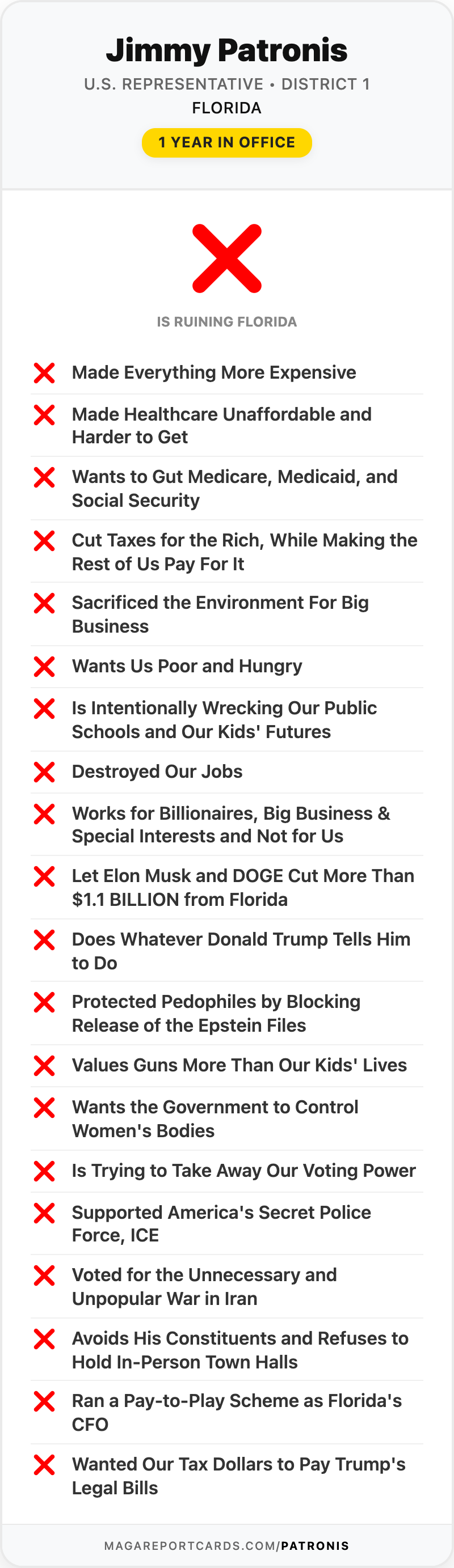
In January 2024, while Florida homeowners were living through the worst property insurance market in the country, the state's Chief Financial Officer was working on a different problem: how to get taxpayers to help pay Donald Trump's legal bills.
Jimmy Patronis did not just support that idea. He brought it to the legislature himself.
The bill
On January 5, 2024, state Sen. Ileana Garcia filed two linked bills. SB 1738 created something called the Defending Freedom Fighters Trust Fund, carried a $5,000,000 appropriation, and put the fund inside the Department of Financial Services — the agency Patronis ran. SB 1740 set the rules for handing the money out. A "qualified person" was anyone who met the Constitution's eligibility requirements for the presidency, lived in Florida or held a Florida driver's license, and complied with campaign finance law. The money would go to qualified persons "subject to political discrimination," to pay legal fees from criminal charges — up to $5 million each.
The sponsor's own account of who that was for was narrower than her bill. She filed it, she later said, "amidst a crowded primary, including two Florida residents." Seventeen days later only one of them was still running.
Patronis had been pushing the concept publicly for months before the bill existed, and when the bill dropped, the announcement went out through his office. His own justification was not about justice or the Constitution. It was a business case.
"If we can help and support a Florida candidate for the White House, that's just good from a dollars and cents perspective. From all the decisions the federal government makes with regard to military installations, to roads, to disaster aid — it's in Florida's best interest to make sure their champion for the President is allowed a fair shot at the White House without being taken down by some fake witch-hunt."
The man in charge of Florida's treasury was pitching a $5 million payment to a billionaire as an investment.
Who decides who's a "victim of political discrimination"?
The part that got the least attention is the part that should have gotten the most.
Under the proposal, the Department of Financial Services — Patronis's department — would have had "the sole authority to determine if a person has been subject to political discrimination."
Not a court. Not a bipartisan panel. Not the legislature. The agency run by a single elected Republican, deciding which candidate's criminal charges count as persecution and therefore qualify for a state check — and that Republican was the same person who had brought the bill to the legislature in the first place.
Even DeSantis wouldn't touch it
The plan lasted about two and a half weeks.
Ron DeSantis — who had just ended his own presidential campaign — posted on X that he opposed it. Less than two hours later, Garcia announced she was pulling the bill. Her statement pointed straight at where it came from:
"My concern was the political weaponization against conservative candidates, and while @JimmyPatronis brought me this bill at a time when all candidates were committing to campaign through the primary, one frontrunner now remains, and he can handle himself. I will be withdrawing the bill."
He can handle himself. The sponsor's own reason for withdrawing was that Trump is rich enough to pay his own lawyers. Both bills were formally withdrawn from consideration on January 25, 2024.
Senate President Kathleen Passidomo, who had endorsed Trump, would not say whether she backed it. Her office sent Politico a statement: "President Trump has the means to cover his legal expenses; however, many people do not, which is Senator Garcia's concern."
Nikki Fried, then chair of the Florida Democratic Party, put it more bluntly: "What this shows you is who the Florida GOP is loyal to because it's certainly not the people of Florida."
He kept arguing for it after it died
Most politicians drop a bill once the governor of their own party publicly kills it. Patronis went on Newsmax that Friday and said the real problem was that nobody had read it.
"We are in a situation now where the Senator has withdrawn the bill and look, I think there was a problem where people just weren't reading the legislation."
"These were not taxpayers' dollars. The dollars that were being used were actually fees that were paid by candidates in qualifying. So we had a pretty elaborate formula there."
The "not taxpayers' dollars" defense is half right and beside the point. Section 3 of SB 1738 did not conjure new money. It took $5 million the state had already set aside for the Department of State to run Florida's public campaign-financing program and reappropriated it to Patronis's department — and that program is paid for out of a trust fund fed by the filing fees candidates pay to qualify. Florida Politics, reporting the interview, said as much in its own voice: "The funds for the legal defense scheme come from fees paid by candidates for political office."
What that leaves is still state money, sitting in the state treasury, that only the legislature could move — taken out of the pot that helps candidates run for office and pointed at one man's criminal defense lawyers. And the fund was to be topped back up by donations solicited from Floridians renewing their driver's licenses — where the "Defending Freedom Fighters Trust Fund" would have appeared as one of 22 charitable options on the renewal form. Between a state appropriation and a line on a government form, this was public machinery either way.
In the same interview Patronis said the quiet part out loud about why he did it:
"Look, I think any state in the union would give the right arm to have a homegrown president in the White House. So this is exactly what we were thinking about. … I was trying to ensure that we change the White House and if it's a Florida man, that's good for Florida."
He also brought DeSantis into it, saying the governor "has been targeted by the threats of investigation by the Justice Department over the migrant flights" — the same argument he had put to POLITICO four days earlier, that "if Governor DeSantis makes another run at it, he has said that he too could face the same legal headwinds that President Trump is facing." That interview ran the same day a jury ordered Trump to pay E. Jean Carroll more than $83 million.
What Floridians actually needed that year
Patronis was Florida's Chief Financial Officer — the official whose agency takes Floridians' insurance complaints. Florida has the highest home insurance costs in the country: an average premium projected at $15,460 for 2025, nearly five times the national average, and the nation's highest rate of insurers dropping customers, according to an analysis of federal Senate Budget Committee data.
That was the problem sitting on his desk. The $5 million he went to the legislature about was for Donald Trump's lawyers.
It is a consistent picture. We have written about the $60,000 Patronis's political committee took from a fake-insurance operation whose CEO is now serving 25 years in federal prison, and about the bill he filed this May to erase the federal machine gun ban — what gun media called the first bill ever written to repeal it outright. The through-line isn't ideology. It's whose problems get his attention.
Patronis is now the congressman for Florida's 1st District and faces a Republican primary on August 18.
We deserve better.
Source
Florida plan to have taxpayers pay Trump's legal bills nixed after DeSantis veto threat — Gary Fineout, POLITICO, Jan. 22, 2024. Follow-up reporting: Florida Politics (A.G. Gancarski, Jan. 28, 2024). Photo: Florida Politics.