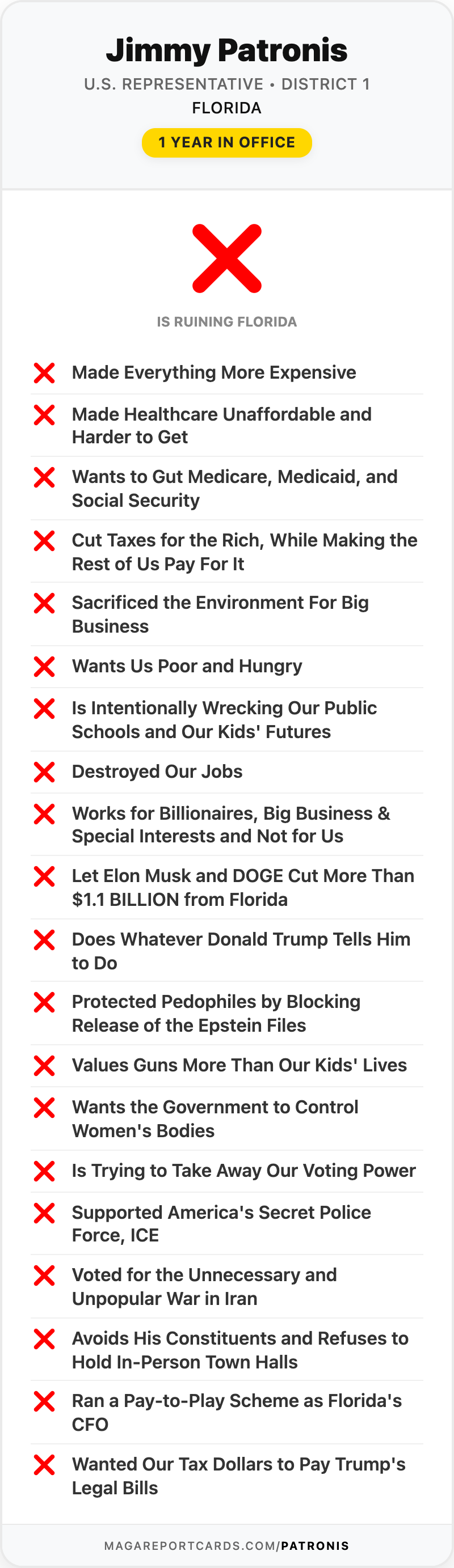
On Friday, May 22, 2026 — right before Congress left town for the Memorial Day recess — Jimmy Patronis introduced a bill to legalize new machine guns.
That is not a characterization. It is what the bill does. H.R. 9009, the "Firearm Freedom Act of 2026," is about as short as a bill gets. It strikes one subsection out of the federal criminal code: 18 U.S.C. § 922(o). The prohibition in it is a single sentence.
"Except as provided in paragraph (2), it shall be unlawful for any person to transfer or possess a machinegun."
Delete that subsection and the flat federal ban on new machine guns is gone.
Gun media noticed immediately. Guns.com ran it under the headline "New Bill Would Make Machine Guns 'Legal' Again." As that story put it, this is the first time anyone in Congress has introduced legislation to remove the ban entirely. Not narrow it. Not carve an exception into it. Remove it.
Patronis has been in Congress since April 2025. This is what he chose to be first at.
What the 1986 law actually did
The subsection Patronis wants deleted is called the Hughes Amendment. It was added to the Firearm Owners' Protection Act of 1986, and it did two things: it closed the federal machine gun registry, and it made it a crime for a regular person to own a machine gun built after May 19, 1986.
It did not confiscate anything. Machine guns already registered before that date stayed legal to own, buy, and sell — the law exempts "any lawful transfer or lawful possession of a machinegun that was lawfully possessed before the date this subsection takes effect." That closed pool is why the surviving guns are so expensive; Guns.com notes that even entry-level ones now run past $10,000 at auction.
So here is the honest version of the problem Patronis says he is solving: a small number of collectors would like to buy machine guns more cheaply. That's it. That's the constituency.
Forty years is a long time for a law to sit on the books without anyone in Congress trying to erase it. Patronis erased it in a bill short enough to read in a minute, filed on a Friday before a holiday weekend.
The part nobody in the press release mentions
Section 922(o) is not just about tripod-mounted belt-fed guns in collectors' safes. Under federal law, a machine gun conversion device — an auto sear, a "lightning link," the little square block people call a Glock switch — is itself legally a machine gun. The statutory definition covers "any part designed and intended solely and exclusively, or combination of parts designed and intended, for use in converting a weapon into a machinegun." The part alone counts, whether or not it is attached to anything.
Which means 922(o) — the subsection H.R. 9009 deletes — is the provision that makes possessing a switch a federal crime.
Those devices are the fastest-growing weapon problem in American policing. Between 2019 and 2023, law enforcement recovered 11,088 machine gun conversion devices — 5,816 of them in 2023 alone, a 784% increase across those five years, according to the ATF's national trafficking assessment. A pistol with a switch on it fires at roughly 1,200 rounds a minute. That is an entire magazine gone before a person can finish a sentence.
Repealing 922(o) would not, by itself, put machine guns on the counter at a sporting goods store. H.R. 9009 touches that one subsection and nothing else, so the National Firearms Act rules that sit elsewhere in the code — registration, a tax stamp, a federal background check — would still apply. What the bill removes is the flat prohibition that currently makes a newly made machine gun contraband no matter what paperwork anyone files, and it reopens a registry that has been closed since Ronald Reagan was president. The sentence police and prosecutors rely on to charge someone caught with a switch would simply not be there anymore.
Patronis's office did not address any of that. His statement was about Washington:
"For years, Washington bureaucrats and the radical Left have tried to chip away at the constitutional rights of hardworking Americans. The Firearm Freedom Act sends a clear message that we will defend the Constitution, stand up for law-abiding gun owners, and protect the freedoms that make America exceptional. I'll never back down from fighting for the Second Amendment."
Gun Owners of America endorsed the bill the same week, calling it "one of the most important Second Amendment bills introduced in a generation." Nine other House Republicans have signed on as cosponsors. It sits in the House Judiciary Committee.
Six weeks later, he collected the police endorsements
Patronis filed H.R. 9009 on May 22. On July 6, his campaign announced that all four sheriffs in Florida's 1st Congressional District had endorsed his re-election — Escambia, Santa Rosa, Okaloosa and Walton counties. Escambia County Sheriff Chip Simmons praised his "unwavering commitment to public safety." Patronis called the sheriffs "among the very best in the nation."
Nobody in that announcement mentioned the machine gun bill. The sheriffs whose deputies would be the ones walking up to cars in Pensacola and Fort Walton Beach were endorsing the congressman who had spent the spring trying to delete the statute that keeps newly built automatic weapons off those streets.
Patronis faces two Republican primary opponents on August 18. The bill and the endorsements both landed in the run-up to it.
This is a pattern, not a one-off
Florida loses about 3,200 people to gun violence every year. Patronis's answer to that, in his first full year in office, was a bill to make more guns legal.
It is the record the gun lobby grades him for. The NRA gave him an "A+" when he ran for state CFO in 2022, and its Political Victory Fund now rates him "A" and endorses him in the 1st District.
He is also not alone in Congress right now. In late July, another Republican introduced a bill to repeal the 78-year-old federal ban on mailing handguns. A week later, a gun store owner in the House led nearly 30 Republicans in demanding the ATF start destroying the firearm records police use to trace guns found at crime scenes. Different bills, same project: take the federal gun laws that have been on the books for decades and pull them out one at a time. We've written before about the Republicans with the worst records on guns, and the through-line is always the same — the people asking for these changes are not the people who get shot.
What this is really about
Nothing in the bill, the press release, or the endorsement announcements points to a problem in Escambia, Santa Rosa, Okaloosa or Walton County that a post-1986 machine gun would solve. What there is, is a freshman congressman three months out from a primary, looking for the loudest possible thing to file to prove he is the most pro-gun Republican on the ballot.
He found it. He filed a bill to erase the sentence that makes a Glock switch a crime.
We deserve a representative who spends his first year in Congress on the 3,200 Floridians a year we bury, not on the price of machine guns at auction. We deserve better.
Source
New Bill Would Make Machine Guns 'Legal' Again — Paul Peterson, Guns.com, May 26, 2026. Bill text and cosponsor list from Congress.gov. Photo: official U.S. House portrait, 119th Congress.