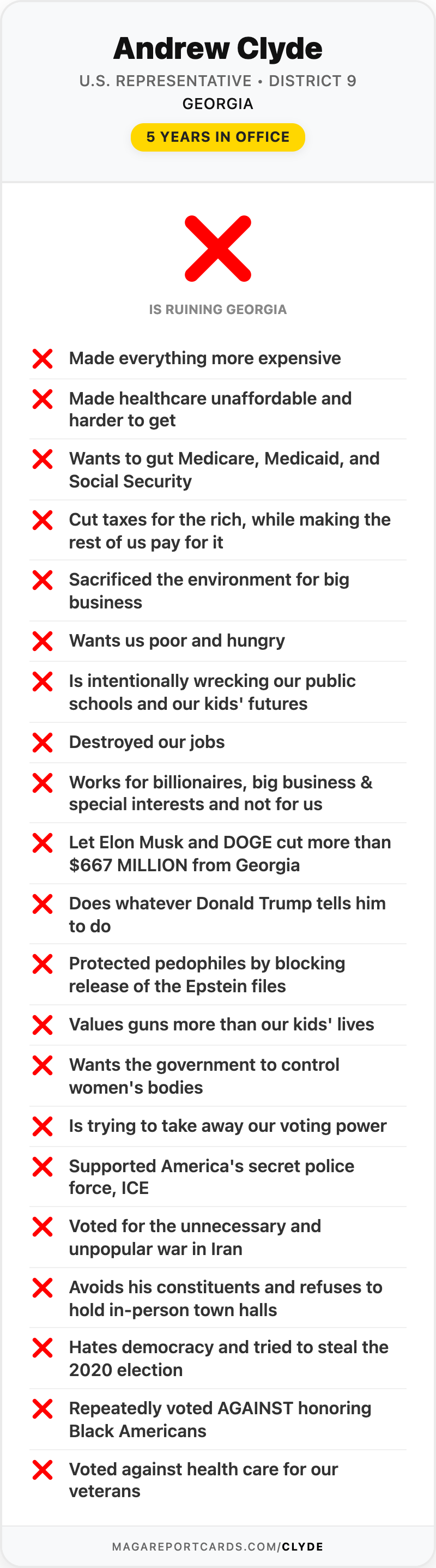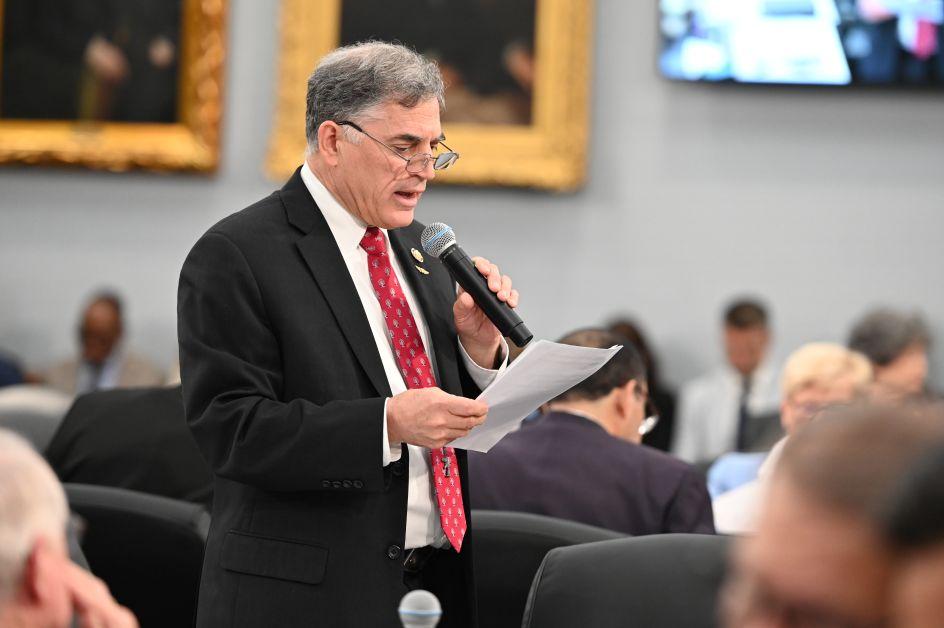
On August 5, 2026, Andrew Clyde sent a letter to the head of the Bureau of Alcohol, Tobacco, Firearms and Explosives with a simple request: start destroying gun records.
Not stop collecting them. Destroy the ones you already have.
Clyde led nearly 30 House Republicans in asking ATF Director Robert Cekada to cap how long firearm transaction records can be kept at 20 years, wipe out everything older than that, and "immediately destroy any recordings" of records the agency has already digitized.
Clyde owns two gun stores.
What the records actually are
When you buy a gun from a licensed dealer, you fill out a Form 4473. The dealer keeps it. If the dealer goes out of business, federal law requires them to send those forms to the ATF's National Tracing Center in West Virginia within 30 days.
That's it. That's the "registry."
Here's what those forms are for. When police recover a gun at a crime scene, they call the Tracing Center with a serial number. Tracing Center staff work backward — manufacturer, distributor, dealer — until they find the 4473 that shows who first bought that gun. The center received 373,349 trace requests in fiscal year 2015, and more than a third of the traces it completed that year — 134,226 — ran through the archive of records from dealers that had gone out of business.
Clyde's letter calls this "an illegal gun registry." But a registry is exactly what federal law already prohibits, and has for decades. 18 U.S.C. § 926(a) bars any regulation establishing "any system of registration of firearms, firearms owners, or firearms transactions or dispositions," and appropriations bills going back to 1979 have blocked the ATF from spending money "consolidating or centralizing" dealer records.
That's why the Tracing Center still works the way it does — staff manually searching scanned images that can't be text-searched or sorted by name, one dealer's records at a time, because the law says they can't be. The thing Clyde says is illegal is the thing the law already forbids. What actually exists is a filing cabinet the ATF is not allowed to index.
What his request would cost
The ATF proposed in May that Form 4473s be kept for 20 or 30 years by the dealer, plus up to 30 more by the ATF — a maximum of 60 years total. Clyde wants that cut to 20 years, total, from the date of sale, with everything older destroyed.
Guns last a lot longer than 20 years.
A rifle sold in 2003 and used in a shooting in 2027 would, under Clyde's rule, be untraceable to the person who bought it. The record that connects it to its first buyer would be gone — shredded on purpose, by request of Congress. Every cold case involving an older weapon gets colder. Every trafficking investigation that depends on finding the straw purchaser hits a wall.
In Clyde's own state, about 2,000 Georgians died from gun-related injuries in 2024 — homicides, suicides and accidents together — a rate of 17.6 deaths per 100,000 people, 37.5% higher than the national rate. Georgia police departments use the Tracing Center. Clyde is asking Washington to take a tool away from them.
He is not a neutral party here
This is the part that doesn't get said enough.
Andrew Clyde is a federal firearms dealer. He owns Clyde Armory, which by his own account operates two brick-and-mortar locations in Georgia. The records he's asking the ATF to destroy are the same category of records his own business is required to generate and keep. The agency he's writing to is the agency that regulates him.
And he sits on the House Appropriations Committee — the committee that writes the funding riders that constrain what the ATF is allowed to do with those records in the first place.
This is not the first time. Clyde was the member who first requested the gun provision in the House version of the One Big Beautiful Bill — language stripping silencers out of the National Firearms Act, the 1930s law that keeps the most dangerous weapons registered and subject to an extra background check. That version didn't survive the Senate. What Trump signed instead cut the federal transfer and manufacturing tax on suppressors from $200 to $0 — a tax cut for the product category a gun-store owner in Congress sells.
He was also one of only four cosponsors of the "AR-15 National Gun Act", a bill to declare the AR-15 style rifle the official "National Gun of the United States."
Who pays him
Among Clyde's campaign donors are the people who run Daniel Defense — the Georgia rifle manufacturer that made one of the two rifles the Uvalde gunman bought before he killed 19 schoolchildren and two teachers. FEC records show Marvin and Cindy Daniel, who list themselves as the company's president and CEO and its executive vice president, have given his campaign $25,200 since 2022.
A gun manufacturer's owners give money to a gun-store owner who sits on the Appropriations Committee, and that member spends his time loosening the rules on the gun industry and asking the ATF to burn its paperwork. You don't have to squint to see the shape of it.
"Privately and free from federal government infringement"
Clyde's letter argues that "gun owners should be able to exercise their Second Amendment rights privately and free from federal government infringement," and that the ATF's records "jeopardize" that.
Set that against what the records do. Nobody's Second Amendment rights are infringed by a Form 4473 sitting in a warehouse in Martinsburg, West Virginia. No gun is confiscated. No purchase is blocked. Nothing happens to that piece of paper at all — unless a police officer somewhere picks up a gun off the ground next to a body and needs to know where it came from.
That's the only moment these records ever get touched. And that's the moment Clyde wants to make impossible.
He is a Georgia congressman in a state where 2,000 people a year die from gunshots, asking the federal government to make the shootings harder to solve, on behalf of an industry that pays him and that he personally profits from.
Source
97.5 Glory FM, "Clyde urges ATF to limit firearm record retention, destroy 'illegal' gun registry" (photo: WGTJ). The letter and Clyde's full statement are posted by his office.