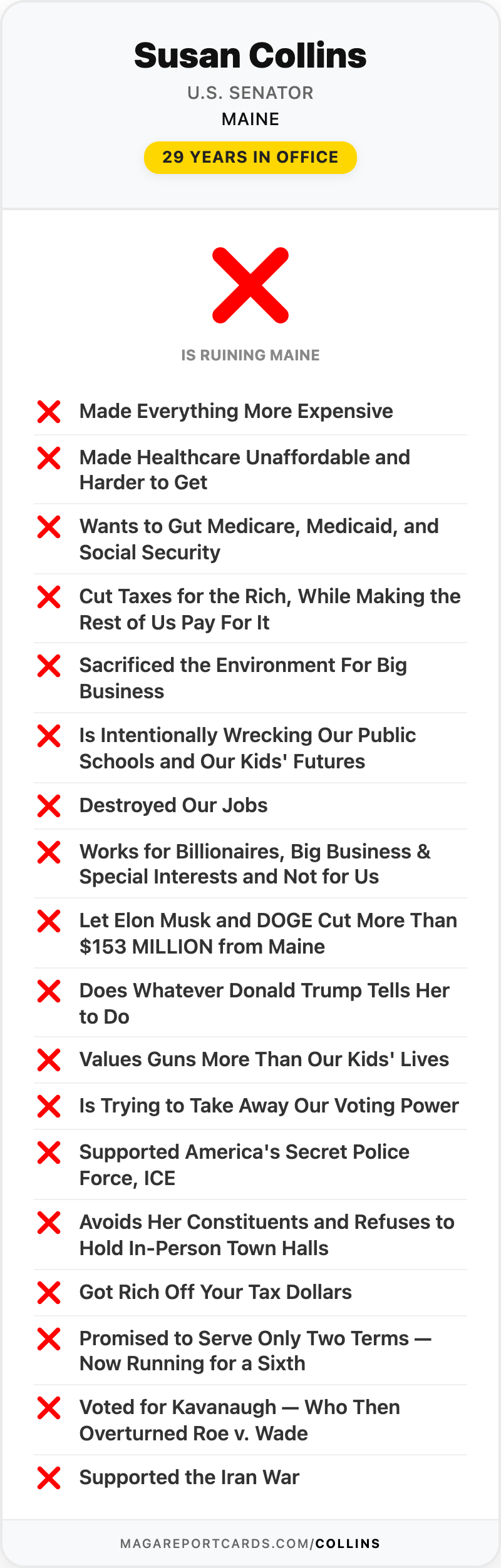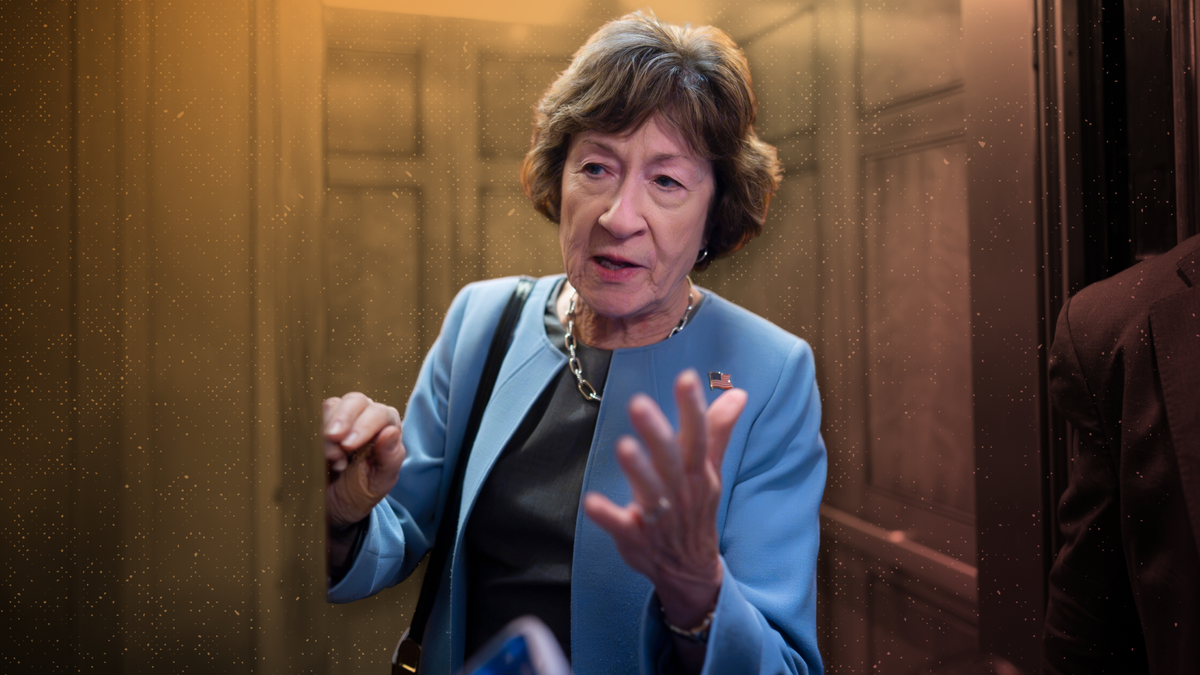
At Tuesday's Maine Senate debate, Democrat Troy Jackson suggested that Susan Collins — a millionaire who has been in the Senate since 1997 — doesn't understand what ordinary Mainers are going through.
Collins answered with a hard-luck story. "I spent a year when I was running for governor in 1994, where I could not afford health insurance," she said, according to The Lever.
She left out what happened next.
The job a gunmaker helped find
Collins lost that 1994 governor's race. About a month later she had a new job: founding executive director of the Richard E. Dyke Center for Family Business at Husson College in Bangor.
Richard Dyke was the owner of Bushmaster Firearms, a Maine company that made AR-15-style rifles. Husson was his alma mater. And the center with his name on it existed because he had helped start it by donating $250,000, according to ProPublica.
Dyke had also backed Collins in that governor's race. ProPublica reported that he'd known her since the 1980s, when she worked for Sen. William Cohen, and that "in 1994, she ran for governor, with Dyke's support."
How did she get the job? The stories don't match. In 2023, a Collins spokesperson told ProPublica that Husson's president, not Dyke, approached her about the job. But back in 2003, Dyke himself told the Portland Press Herald that he'd spoken to Collins directly and suggested the job "might be a good fit for you until you decide to run again," according to The Lever. The Press Herald reported then that Dyke "played a big role in finding her next job."
About a year in, Collins cut back her hours to run for the U.S. Senate. Dyke gave her campaign $2,000. Federal Election Commission records show Dyke kept giving to her campaigns through 2020, and Bushmaster employees through 2007. Dyke died in 2023. ProPublica, too, reported that Collins won her 1996 race "with Dyke and other Bushmaster executives among her donors."
What Bushmaster rifles did
Bushmaster rifles were used in the 2002 Beltway sniper attacks, which killed 10 people, and in the 2012 Sandy Hook Elementary School shooting, which killed 20 children and six adults.
After the sniper attacks, ProPublica found, Dyke's bankers wrote that the shootings were "obviously an unfortunate incident" but had "dramatically increased awareness of the Bushmaster product and its accuracy."
Bushmaster was sued over the sniper killings. Dyke publicly lobbied for years for a bill to block lawsuits like that, The Lever reports, telling a reporter in 2003 that they were "just another attempt by the anti-gun people."
Then Collins voted for the law he wanted
In July 2005, the Senate voted on the Protection of Lawful Commerce in Arms Act — a bill to stop lawsuits against gun manufacturers and dealers over crimes committed with their guns. ProPublica says it was a law "which Dyke had pushed hard for."
Collins voted yes on final passage. It passed 65–31.
The same day, Sen. Frank Lautenberg offered an amendment to carve out one exception: lawsuits involving injuries to children. Collins voted no. It failed, 35–64.
That law is still on the books. Collins voted to give the gun industry that shield, and voted against an exception for kids.
In 2013, four months after Sandy Hook, the Senate voted on an amendment to regulate assault weapons. Collins voted no. It failed, 40–60.
Collins told ProPublica that Dyke "was a longtime friend of mine." She did not respond to The Lever's request for comment on this story.
Why it matters
Collins brought up 1994 to show voters she knows what it's like to struggle. The full story shows something else: when she was down, a wealthy gun-company owner who had donated to her campaign was there with a job at a center he'd funded. When she got to the Senate, he and his employees kept writing checks — and she voted for the lawsuit shield he'd lobbied for, and against protecting kids from it.
In summary
Susan Collins told voters this week she couldn't afford health insurance during her 1994 run for governor. Within about a month of losing, she was running a business center funded with $250,000 from Bushmaster Firearms owner Richard Dyke, a donor who said he suggested the job to her. In 2005 she voted for the law shielding gunmakers from lawsuits that Dyke had pushed for, and against an exception for lawsuits over injured children; in 2013, months after a Bushmaster rifle was used at Sandy Hook, she voted against regulating assault weapons.