North Carolina makes you earn a concealed carry permit. You have to be 21. You have to have lived here 30 days. You have to complete an approved firearms safety course that includes actually firing the handgun and covers state law on deadly force. And your county sheriff has to sign off — and is required by law to say no if you're a fugitive, under felony indictment, or in a long list of other categories.
Richard Hudson has spent eleven years trying to make all of that unenforceable against anyone from out of state.
His bill is H.R. 38, the Constitutional Concealed Carry Reciprocity Act. He introduced this version on the first day of the current Congress with more than 120 cosponsors — it's now up to 189. The House Judiciary Committee approved it 18–9 in March 2025, and it has been sitting on the House calendar since October 3, 2025, waiting for a floor vote that could come at any time.
And the biggest organization of rank-and-file police officers in America is trying to stop it.
What the bill actually does
Congress's own summary is not subtle. H.R. 38 "preempts most state and local laws related to concealed carry" and creates a private right of action — a lawsuit — for anyone adversely affected by interference with the carrying right it creates.
In practice, two things happen:
- A permit from any state works in every state. Not just states with comparable standards — any state.
- A resident of a state with no permit requirement at all can carry here without one. Gun Owners of America counts 29 states with permitless or "constitutional" carry in its own statement praising Hudson's bill.
So a visitor from a permitless state can carry a concealed handgun through downtown Fayetteville without ever taking the safety class, without ever firing the gun in front of an instructor, and without a North Carolina sheriff ever looking at their name. The North Carolinian standing next to them had to do all three.
Everytown for Gun Safety's objection, as MS NOW summarized it, is that the bill could let many people carry concealed weapons without passing a background check, going through safety training, or having any experience handling a gun. That's not a stretch of the text. That's the text.
The police union that endorsed Trump is fighting Hudson's bill
On November 17, 2025, the National Fraternal Order of Police — the largest police union in the country, and an openly pro-Trump one — issued a joint call to action with the International Association of Chiefs of Police urging Congress to reject H.R. 38.
Their objection isn't about the Second Amendment. It's about what the bill does to officers on a traffic stop:
"The legislation exempts any person with a valid photographic identification from state or local firearms law who asserts that they are lawfully carrying a firearm under the laws of their own state of residence. This is problematic, but the most concerning provision of H.R. 38 is that it prohibits law enforcement officers from making any arrest or detaining a suspect for any violation of state or local law pertaining to the possession, transportation, or carriage of a firearm."
The two groups also warned that this "makes it impossible for an officer to conduct any investigation with respect to ascertaining if the person is in fact compliant with the firearms law in their state of residence," and that "officers would be expected to interpret and apply laws from all 50 states in real time, without reliable means to verify an individual's eligibility to carry concealed weapons."
Read that again. A driver produces a photo ID and says he's allowed to carry back home, and the officer has to take his word for it — and can be sued if he doesn't.
Gun Owners of America's response to the country's biggest police union was to accuse it of betrayal. "Fraternal Order of Police betrays the Second Amendment by opposing H.R. 38," the group posted the next day.
Hudson's answer to the police has been to keep going. "I will not stop fighting to get this legislation signed into law," he said when he introduced it.
The people who wanted this bill have paid him for it
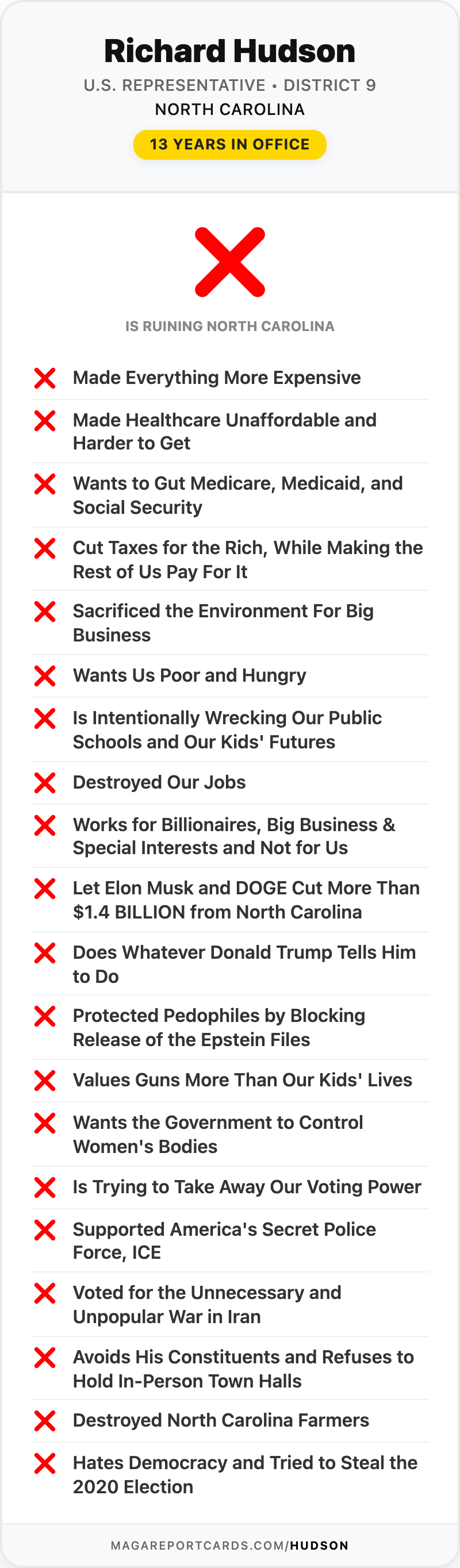
Hudson's report card lays out where his money comes from, and guns are near the top of it. The National Rifle Association has given him $39,650 — one of his largest single sources, and it is not a mystery what it bought. When he introduced H.R. 38, NRA-ILA executive director John Commerford put out a statement thanking him by name: "NRA applauds and thanks Rep. Hudson for his longstanding and unwavering leadership in the fight for right-to-carry reciprocity."
Gun Owners of America called the bill "the greatest legislative victory for the gun rights movement in a century."
Overall, only 3% of Hudson's campaign money comes from small grassroots donors, and he ranks 343rd out of 440 House members in grassroots funding. He is funded by organizations, and he legislates for them.
Josh Horwitz, co-director of the Johns Hopkins Center for Gun Violence Solutions, described national reciprocity to The Trace as "the absolute prize" for Republicans. Hudson is the man carrying it.
This has been his project since 2015
Hudson first filed it as H.R. 986 in February 2015. The House actually passed a version once, on December 6, 2017, by a vote of 231–198. The Senate never took it up, and it died.
He has reintroduced it in every Congress since. What's different now is that Republicans control the House, the Senate, and the White House, and Trump has said he'd sign it. This is the closest the bill has ever been to becoming law — which is exactly why the police unions moved when they did.
Hudson isn't alone in North Carolina, either. His colleague Pat Harrigan filed a bill in April 2026 that would override every state's carry laws for special operations veterans — and, unlike the retired-police law it copies, waives the yearly requalification. Two members from the same state, both writing bills whose effect is to move the decision about who may carry a concealed gun in North Carolina out of North Carolina.
What it means where he lives
North Carolina loses about 1,800 people a year to gun violence — a rate 27 percent above the national average. Hudson's district includes Fort Bragg, part of Fayetteville, and all of Hoke, Moore, Randolph, and Alamance counties. The sheriffs in those counties are the officials whose sign-off H.R. 38 makes irrelevant for everyone driving in from out of state, and their deputies are the ones the FOP says would lose the authority to check.
Hudson has been in Congress since 2013 — thirteen years. In that time the single piece of legislation most associated with his name is one that takes a safety decision away from North Carolina sheriffs, hands it to whichever state has the loosest rules in the country, and lets the gun owner sue the cop who questions it.
The NRA thanked him for it. The police are asking Congress to stop him.
Source
Concealed carry 'reciprocity' law splits MAGA gun and law enforcement groups — Ja'han Jones, MS NOW, November 21, 2025. The FOP and IACP joint call to action is available from the Fraternal Order of Police.