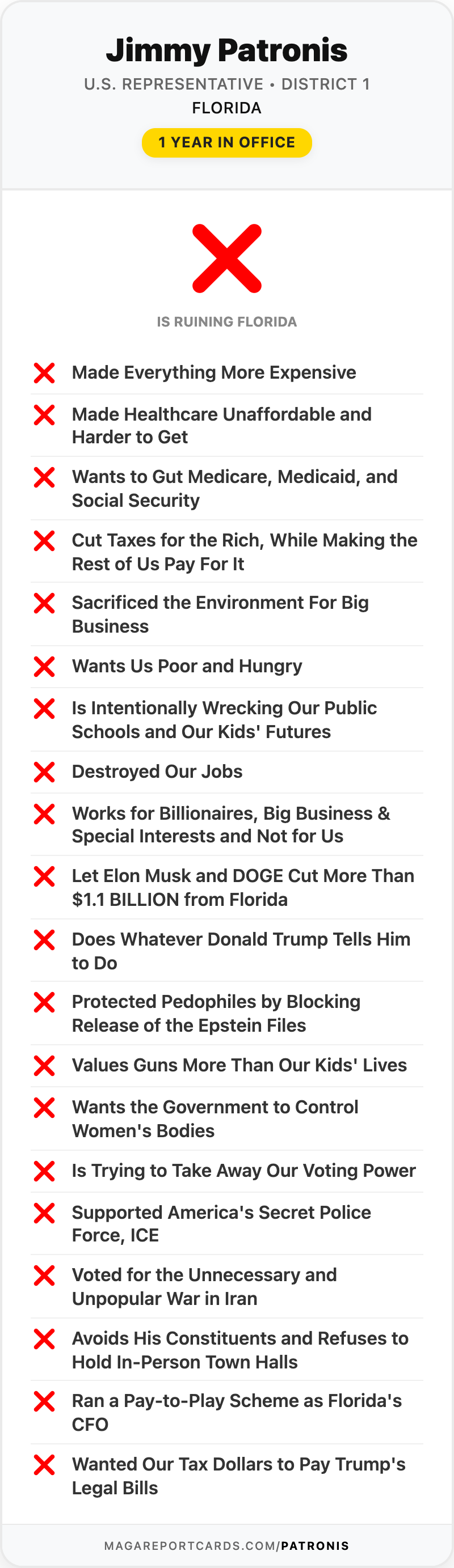
There is a photograph, taken in April 2018, of Florida's Chief Financial Officer standing with a group of executives. Jimmy Patronis is third from the right. Second from the left is Steven Dorfman, the CEO of a Hollywood, Florida company called Simple Health.
That fall, a federal judge shut Simple Health down.
Six years later, Dorfman was sentenced to 25 years in federal prison.
In between, Patronis's political committee took at least $60,000 from Simple Health and a related company — and kept taking it after a state attorney general had already put out a national alert warning consumers that the operation was a scam.
Patronis's job at the time was protecting Floridians from exactly this.
What Simple Health did to people
This was not a technical violation or an accounting dispute. Federal prosecutors laid it out in detail when Dorfman was sentenced in July 2024.
Simple Health sold what are called limited indemnity plans — policies that pay out a small, capped amount and then stop. Salespeople were trained to make customers believe they were buying real, comprehensive health insurance. According to the U.S. Attorney's office, the scripts included lines like "the whole idea of this plan is to make your out-of-pocket expenses as low as possible" and "when all is said and done, you'll end up owing pennies on the dollar." Salespeople told additional lies off-script, and prosecutors said Dorfman made little effort to stop them.
The company sold those policies to more than 400,000 people between 2012 and 2018 and took in more than $190 million. When customers actually got sick, they found out what they had bought.
"Although the Simple Health salespersons had promised that the policies would cover most of their medical expenses, when the victims attempted to use the policies, they found out that they provided little, if any, coverage. As a result, these victims were left owing thousands of dollars' worth of medical bills that were not covered by the limited indemnity plans sold by Simple Health." — U.S. Attorney Rachelle Aud Crowe
The Federal Trade Commission separately won a $195 million judgment against Simple Health and Dorfman in February 2024, along with a permanent ban on selling healthcare products, and the court ordered the company's frozen assets liquidated to refund customers.
The money, and the timeline
Here is the part that matters about Patronis.
In July 2017 — the same month Rick Scott installed Patronis in the CFO job — the Nebraska Attorney General's office posted a public alert warning that scam artists based in Florida were impersonating Blue Cross and Blue Shield of Nebraska, and named Simple Health of Hollywood, Florida. Victims, the alert said, were being charged monthly and never getting proof of coverage.
Five months after that alert, Patronis's political committee, Treasure Florida, took $35,000 from Simple Health on December 20, 2017.
It took another $15,000 on May 31, 2018.
It took $10,000 from a related company, Health Benefits 1, in July 2018 — a full year after Nebraska's warning.
Then in the fall of 2018 the FTC sued, a federal judge froze the operation, and the Florida Phoenix called the campaign to ask why the state's chief financial officer had been taking money from a company under a national fraud alert.
The answer, from a Patronis campaign spokesman: "We didn't know about the Nebraska issue."
The same day, the campaign announced Treasure Florida would give $65,000 to the United Way of Northwest Florida for Hurricane Michael relief. That announcement came the day a reporter asked about the checks.
He was the official you were supposed to complain to
This is not a case of a politician taking a check from a company he had nothing to do with. As Chief Financial Officer, Patronis ran the Florida Department of Financial Services. Consumer insurance complaints went to his agency. He is one of four elected officials who oversee the state's financial regulator — a job the Tampa Bay Times described as one that is supposed to be above politics.
He also campaigned on it. Running against Jeremy Ring in 2018, Patronis touted his record cracking down on insurance fraud — while three checks from a fake-insurance operation sat in his PAC.
Years later he was still building the brand. In May 2024 he wrote to Congress demanding tighter security on the Affordable Care Act marketplace, announcing that his office had opened more than 900 investigations into people being signed up for health plans they never asked for, "all so a bad actor can collect a commission."
He is right about the harm. He just has a very specific history with the people who profit from it.
The regulator who says he was told to back off
The Simple Health money is not the only pay-to-play question from Patronis's time as CFO — and the second one comes from the state's own top banking regulator, on the record.
Drew Breakspear ran Florida's Office of Financial Regulation from 2012 until Patronis forced him out in 2018. In a 2019 interview with the Times/Herald, Breakspear said Patronis's staff told his office to "drop" its support for an industry watchdog's case against a Miami financial adviser named Patrick Dwyer, who was fighting to erase customer complaints worth more than $7.2 million from his record. Breakspear said his office refused, and that nobody would explain why the request was being made.
Dwyer's lawyer wrote to Patronis complaining about Breakspear's office on April 12, 2018. Three weeks later, on May 3, Patronis publicly demanded Breakspear resign, citing a "lack of cooperation, responsiveness, and communication."
Only after he was gone did Breakspear learn that in late March — before the letter, before the ouster — Dwyer had given Patronis's campaign $25,000, by far the largest state political contribution Dwyer had ever made, and his only donation to a Cabinet race.
"You sort of sit there and say, 'Wait a minute.'" — Drew Breakspear
Breakspear described two other episodes to the Times/Herald: pressure from Patronis's office to seat particular people on the board of a bank his office regulated, and pressure to let Walmart cash bigger checks without running them through the state's anti-fraud database. Breakspear fought that one because, he said, people would simply go to Walmart to cash fraudulent checks. His opposition helped kill the bill.
Patronis's spokeswoman denied all of it — the Dwyer request, the bank board, the Walmart push. "Our office never took a formal position on this issue and did not pressure (Breakspear's office) to intervene in any way," she wrote of the Dwyer case. Breakspear's answer was that this was false.
Patronis's communications office then gave reporters a second reason: copies of an internal harassment case, with the assertion that Breakspear's handling of it was why he should step down. Patronis's own office had run that investigation, closed it without discipline, and mailed it out.
"The whole sexual harassment thing, to me, was just something to throw at (me)." — Drew Breakspear
Breakspear's replacement, Ron Rubin — whom Patronis had personally championed for the job — later made similar allegations in a racketeering suit, claiming a lobbyist close to Patronis repeatedly solicited a $1 million contribution from Rubin's elderly father. In fairness to Patronis: he was not a defendant, and Rubin lost. A judge granted summary judgment against him in 2022 and an appeals court upheld it in 2023.
Two different top financial regulators, both forced out under the same CFO, told the same kind of story about the same office. That is the part that doesn't go away when a lawsuit fails.
Why this still matters
Patronis is not Florida's CFO anymore. He has been a member of Congress since April 2025, representing the Panhandle — and he was on the ballot again in a Republican primary on August 18, which he won. The general election is November 3.
The pattern he built in Tallahassee is the thing to watch. A regulator who takes money from the industry he regulates is not an abstraction; it is 400,000 people who thought they had health insurance and found out in a hospital that they didn't. We have seen this movie in other states — a state attorney general who kept her state out of the Purdue Pharma case and later took more drug-industry money than anyone else from her state, or a coal lobbyist who went to Congress after working the bill at the center of Ohio's biggest bribery scandal. The job title changes. Who gets protected doesn't.
We deserve better.
Sources
Chief Financial Officer Patronis took campaign cash from insurance companies shut down Friday for suspected consumer fraud — Julie Hauserman, Florida Phoenix, Nov. 2, 2018. Photo: Florida Phoenix, republished under CC BY-NC-ND 4.0. Additional reporting: Tampa Bay Times (Lawrence Mower, July 14, 2019) and the U.S. Attorney's Office for the Southern District of Illinois.