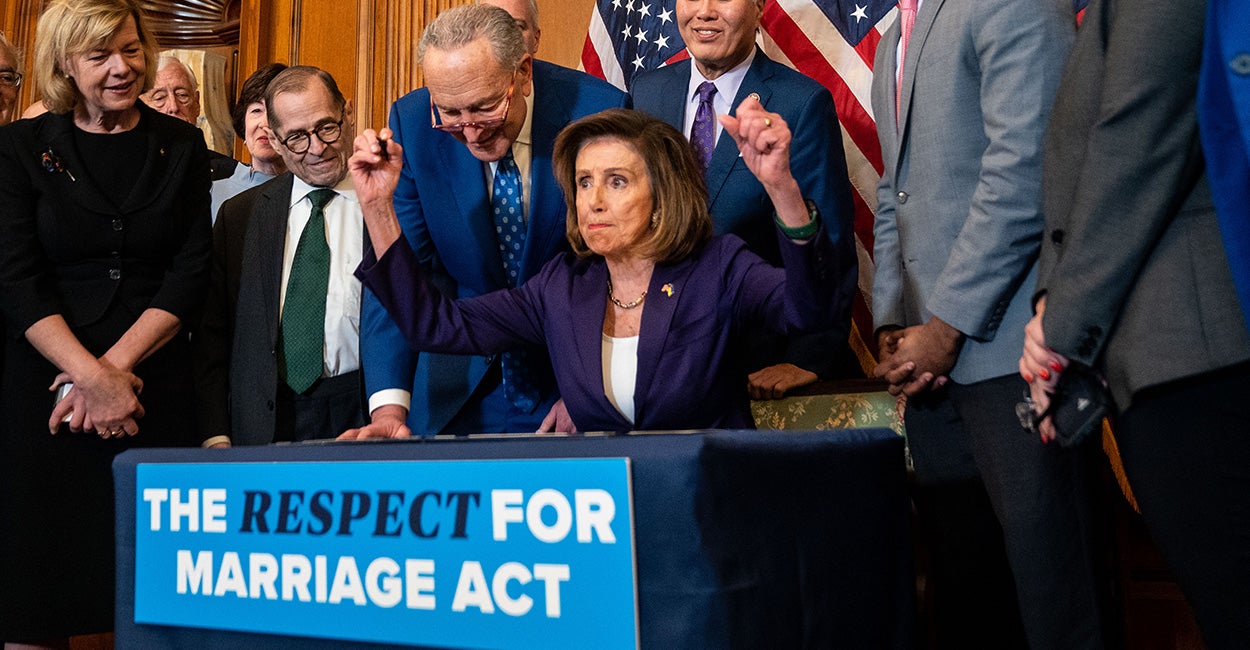
On July 19, 2022, Dan Meuser voted yes on the Respect for Marriage Act — the bill that guarantees the federal government and every state must recognize legal marriages between same-sex couples and between interracial couples.
On December 8, 2022, the same bill came back to the House for final passage. Meuser voted no.
Same bill. Different vote.
Only seven House Republicans switched from yes to no between those two votes. Two of them were from Pennsylvania: Meuser and Scott Perry. The Daily Signal, a conservative outlet, wrote them up by name.
What he said in July
Meuser didn't cast that first vote quietly. He explained it to a local news site in his district.
"My vote in support of H.R. 8404 was to affirm the current law and support the rights and freedoms of all Americans," he said in a statement to LebTown. "The passage of this legislation reflects current law, which was upheld by a Supreme Court ruling nearly 10 years ago."
And then the line that matters most:
"This vote was not difficult for me, as it does not infringe upon anyone's personal and religious rights."
Not difficult. Doesn't touch anyone's religious rights. That's his own reading of the bill, in his own words, within a week of voting for it.
It got him praise back home. His local paper ran an editorial titled "Meuser casts brave vote on same-sex marriage bill," noting he was one of 47 Republicans who voted yes.
What he said in December
Five months later, the same congressman had a very different explanation.
"It is unfortunate that the Senate missed a critical opportunity to affirm the current law by passing the House version of the 'Respect for Marriage Act,'" Meuser said. "The Senate version, unlike the original House version, includes language that puts religious freedoms in jeopardy and opens up organizations to civil suits."
"… Therefore, I cannot support the Senate Amendment to the Respect for Marriage Act because it jeopardizes the basic religious liberties of every American."
That's a serious charge. It's also backwards.
What actually changed between the two votes
You don't have to take anyone's word for this. Both versions of the bill are public, and you can read them side by side.
Here is the version Meuser voted for in July. It has five sections. It repeals the Defense of Marriage Act, requires states to recognize each other's marriages, updates the federal definition of marriage, and includes a private right of action letting a harmed person sue. There is not one word in it about religion.
Here is the version that became law in December. The Senate added new sections that did not exist in the bill Meuser supported, including these two:
- Section 6 — "No Impact on Religious Liberty and Conscience." It says nothing in the law can be used to "diminish or abrogate a religious liberty or conscience protection" already available under the Constitution or federal law. It says nonprofit religious organizations — including churches, mosques, synagogues, religious schools and faith-based social agencies — and their employees "shall not be required to provide services, accommodations, advantages, facilities, goods, or privileges for the solemnization or celebration of a marriage."
- Section 7 — "Statutory Prohibition." It says the law can't be used to strip anyone of "tax-exempt status, tax treatment, educational funding, or a grant, contract, agreement, guarantee, loan, scholarship, license, certification, accreditation, claim, or defense." It also says the law can't be read to require federal recognition of polygamous marriages.
Now compare that to Meuser's stated reason. He said the Senate version "opens up organizations to civil suits." Section 6 of the final law says the exact opposite, in plain English: if a nonprofit religious organization refuses to take part in a wedding, that refusal "shall not create any civil claim or cause of action."
And the private right of action he objected to? It's in both versions, word for word — subsection (c) of the new Section 1738C, identical in the July text and the December text, and limited both times to people "acting under color of State law." Meuser voted for that language in July and called the vote easy.
So the bill he rejected in December was the July bill plus religious protections. He voted for the version with fewer protections and against the version with more.
A church disagreed with him
The religious liberty language wasn't dreamed up by Democrats. It was negotiated by a bipartisan group of senators — Tammy Baldwin, Susan Collins, Rob Portman, Kyrsten Sinema and Thom Tillis — and announced on November 15, 2022.
That same day, The Church of Jesus Christ of Latter-day Saints — an institution whose doctrine on marriage hadn't changed at all — put out a public statement backing the approach:
"We are grateful for the continuing efforts of those who work to ensure the Respect for Marriage Act includes appropriate religious freedom protections while respecting the law and preserving the rights of our LGBTQ brothers and sisters. We believe this approach is the way forward."
A major church looked at the senators' religious freedom protections and called them "the way forward." Meuser looked at the same bill and said it "jeopardizes the basic religious liberties of every American." One of those readings matches the text.
Thirty-nine House Republicans voted yes on the final bill. Meuser wasn't one of them — after being one of the 47 who voted yes the first time. In Pennsylvania's delegation, Brian Fitzpatrick was the only Republican who voted yes both times.
Why any of this still matters
Congress didn't take up the Respect for Marriage Act out of nowhere. It moved after the Supreme Court overturned Roe v. Wade in June 2022, when Justice Clarence Thomas wrote separately to urge the court to reconsider other landmark cases, including the 2015 decision recognizing same-sex marriage. The law was built as a backstop in case the court came back for marriage next.
That wasn't paranoia. In 2025, former Kentucky clerk Kim Davis asked the Supreme Court to do exactly that. The justices turned her down on November 10, 2025, without explanation — but somebody asked, and someone will ask again.
Here's the part that lands closest to home for Meuser's constituents. Pennsylvania's own 1996 law defining marriage as one man and one woman is still on the books. A federal judge struck it down on May 20, 2014, on the grounds, as the ACLU put it, that it "unconstitutionally discriminates against lesbians and gay men" — but the legislature never repealed it. The state House passed a repeal on March 25, 2026, by a vote of 127–72, and it's now sitting in the Republican-controlled state Senate, where the same effort has stalled before.
Which means the federal law Meuser voted against is, right now, a real part of what keeps married couples in his district married.
A pattern of explanations
This is not the first time Meuser has needed a story to explain a vote his constituents didn't like. In August 2026 he spent over an hour in front of a closed conservative group walking through why he voted against certifying Pennsylvania's own 2020 electoral votes — an explanation he has been happy to give behind a confidentiality pledge, while declining to name an open town hall he has held and refusing to turn up at his constituents' weekly protests because he doesn't want to "basically be a piñata."
He's not alone in voting against it. Fellow Pennsylvania Republican Glenn Thompson voted no both times — and attended his own gay son's wedding three days after the July vote. In Wisconsin, Tom Tiffany voted no and is now running for governor.
But Meuser's case is its own thing, because he already told us what he thought. He read the bill in July and said protecting these marriages was easy and hurt no one's faith. Then the Senate added protections for people of faith, and he voted no and said the opposite.
Either his July explanation wasn't true, or his December one wasn't. It can't be both.
We deserve better.
Source
This post is built on the official House roll calls for the July 19, 2022 and December 8, 2022 votes on H.R. 8404, the full text of both versions of the bill at GovInfo, and The Daily Signal's December 8, 2022 account of the seven House Republicans who changed their votes. Photo: The Daily Signal.