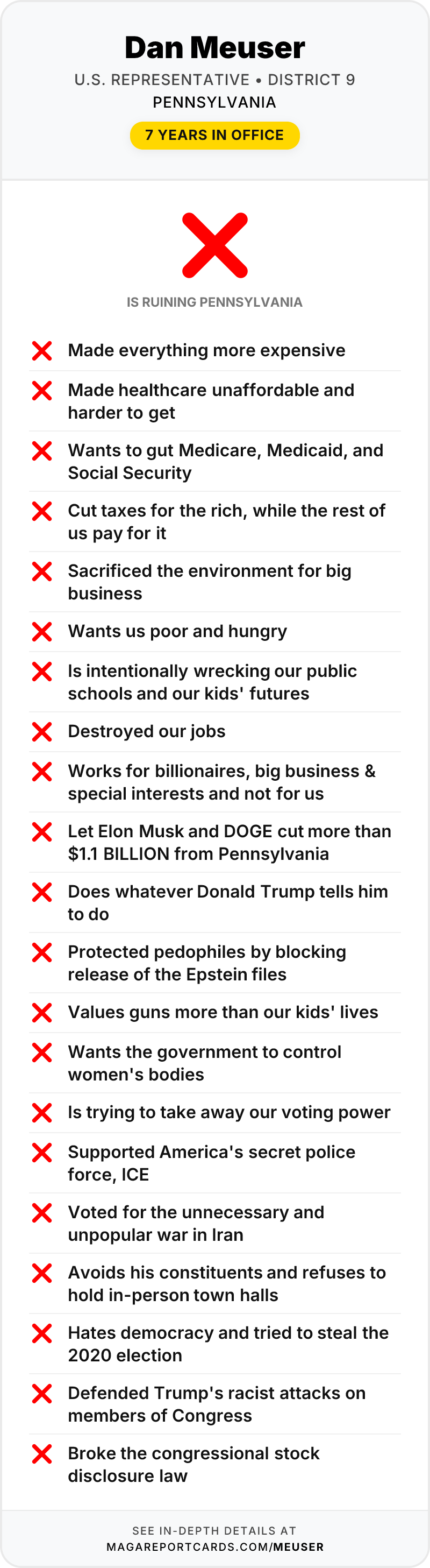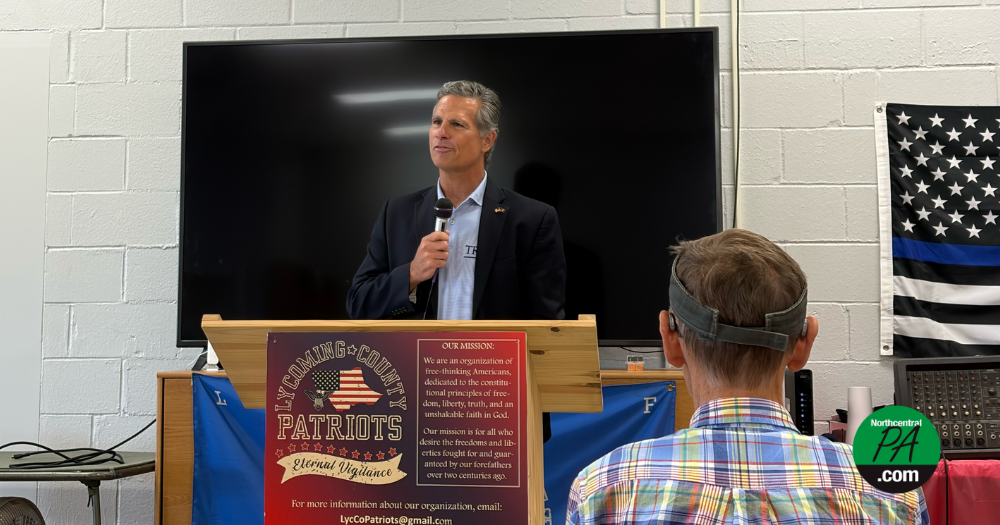
On August 3, Dan Meuser spoke for over an hour to about 40 members of the Lycoming County Patriots — a conservative group whose meetings open with a prayer and a group recitation of a confidentiality pledge.
He took questions on elections, immigration, Social Security, and guns. He explained, five and a half years later, why he voted against counting Pennsylvania's own electoral votes.
As of that week, he had still not agreed to debate the woman running against him.
What he told the room about 2020
Here is Meuser's explanation, in his own words, for why he refused to certify the electors chosen by the voters of his own state:
"They changed the rules weeks before the election. They allowed curative ballots. They said signatures don't need to match. They put drop boxes out there. There was ballot harvesting taking place, which was completely illegal to the tune of tens of thousands. There were significant irregularities."
The reporter who covered the meeting added the necessary correction directly beneath the quote: no court, no state review, and no bipartisan election audit has ever substantiated fraud on anything like that scale in Pennsylvania's 2020 results — results that were certified and upheld through litigation.
That is not a matter of interpretation. Pennsylvania's 2020 election was litigated exhaustively, in state and federal court, and the outcome held every time.
The vote itself
This is not a hypothetical. The record is public.
On January 7, 2021 — hours after the Capitol was cleared — the House voted on whether to sustain the objection to Pennsylvania's electoral votes. Roll Call 11 shows Meuser voted Yea.
Two things about that vote are worth sitting with.
First, he was voting to throw out the votes of the people he represents. Pennsylvania's electors reflected the ballots cast by Pennsylvanians, including his own constituents in the 9th District.
Second, he did not have to. The objection failed 138 to 282, and 64 Republicans voted against it — among them Brian Fitzpatrick, the one Pennsylvania Republican who voted Nay. Voting no was available. Meuser chose Yea.
The claim he could not answer
One attendee asked Meuser whether Trump might declare a national emergency over election administration before the midterms and have "the military take over the election in November to require paper ballots."
Meuser said he didn't know.
He did not say the question was absurd. He did not say the military does not run American elections. He offered that Trump "follows the law. He follows the Constitution. He follows the courts" — and then added that the courts are "biased."
A member of Congress was asked, in plain language, whether the U.S. military might take over an election in three months, and the answer from a sitting representative was that he wasn't sure.
What he wants to change
Meuser was clear about the policies he supports, and they all point the same direction.
- He called Pennsylvania's mail-in voting law an "unbelievably terrible, unconstitutional piece of legislation."
- He backs the federal SAVE Act, which would require documentary proof of citizenship to register to vote — a requirement that stops married women whose current name doesn't match their birth certificate, and the millions of Americans who don't have ready access to proof of citizenship. The same requirement is stuck in the Senate as the SAVE America Act, where Republican leaders sent members talking points telling them to deflect questions about it — and Tommy Tuberville threw those in the trash.
- On photo ID at the polls, he said Pennsylvania "requires absolutely nothing" and that "it's absolutely ridiculous not requiring it."
- He complained that other states have tightened their election laws while "we've done absolutely nothing."
He also told the group Republicans need roughly a two-to-one advantage over Democrats in mail-in turnout to feel safe in November — a candid acknowledgment that the mail voting he calls unconstitutional is something his own party is now counting on.
The SNAP number he got wrong
Meuser also attacked Gov. Josh Shapiro over food assistance, telling the room: "He has a 13% fraud rate right now, and he's going to get penalized."
There is no such thing as a state SNAP "fraud rate." What USDA publishes is a payment error rate, and the Congressional Research Service could not be clearer about what that is:
"Errors are not the same as fraud. Fraud is intentional activity that breaks federal and/or state laws, while errors are mistakes."
And on the payment error rate specifically, CRS states flatly: "This rate is not a measure of fraud."
The rate counts overpayments and underpayments — meaning a state gets dinged when a family is given too little food assistance. CRS also notes that "SNAP fraud is rare, according to available data and reports."
Meuser took a number that measures paperwork mistakes in both directions and told a room of constituents it was fraud by the governor. That is how a state gets painted as a den of thieves and how cuts to food assistance get sold.
"The Muslim problem"
One member of the audience asked Meuser about what he called "the Muslim problem in this country," saying it "keeps me up at night" and citing fear of Muslims "wanting to take over and do us in."
Meuser's answer began with a disclaimer and ended with agreement:
"None of us want to classify a group. None of us want to do anything like that. But we judge people on their actions, right? Nothing else. Their actions and their words, to an extent. I'm not going to disagree with you. We're seeing what's happening in Europe. There are those — not just necessarily Muslims — that come to our country that do not want to assimilate, that do not want to be Americans."
A constituent described an entire religion as a "problem" that might "do us in," and his congressman told him he wouldn't disagree.
He went on to say the 14th Amendment's citizenship clause has been "misinterpreted from the very beginning," and that Trump "does have a plan for revisiting it."
Who gets to ask him questions
The through-line here isn't any single quote. It's the venue.
Meuser gave an hour of his time, took open questions, and spoke candidly — to a private organization whose members recite a confidentiality pledge before the meeting starts.
Meanwhile, constituents in his district have protested every Monday for more than a year asking him to hold an open town hall. He has named no such town hall, and says he won't turn up at the protests because he doesn't want to be a "piñata", dismissing his critics as "the same 40 people that write nasty things on my social media."
He was in a room of about 40 people on August 3. He just picked which 40.
And when his opponent Rachel Wallace — whom Meuser refused to name at the meeting — called for debates, and when WVIA and WGAL both invited the two of them, she accepted both invitations. As of August 5, Meuser had agreed to neither.
His explanation for why he tried to discard Pennsylvania's electoral votes is apparently available. You just have to be in the right room to hear it.
Source
Meuser explains his 'no' vote to certify 2020 Pa. election results ahead of midterms — Laura Ulrich, NorthcentralPa.com. Photo: Laura Ulrich / NorthcentralPa.com.