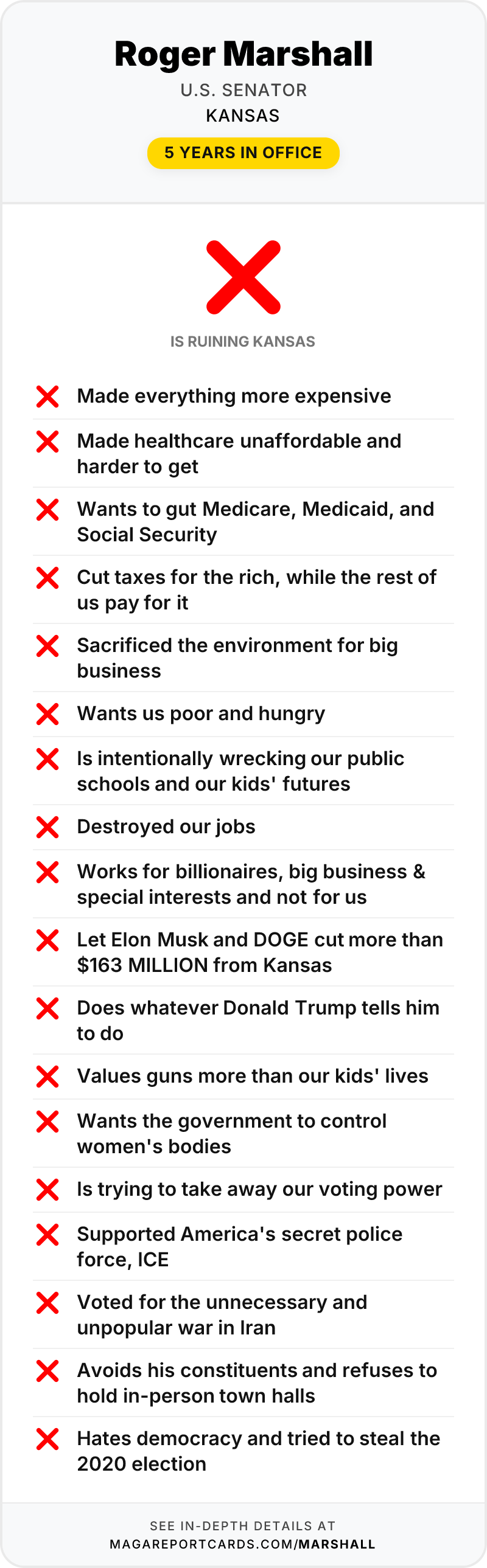
Roger Marshall is a doctor. He practiced medicine in Great Bend, Kansas, for more than 25 years as an OB/GYN and delivered more than 5,000 babies, and it is the first thing his own Senate biography tells you about him.
On Thursday, Kansas doctors held a press conference to say that a law he voted for is going to take care away from their patients. His answer the next day, on camera, was that they are lying.
"There are no Medicaid cuts"
At a virtual press conference, Dr. Christa Balanoff, a Kansas surgeon, laid the coming Medicaid losses directly at Marshall's feet.
"When the Medicaid cuts that Senator Marshall supported take full effect next year, more Kansans will go without care. Senator Marshall should be working to fix the problem. A physician in the United States Senate should be leading the effort to expand access to care, not taking a victory lap on policies that make coverage harder to afford, and harder to keep."
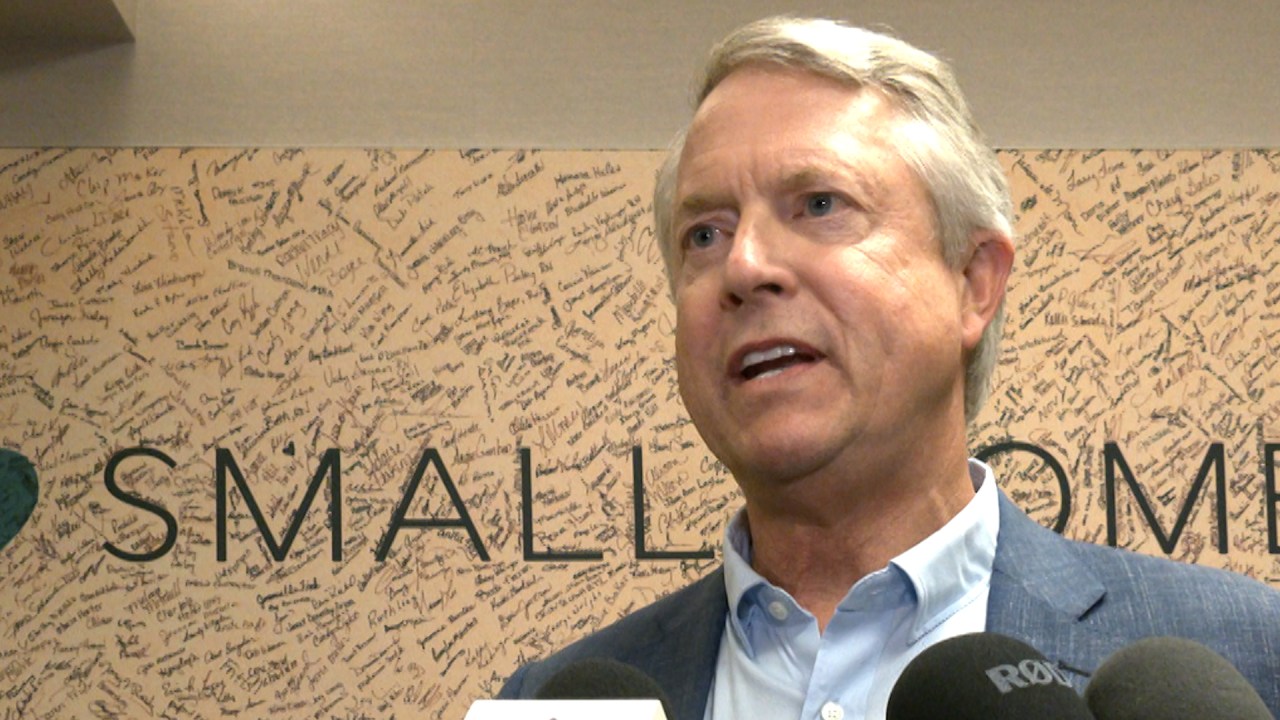
The next day, KSNT's Capitol Bureau asked Marshall to respond. He did not soften it, qualify it, or point to a program he was trying to protect.
"There are no Medicaid cuts," Marshall said. "We spent more money on Medicaid this year than last year, we're going to spend more money next year than we are this year as well. There are not any Medicaid cuts. I think that's a lie and you can look at the numbers to see that we're increasing spending every year on Medicaid."
The numbers he says to look at
So look at them.
The Congressional Budget Office estimates the 2025 budget law will reduce federal Medicaid spending by more than $1 trillion over ten years. KFF, allocating those CBO estimates state by state, puts Kansas's share at about $2.85 billion in lost federal Medicaid money over the decade — 8% of what Kansas would otherwise have received.
Independent modeling done for Kansas specifically lands in the same place. Manatt Health, commissioned by the United Methodist Health Ministry Fund and the REACH Healthcare Foundation, ran the final version of the law through Kansas's KanCare program and projected the state would lose $3.9 billion in Medicaid funding over ten years, with $2.7 billion of that coming out of Kansas hospitals. The analysts noted their own estimates are understated, because the model doesn't capture everything the law changes.
Marshall's defense is that total Medicaid spending goes up each year. That is true and beside the point. Spending was already scheduled to rise as costs and enrollment rose; the law cuts roughly a trillion dollars off that path. Saying there is no cut because the line still slopes upward is the same argument as saying a pay cut isn't a pay cut as long as you got a smaller raise than you were promised.
Sheena Schmidt, a senior analyst at the non-partisan Kansas Health Institute, described where the money actually comes from:
"The Medicaid cuts in H.R 1 are going to be primarily related to what providers or hospitals receive to increase access to care across the state of Kansas."
And she said when Kansans will feel it: some changes start around the beginning of 2027, but "the bulk of the changes that I think will result in the most funding loss will start to happen beginning in 2028."
That timing matters. Marshall voted for the law in 2025. The hospitals lose the money starting after the 2026 election.
He has said the quiet part before
This is not the first time Marshall has told Kansans that the people worried about losing coverage have it wrong.
Back in 2017, as a freshman congressman helping lead the Republican effort to replace the Affordable Care Act, he told the health care news site STAT that he did not believe Medicaid had helped people: "There is a group of people that just don't want health care and aren't going to take care of themselves."
In December 2025 he told Newsmax he expects the enhanced ACA subsidies to expire, shrugging that "some people's premiums are going to go up some."
The pattern is consistent: when Kansans stand to lose coverage, Marshall's position is that the loss is either imaginary, or their own fault, or not that big.
Other Republicans are running the same play
Marshall isn't alone in this. When a hospital CEO in his district warned that the budget bill would cost him his intensive care unit, Rick Allen said he was "dead wrong". Jeff Hurd signed a written promise not to cut Medicaid and then voted for the cuts twice. Michael Guest spent his August recess promoting $206 million for Mississippi's rural hospitals after voting for the law projected to take billions out of the state's Medicaid funding.
The difference in Marshall's case is the credential. When a surgeon tells a senator the cuts will hurt patients, most senators have to argue policy. Marshall is a physician, and he used that standing to tell Kansas health care workers that what they are describing is a lie.
What the record shows
Roger Marshall voted for a law that the Congressional Budget Office scores as cutting more than $1 trillion from Medicaid over ten years — about $2.85 billion of it in Kansas, 8% of the federal money the state would otherwise get. Independent modeling for Kansas puts the total loss at $3.9 billion, with $2.7 billion coming out of the state's hospitals, and the non-partisan Kansas Health Institute says the biggest losses hit starting in 2028. When Kansas doctors said so publicly, Marshall — a physician himself — told a reporter there are no Medicaid cuts and that saying there are is a lie.
Source
"There are no Medicaid cuts": Sen. Marshall responds to criticism about Medicaid changes passed in H.R 1 — KSNT 27 News Capitol Bureau, August 28, 2026, by Brayden Day.