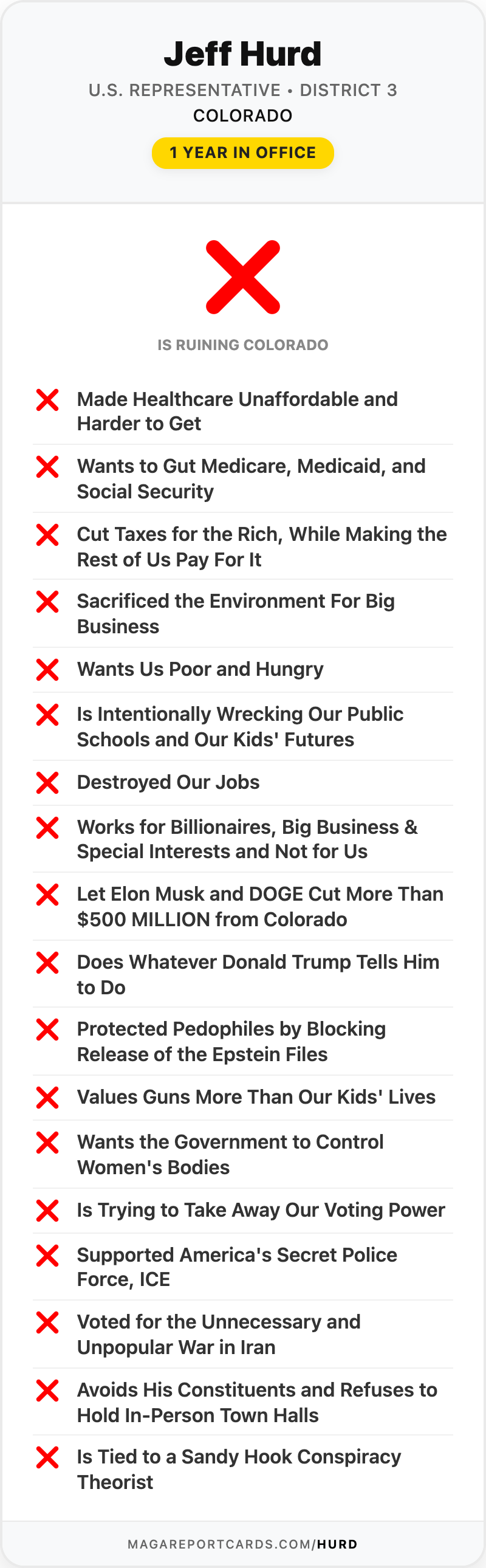
On April 14, 2025, twelve House Republicans sent a letter to their own leadership about Medicaid. Jeff Hurd signed it.
The letter wasn't hedged. As the American Hospital Association reported it, the signers said they were open to "targeted reforms," and then drew a hard line:
"We cannot and will not support a final reconciliation bill that includes any reduction in Medicaid coverage for vulnerable populations."
They explained exactly why, in language written for districts like Hurd's:
"Many hospitals — particularly in rural and underserved areas — rely heavily on Medicaid funding, with some receiving over half their revenue from the program alone. Providers in these areas are especially at risk of closure, with many unable to recover. When hospitals close, it affects all constituents, regardless of healthcare coverage."
Hurd represents Colorado's 3rd District — the western and southern third of the state. Rural hospitals, small towns, long drives to the next clinic. If that warning was written for anybody, it was written for him. The letter went to Speaker Mike Johnson, Majority Leader Steve Scalise, Majority Whip Tom Emmer and Energy and Commerce Chairman Brett Guthrie.
Then he voted for the cuts. Twice.
The timeline
April 14, 2025 — Hurd signs the letter. "Cannot and will not."
April 23, 2025 — Dozens of members of AFSCME, the public employees union, gather outside his Pueblo office asking him to vote no on Medicaid cuts. KKTV reported that the union said Hurd had not responded to any of their requests to meet. One member, Betty Spinuzzi, put it this way: "If Hurd is worried about working people and he's walking our direction we'd be glad to walk with him, but we cannot walk with him if he won't talk with us."
Hurd's response added a caveat the letter didn't have. Medicaid, he said, "is an essential health benefit that we need to preserve" — but the program "should not be supporting able-bodied adults who are capable of working but choose not to."
May 22, 2025 — Hurd votes yes on H.R. 1, the bill his letter had been about.
May 30, 2025 — Constituents from western Colorado Indivisible groups show up at his Grand Junction office to tell him what they think of that vote. Hurd isn't there. His district director takes notes and collects their letters. Afterward his office tells the paper that Indivisible never tried to arrange an official meeting.
July 3, 2025 — The Senate sends its version back. Hurd votes yes again. It becomes law.
The promise said "any reduction in Medicaid coverage for vulnerable populations." The bill reduced Medicaid coverage. He voted for it. There is no third reading of those facts.
What he said afterward
A week after the final vote, Hurd sat down with Colorado Public Radio's Ryan Warner. He didn't deny people would lose coverage. He estimated that 4 percent of the people on Medicaid in his district could lose access to the program because of the law — and argued the reduction would improve it for everyone else.
Here is how he defended it:
"It's the individuals who are otherwise able-bodied, adults who are able to work and contribute that should, I think, be contributing towards Medicaid and it's not appropriate to take money from the most needy and give it to those who don't have that need."
Notice the move. The letter he signed drew the line at vulnerable populations. Afterward, he simply reclassified the people losing coverage as not vulnerable — able-bodied adults who ought to be working. That way the promise technically survives while the coverage doesn't.
Asked directly whether health care in western and southern Colorado would be better or worse off, he never said better or worse. He said the legislation "is consistent with protecting and supporting those vulnerable populations."
Warner had opened that stretch of the interview with the Congressional Budget Office's estimate — a trillion dollars in cuts over a decade, around 12 million people losing health insurance. He came back to the agency at the end, this time on the debt: $3.4 trillion over a decade. Hurd waved it off:
"I think we need to take with a grain of salt what the Congressional Budget Office is saying, particularly when it comes to dynamic scoring."
The number he didn't mention
Hurd's "4 percent" is a share of a share. Here's the count.
The Joint Economic Committee's House minority staff ran the projections district by district, out to 2034. For Colorado's 3rd, the figure is more than 32,000 people losing health coverage — 24,434 losing Medicaid and 7,900 losing Affordable Care Act coverage.
Thirty-two thousand people is not a rounding error. It's a mid-sized Colorado town, gone from the coverage rolls.
And losing coverage isn't only a problem for the person who loses it. That's the part the letter Hurd signed said better than we could: when Medicaid revenue drops, a rural hospital doesn't quietly serve fewer Medicaid patients. It cuts services, or closes a clinic, and everybody in the county drives farther — insured or not.
Paperwork requirements, which is what most of the Medicaid share of those losses comes down to, don't check whether you deserve care. They check whether you filed on time. A rancher who misses a re-enrollment notice and a person who "chooses not to work" come off the rolls exactly the same way.
He's not the only one who signed it
Eleven other Republicans put their names on that letter, and the pattern repeated. Virginia's Rob Wittman signed the same letter, told a columnist his constituents were protected, and voted yes — and clinics in his state started closing about two months after the bill was signed.
That's what makes this worth writing down. It isn't one member getting rolled. It's a play: state the concern loudly enough to get quoted, collect the credit for standing up to leadership, then vote with leadership and hope nobody keeps the letter.
We kept the letter. It has twelve names on it, and one of them is Jeff Hurd's.
Source
The American Hospital Association's April 16, 2025 report, A dozen House Republicans send letter opposing Medicaid cuts, and Colorado Public Radio's July 10, 2025 interview with Rep. Hurd by Ryan Warner. Photo: KKTV.