Roger Marshall is one of the Republicans who said publicly that the Justice Department's Jeffrey Epstein files should be released.
On September 10, 2025, he got a chance to force it, and voted the other way.
The Senate voted on a motion to kill an amendment to the defense bill that would have required the attorney general to release all unclassified records related to Epstein: the flight logs, the vehicle manifests, the names connected to his crimes, the entities tied to him, and the material about his death.
The motion to kill it passed 51-49. Marshall voted with the 51. Only two Republicans, Rand Paul and Josh Hawley, voted to let the amendment live.
Marshall called the amendment a "political stunt" that held servicemembers "hostage."
The objection, and what it was worth
Marshall's stated reason was procedural. The amendment was attached to the annual defense policy bill — the one that authorizes the yearly troop pay raise — and that, both Kansas senators said, was why they voted to kill it.
That is a real bill and a real pay raise. It is also the standard objection to any amendment anyone does not want to vote for, and it disappears the moment you notice what he did next.
Two months later, in November 2025, the House passed a standalone bill compelling the release. No defense bill, no troops, no hostages. The Senate passed the same bill by unanimous consent, and Marshall did not object.
So the version he could kill quietly, he killed. The version that was going to pass anyway, he let through without a word. Three weeks after the September vote, a PBS News/NPR/Marist poll found about three-quarters of Americans wanted all the Epstein files released.
The money
Two Blackstone executives whose names appear in the Epstein files gave money to Marshall's campaign committee, Kansans for Marshall, in the spring of 2025 — months before that September vote. Federal Election Commission records show:
- Stephen Schwarzman, Blackstone's chief executive: $7,000 on March 27, 2025.
- Joseph Baratta, a Blackstone executive: $6,000 on April 4, 2025.
That is $13,000 in eight days of filings, five months before Marshall voted to bury the files.
Schwarzman is not new to Marshall's donor list. FEC records show he also gave $2,800 in 2020 and $2,700 in 2016.
Our earlier reporting on the Epstein-file billionaires funding Ashley Hinson established the detail on Schwarzman himself: his name appears in the files 23 times, including an email in which Epstein called him "terrific." He never emailed Epstein directly and faces no accusations of any wrongdoing related to Epstein. A name in the files is not an accusation.
Marshall also took $500 in September 2020 from lawyer Greg Ezring, whose name appears in the files 35 times, and $11,400 in October 2019 from Bryant Park Capital chief executive Joel Magerman, whose name appears three times — though FEC records show $5,600 of the Magerman money was reattributed to his wife and $200 refunded, leaving $5,800 credited to him.
Schwarzman's money has followed this pattern elsewhere. A super PAC backing Susan Collins took his money too.
The rest of the record
Marshall's handling of the Epstein files is not an isolated data point. It sits on top of a voting record on sexual violence that runs the same direction.
In April 2019, as a House member, Marshall voted against reauthorizing the Violence Against Women Act. It passed anyway, 263-158.
He voted to confirm Defense Secretary Pete Hegseth and Health Secretary Robert F. Kennedy Jr., both of whom faced sexual assault allegations. He voted to confirm Todd Blanche as attorney general after Epstein survivors asked senators to vote no.
We have written about other parts of his record: 500 days without a town hall, a Stock Act violation, and telling Kansas doctors there are no Medicaid cuts in the bill he voted for.
Why it matters now
Marshall is running for a second term, and it is closer than anyone expected. A poll taken days after the August primary put him a single point ahead of Democratic pastor Adam Hamilton, 46 to 45.
He does not have to explain the September vote to anyone but Kansas voters, and there is no roll call left to change it.
What the record shows
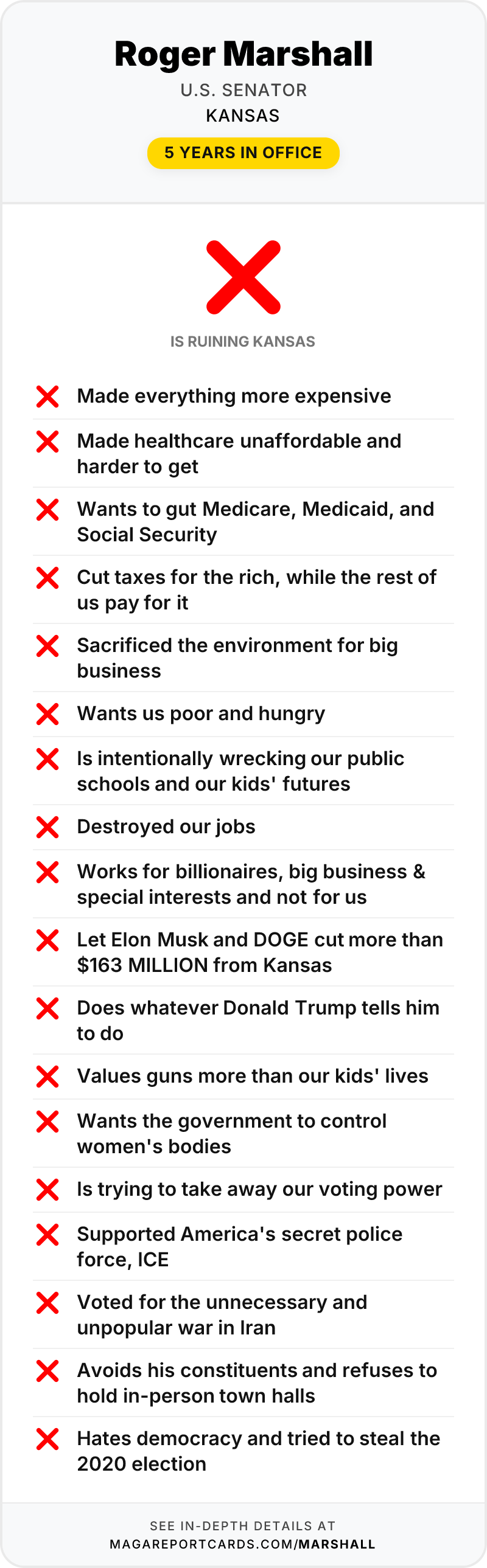
Roger Marshall was among the Republicans who said the Epstein files should be public. On September 10, 2025, he cast one of the 51 votes that killed the amendment forcing their release, calling it a political stunt that held servicemembers hostage — then raised no objection two months later when a standalone bill with no troops attached passed the Senate. Five months before that vote, two Blackstone executives named in the files gave his campaign $13,000. In 2019 he voted against reauthorizing the Violence Against Women Act.
Source
Roger Marshall has an Epstein files problem, by Jesse Valentine, American Journal News, September 4, 2026. The roll call, the Kansas quotes and the donation figures above were verified independently against the Senate's own vote records, KSNT's reporting and the Federal Election Commission's contribution database.