Data centers are giant buildings full of computers that run artificial intelligence. They use enormous amounts of electricity and enormous amounts of water, and somebody has to pay to build the power lines and substations that feed them. In the Hudson Valley, that somebody is you.
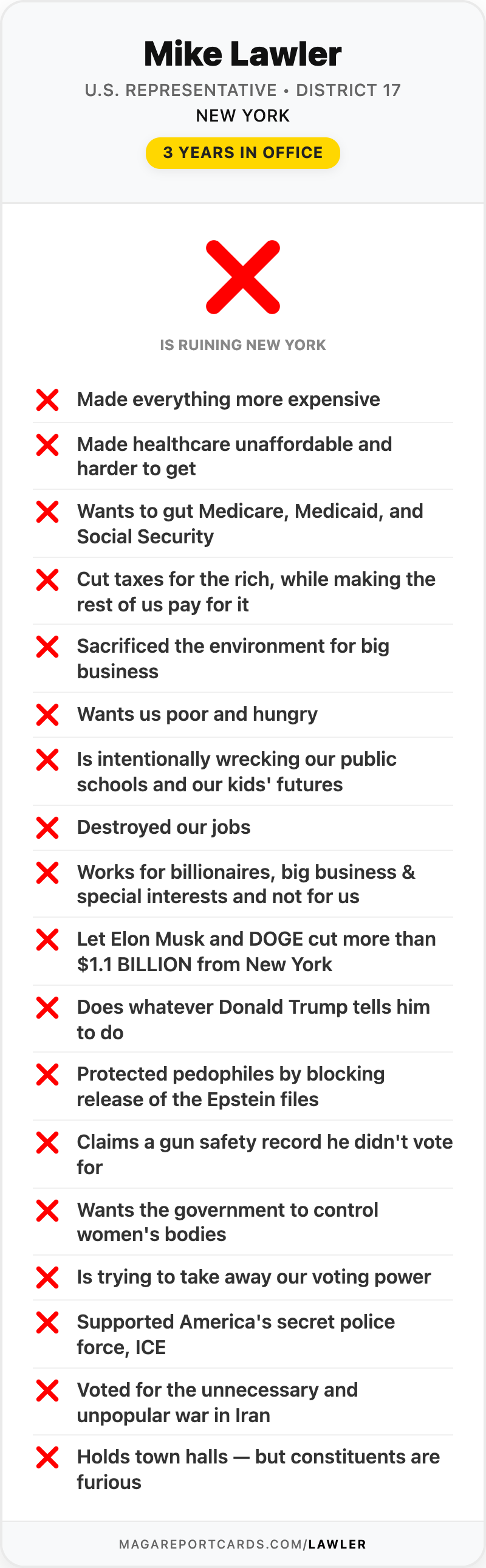
Mike Lawler represents New York's 17th District — Rockland, Putnam, and parts of Westchester and Dutchess. Several data centers have been proposed there. And over the past year, his constituents have been showing up at town halls and planning board meetings, more than a hundred at a time, to fight them.
On July 17, 2026, Lawler went on Fox Business to talk about data centers. He did not talk about his constituents. He went on "Maria Bartiromo's Wall Street" to attack New York's new limits on data center permits, arguing they hurt innovation and investment and push the industry toward rivals like China. The segment's title says it plainly: banning data centers will only hurt New York's economy.
Nine days earlier, the planning board in his own district had voted unanimously to stop one.
What happened in Orangeburg
Orangeburg, in Rockland County, has quietly become a regional data center hub — with facilities operated for or associated with Bloomberg, JPMorganChase, DataBank and 1547 Critical Systems Realty, according to Rockland News. DataBank runs a 20-megawatt facility at 2000 Corporate Drive. That address sits near Lake Tappan — a reservoir that supplies drinking water to communities across the New Jersey line.
DataBank wanted to build a second phase. Residents organized against it.
In May, residents rallied outside Orangetown Town Hall, chanting "We can't drink data" and calling for a moratorium on further growth. They raised the electricity demand, the water, the jobs AI might replace, and the possibility that their power bills would go up to pay for it all.
The company scaled the project back — cutting the proposed building roughly in half, from 146,000 square feet to about 77,862, and dropping a planned electrical substation. It didn't help. On July 8, 2026, the Orangetown Planning Board voted unanimously that the expansion could have significant environmental effects and ordered a full environmental impact statement — which stops the project until that study is done. More than 100 residents gathered outside town hall before the meeting, alongside Food & Water Watch, Indivisible Rockland, the Data Center Crisis Coalition and the Sierra Club.
The reasons its consultants and residents gave were not abstract: electricity use, air quality, noise, diesel exhaust, and the site's proximity to the Lake Tappan reservoir. Peggy Kurtz of the Rockland Sierra Club put it directly:
"The possibility of contamination of Lake Tappan, which serves northern NJ communities, from leaking tanks or from an electrical fire is very real."
It is not just Rockland. In Dutchess County, residents have been fighting a proposed 1-gigawatt data center in East Fishkill — one of the largest data center proposals in New York State. More than 1,000 people signed a petition against it, citing noise, water use, electricity costs, grid instability and environmental damage. One resident's summary: "Our energy bills are already off the charts, and this new facility would likely only further burden area residents."
Then the state acted, and he objected
On July 14, Governor Kathy Hochul signed Executive Order 62, the first statewide moratorium of its kind in the country.
It is worth being precise about what it does, because a lot of the noise around it was not precise. It is not a ban on building data centers. It directs the state Department of Environmental Conservation to pause discretionary permit applications for data centers that would draw at least 50 megawatts, and only where those applications had not already been declared complete. Local zoning, planning and building approvals aren't touched. Facilities used mainly for manufacturing, research, education and medical care are exempt. The pause lasts while the state finishes an environmental review — up to a year.
The reason for it is a number: nearly 12,000 megawatts of proposed data center demand had entered New York's electric grid queue as of May 2026, more than 8,000 megawatts of that added during 2025 alone. Hochul said the surge raises the risk that residential and business customers get stuck helping pay for the transmission lines and grid upgrades large tech companies need. The order also tells regulators to consider requiring developers to pay into a grid-acceleration fund or finance new generation and battery storage themselves, and Hochul said she will seek legislation ending statewide sales-tax exemptions for the largest data centers.
Three days later, Lawler was on Fox Business calling it a mistake.
Note what he did not do. He did not say Lake Tappan should be protected. He did not say the 12,000 megawatts should be paid for by the companies asking for it. Food & Water Action, endorsing his opponent, pointed out that Lawler has not spoken out against any of the data center projects proposed in his district — in Orangeburg, in East Fishkill, or at Indian Point in Buchanan — while he has criticized the state's attempt to slow them down.
He already voted to take this power away from New York entirely
Here is the part that ties it together.
On May 22, 2025, the House passed Trump's budget bill by a single vote, 215 to 214. Lawler voted yes. The version he voted for contained a provision that would have imposed a ten-year ban on states enforcing their own AI rules — a sweeping preemption that would have stopped more than 1,000 state AI bills in their tracks.
The Senate stripped it out on July 1, 2025, by a near-unanimous vote of 99 to 1 — after criticism from state attorneys general, governors, consumer advocates and Republican senators, and after Marsha Blackburn withdrew from a compromise saying the provision was "not acceptable to those who need these protections the most."
Had the provision Lawler voted for survived, Albany's ability to write AI rules would have been frozen until 2035 — and Hochul's order would likely not have been possible, because it targets hyperscale data centers, which are generally AI data centers. We wrote about the same vote in Pennsylvania, where all ten Republicans in the House delegation backed it while their constituents' power bills climbed.
So the sequence is: vote to strip states of the power to regulate AI, watch the Senate kill that 99–1, then go on national television to complain when your state uses the power it barely kept.
"Energy affordability" — when it's a press release
Three months before the Fox Business appearance, Lawler introduced the Energy Affordability and Reliability Act of 2026, which would create an Office of Energy Affordability inside the U.S. Department of Energy to study how federal energy policy affects household bills. He described it as a response to an "energy affordability crisis":
"Energy affordability and reliability are fundamental to the strength of our economy and the well-being of Hudson Valley families."
That is a real sentence about a real problem. The trouble is what he does when the affordability crisis has a name and an address.
A new office that writes reports about energy costs is safe. Saying no to a 1-gigawatt facility in East Fishkill is not. Asking data centers to pay for their own transmission upgrades instead of putting them on the residential bill is not. When the choice was between an abstraction and the specific thing driving demand on the Hudson Valley's grid, he picked the abstraction and went on TV against the specific thing.
And the economic case he's defending doesn't hold up well up close. Rockland County's Industrial Development Agency approved nearly $77 million in sales-tax exemptions for a roughly $1 billion JPMorganChase data center expansion in Orangeburg. The project pledged to create one additional permanent job, according to documents reviewed by New York Focus and reported by Rockland News. Seventy-seven million dollars of foregone sales tax. One permanent job.
This isn't a fringe position he's standing up to
Lawler's framing on Fox Business was that restricting data centers is an anti-growth, anti-innovation idea that helps China. The public does not see it that way, and neither do his neighbors.
A June 2026 Reuters/Ipsos survey found that 57% of Americans would oppose a data center being built in their community, against 14% who said they were okay with one near them. 77% said they were worried that AI would make electricity more expensive.
In his district, that concern has a face: the retiree in Orangeburg watching a Con Edison bill, the East Fishkill parent who signed one of a thousand names on a petition, the Sierra Club volunteer worried about a reservoir. They organized, they showed up, and they got their planning board to listen.
Their congressman's contribution to that fight was a television appearance on the other side of it.
Byron Donalds ran the same play in Florida, promising data centers wouldn't raise electric bills while their developers wrote him $894,000 in checks — we covered that too. The pattern is consistent across states: the buildings go up, the bills go up, and the Republicans who represent the people paying those bills spend their airtime defending the buildings.
Mike Lawler is up for reelection in November in one of the closest House races in the country. His constituents have already told him where they stand on this. He answered them on Fox Business.
Source
Fox Business, "Banning data centers will only hurt New York's economy, says Rep Mike Lawler," Maria Bartiromo's Wall Street, July 17, 2026. Image: Fox Business.