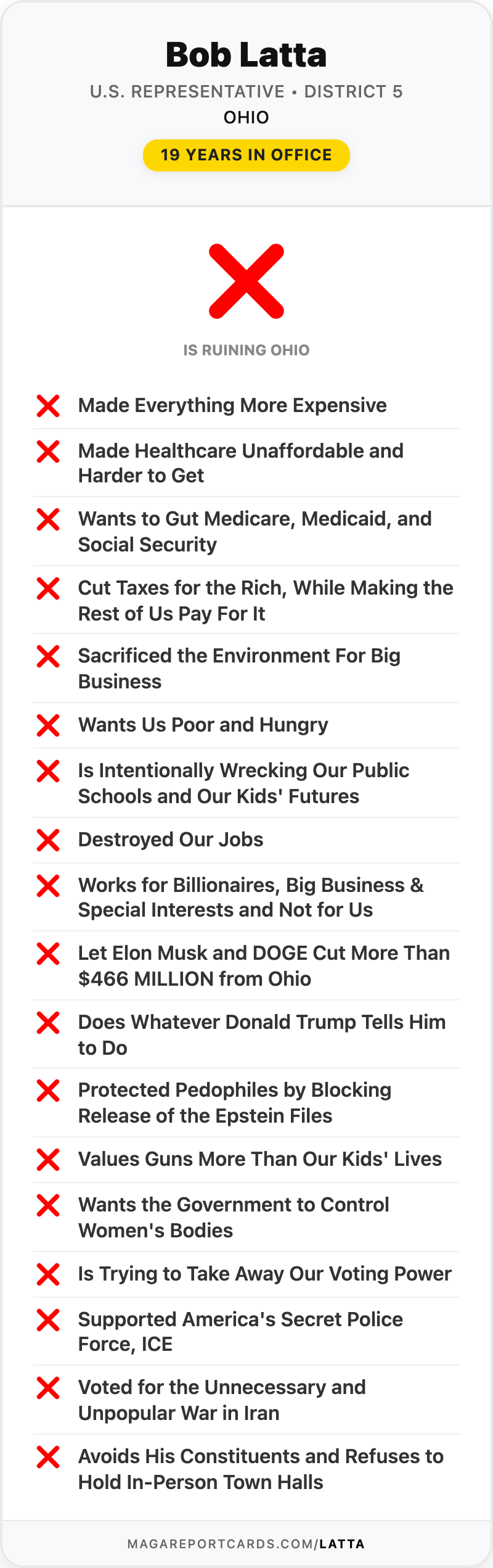
On June 4, 2026, Bob Latta signed a letter to the director of the FBI.
He wasn't reporting a crime. He was asking the federal government to look into why people in his own state are angry about their electric bills.
Latta is the Republican congressman for Ohio's 5th District and the chairman of the Energy Subcommittee of the House Energy and Commerce Committee. That subcommittee is the one in the House with jurisdiction over the electric grid. If your power bill goes up, his committee is where the federal end of that story is written.
Ohio has a data center problem. Data centers are giant warehouses of computers that run AI. They use staggering amounts of electricity and water, and somebody has to build the power plants that feed them. Ohio now ranks fifth in the country for the number of data centers it hosts, and dozens more are on the way. Township trustees, city councils, and ordinary residents across the state have been showing up to meetings to fight them.
Latta's response to that was to co-sign a letter to FBI Director Kash Patel and the co-chairs of the President's Council of Advisors on Science and Technology, asking what the administration is doing about "foreign influence campaigns" that might be stirring the whole thing up.
What the letter actually says
The letter was signed by Latta, Energy and Commerce Chairman Brett Guthrie of Kentucky, and Oversight Subcommittee Chairman John Joyce of Pennsylvania. It leans on two reports — one from the Bitcoin Policy Institute, one from a group called Power the Future — claiming that Chinese state media, foreign-funded nonprofits, and billionaire donors are working to turn Americans against data centers.
As the Cleveland.com report on the letter notes, those reports do not establish any direct coordination between foreign governments and the specific campaigns opposing data centers in the United States. They describe networks and funding flows. They don't connect them to the township meeting in your county.
The letter's own language is grand:
"The U.S. is in a global race for technological superiority that has significantly raised the stakes for economic and national security if our nation falls behind."
Guthrie put it more bluntly in the committee's press release: "Americans deserve to know who is bankrolling the disinformation campaign that seeks to block critical infrastructure investments."
The chairmen gave the administration two weeks to brief them.
Five weeks earlier, Latta said the opposite
Here is the part that doesn't fit.
On April 29, 2026 — thirty-six days before he signed that letter — Latta gaveled in a hearing of his own subcommittee titled "Meeting Growing Power Demand While Protecting Ratepayers." In his prepared opening statement, he said this:
"At the same time, the American people are understandably uneasy. Many question whether AI, and the data centers that power it, will ultimately do more harm than good, particularly when it comes to individual energy costs. These concerns deserve to be taken seriously."
In April the concerns were understandable and deserved to be taken seriously. In June they were something the FBI should look into.
Nothing changed in between except that the backlash got louder. And it got louder because the bills got bigger.
The bills really are going up, and data centers really are why
You don't need a foreign agent to explain an Ohio electric bill. You need PJM, the 13-state grid operator that serves Ohio.
PJM runs a "capacity auction" — power plants get paid to promise they'll deliver electricity when demand peaks, and that cost gets baked into everyone's bill. It is a small share of the bill, and it has been climbing fast. A few years ago, capacity cleared at about $29. Ohio Capital Journal reported that the 2024 auction shot to $270, and the next one hit the court-imposed cap of $329. The cause is not mysterious: rapid demand growth from users like data centers, running into a supply of power plants that is shrinking as old ones retire.
The same report cites a Natural Resources Defense Council study projecting that the average family will pay about $70 more a month on their electric bill by 2028.
The most recent auction, in July 2026, cleared at the maximum price again — and still came up short of PJM's own reliability target. WOUB Public Media reported the Ohio Consumers' Counsel's reaction:
"Today's auction sends the wrong message. Consumers should not have to pay record high prices and still face growing reliability concerns."
That's the state office Ohio created to represent residential utility customers. Not a nonprofit funded from overseas.
Meanwhile, in that same April opening statement, Latta told the hearing that "the Lawrence Berkely National Lab and others have found that data center load growth lessens retail electricity costs." Ohioans opening their bills are not finding that.
The evidence Latta didn't have
Six days after the letter went out, OpenAI published its own report on exactly this. And it did find something: a cluster of banned ChatGPT accounts, likely operating from China, generating English-language posts and cartoons claiming data centers were raising electricity prices for ordinary families. OpenAI named it the "Data Center Bandwagon" campaign.
So a Chinese operation did exist. Read what OpenAI said about it:
"The targeting of OpenAI and US data center buildouts is significant not because the operation appears to have shifted public opinion... The operation sought to exploit and amplify existing public concerns about energy prices and local impacts of data center development, but we found no evidence of meaningful breakout beyond its own activity."
In plain English: some people in China posted things, almost nobody saw them, and the concerns they were trying to exploit were already there. That is the opposite of a foreign influence campaign creating a backlash. It's a foreign influence campaign failing to catch a ride on one.
Even an analyst who studies Chinese influence operations warned the framing would backfire. Ryan Fedasiuk, a fellow at the American Enterprise Institute, wrote on X — in a post Newsmax quoted — that telling Americans their concerns over electric bills and water use were "paid for by the CCP" is "not a winning political message." He said the Chinese-backed propaganda itself is real. He just didn't think blaming Americans' bills on it was smart.
What it sounds like to the people paying the bill
The Cleveland.com podcast Today in Ohio put it about as directly as it can be put. Host Chris Quinn:
"He's basically saying that Ohioans are too stupid to come up with their own independent thought, so it has to be China."
Host Leila Atassi made the point that actually matters:
"If China posted a million tweets today saying Ohio electric bills are going up because of data centers, it still is true that Ohio electric bills are going up because of data centers," she said. "The facts don't change based on who's talking about them."
And Ohioans have been saying it themselves, in person, on the record. At a hearing of the Ohio General Assembly's Select Committee on Data Centers, Brown County attorney Austin Baurichter — one of the people trying to put a data center limit before Ohio voters — answered the foreign-money charge before Latta's letter had even landed:
This is a pattern, not a one-off
Ohio isn't alone, and Latta isn't the only Republican whose answer to the data center backlash is to change the subject. In Florida, Byron Donalds promised the state's new data center law guarantees your rates won't go up — PolitiFact rated that Half True, and the developers behind four Florida projects have given him $894,000. In Pennsylvania, every Republican in the state's U.S. House delegation voted for a ten-year ban on states enforcing their own AI rules while their constituents' bills climbed. Latta's own Ohio colleague Troy Balderson wrote a bill that would legally redefine burning gas as "clean" energy.
The common thread is who gets protected. Not the household.
What a chairman could have done instead
Latta holds one of the few gavels in Congress that could actually do something here. He can subpoena. He can write the bill. He can haul PJM in and make it answer for a demand forecast that lands on residential customers.
He held the hearing. He introduced bills. And then, when his constituents kept complaining anyway, he asked the FBI to find out who put them up to it.
Ohioans in the 5th District will get to weigh in this November. Latta faces Democrat Brian Shaver, the Fostoria city council president, who has been touring all nine counties in the district holding informal town halls and running on three words: affordability, accountability, availability.
Latta has held this seat since 2007. Somewhere in those 19 years, the job stopped being about the people getting the bill.
Source
"Ohio data center opposition: is China involved? Congress wants answers" by Sabrina Eaton, cleveland.com, June 8, 2026. Photo: data center protestors at the Hillsboro Civic Center in Hillsboro, Oregon, before a June 2, 2026 city council work session, by Mike Rogoway/The Oregonian.